Beryllium
Beryllium (Be) is an alkaline earth metal with atomic number 4 and an atomic mass of 9.0122. Its electron configuration is [He] 2s2, which gives it 2 valence electrons.
Beryllium key data
| Symbol | Be |
|---|---|
| Atomic number | 4 |
| Atomic mass (standard atomic weight) | 9.0122 |
| Molar mass | 9.0122 g/mol |
| Protons | 4 |
| Neutrons (most abundant isotope, beryllium-9) | 5 |
| Electrons (neutral atom) | 4 |
| Valence electrons | 2 |
| Category | Alkaline earth metal |
| Period | 2 |
| Group | 2 |
| Block | s-block |
| Noble gas notation | [He] 2s2 |
| Full electron configuration | 1s2 2s2 |
| Electrons per shell | 2, 2 |
Atomic mass: IUPAC CIAAW abridged standard atomic weights, 2024. Most abundant isotope: NIST Atomic Weights and Isotopic Compositions.
The values are facts and free to use; this page’s selection and presentation are © 2026 ScienceQuest.
Measured properties of beryllium
From PubChem, the US National Institutes of Health. Public domain. PubChem’s periodic table gives no value for the rows not shown.
| Melting point | 1560 K (1286.9 °C), 38th of 103 by melting point |
|---|---|
| Boiling point | 2744 K (2470.9 °C), 48th of 93 by boiling point |
| Density | 1.85 g/cm³, 78th of 96 by density |
| State at room temperature | Solid |
| Electronegativity | 1.57 (Pauling), 51st of 95 by electronegativity |
| Van der Waals radius | 153 pm, 93rd of 99 by atomic radius |
| First ionisation energy | 9.323 eV (899.5 kJ/mol), 21st of 102 by first ionisation energy |
| Common oxidation states | +2 |
| Discovered | 1798 |
Each rank counts down from the highest value, among the elements PubChem’s table gives one for, and links to that property ranked across the whole table. All of them are collected under periodic trends.
Beryllium electron configuration
The full electron configuration of beryllium is 1s2 2s2. With the noble-gas core collapsed it is [He] 2s2, and the outermost subshell is 2s2.
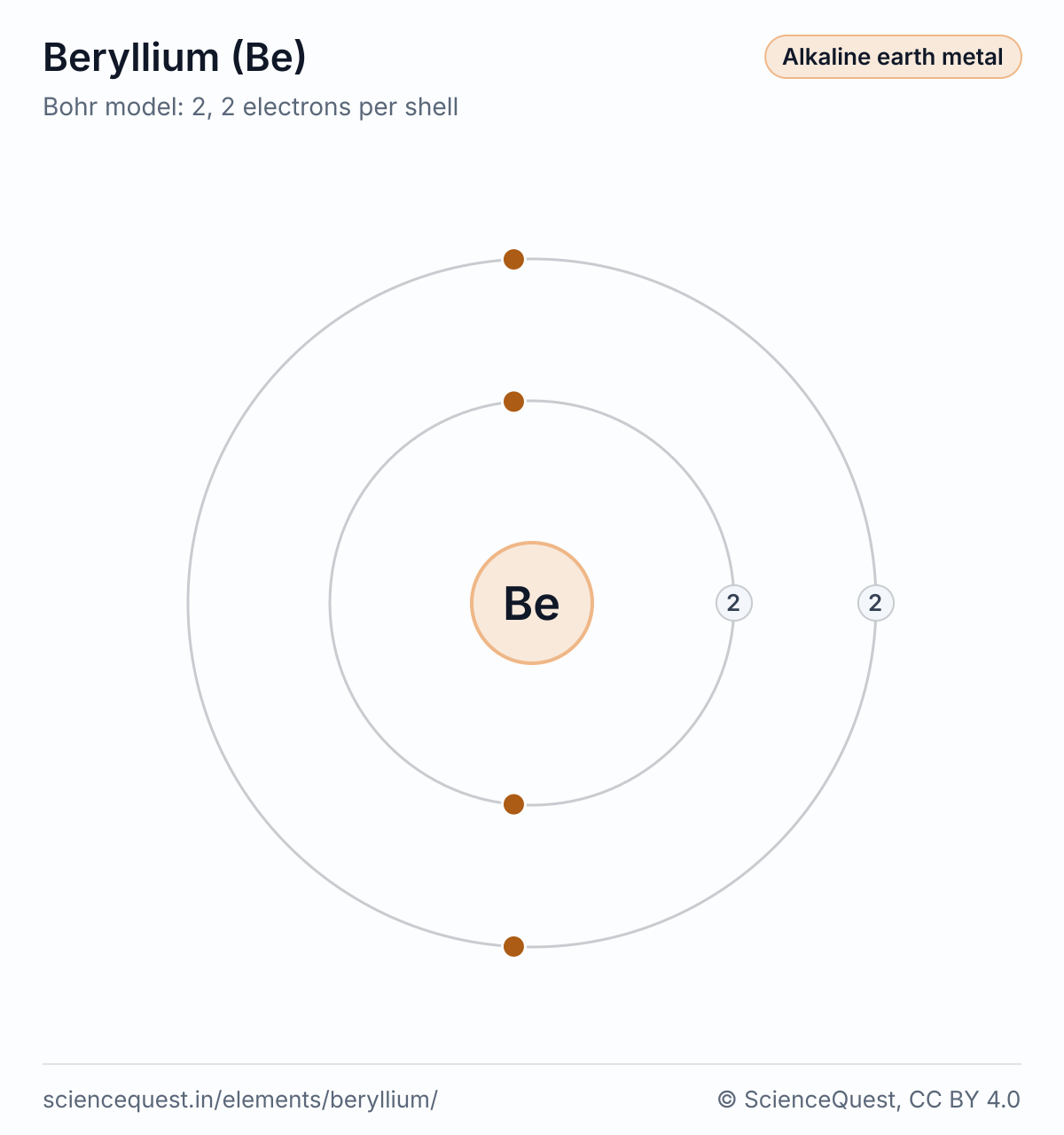
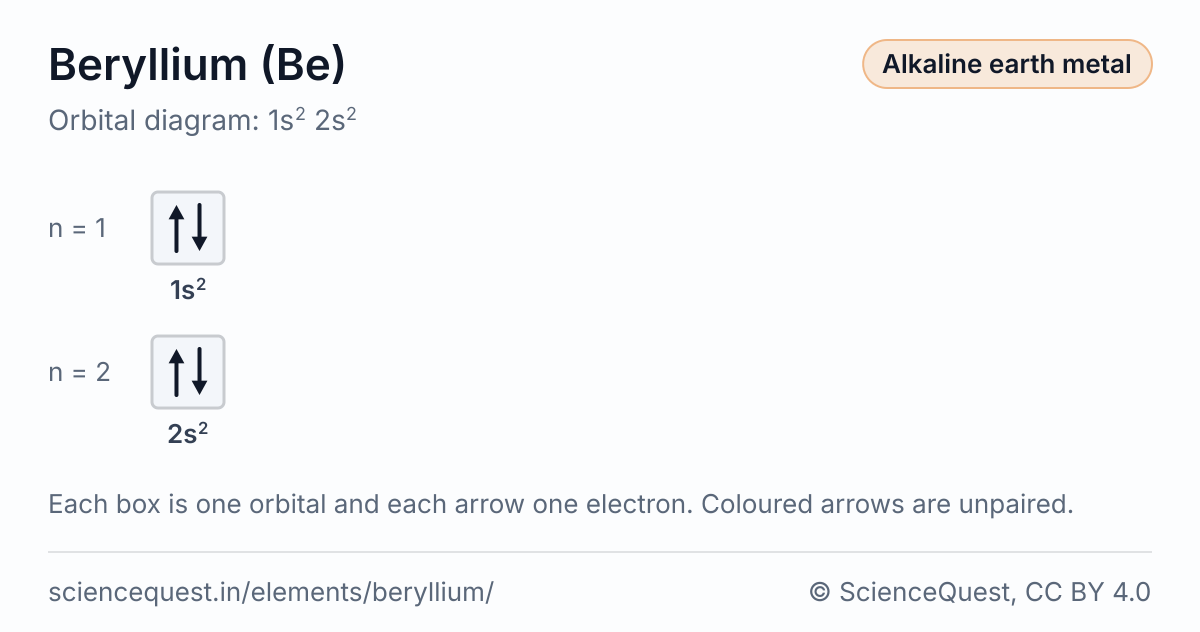
Why group and block follow from this is set out in how the periodic table maps electron configuration, and the electron configuration of every element is listed on one page.
Mass of one beryllium atom
A molar mass is grams per mole, so dividing by the Avogadro constant gives the mass of a single atom, or for an element with more than one natural isotope the average mass of its atoms, and the reciprocal gives how many atoms sit in a gram.
Mass of one atom
- one atom = 9.0122 / (6.02214076 × 10²³)
- = 1.4965 × 10⁻²³ g
Atoms in one gram
- atoms per gram = 6.02214076 × 10²³ / 9.0122
- = 6.6822 × 10²² atoms
Beryllium on the periodic table
Beryllium is in period 2, group 2, in the s-block.
The other elements of group 2 are magnesium, calcium, strontium, barium and radium.