Ascending aorta
The ascending aorta is the first part of the aorta. It rises from the left ventricle for about 5 cm, then the aorta turns to form its arch. (OpenStax A&P 2e, 20.5; StatPearls, Thorax, Heart Aorta; Gray’s Anatomy (1918), The Ascending Aorta)
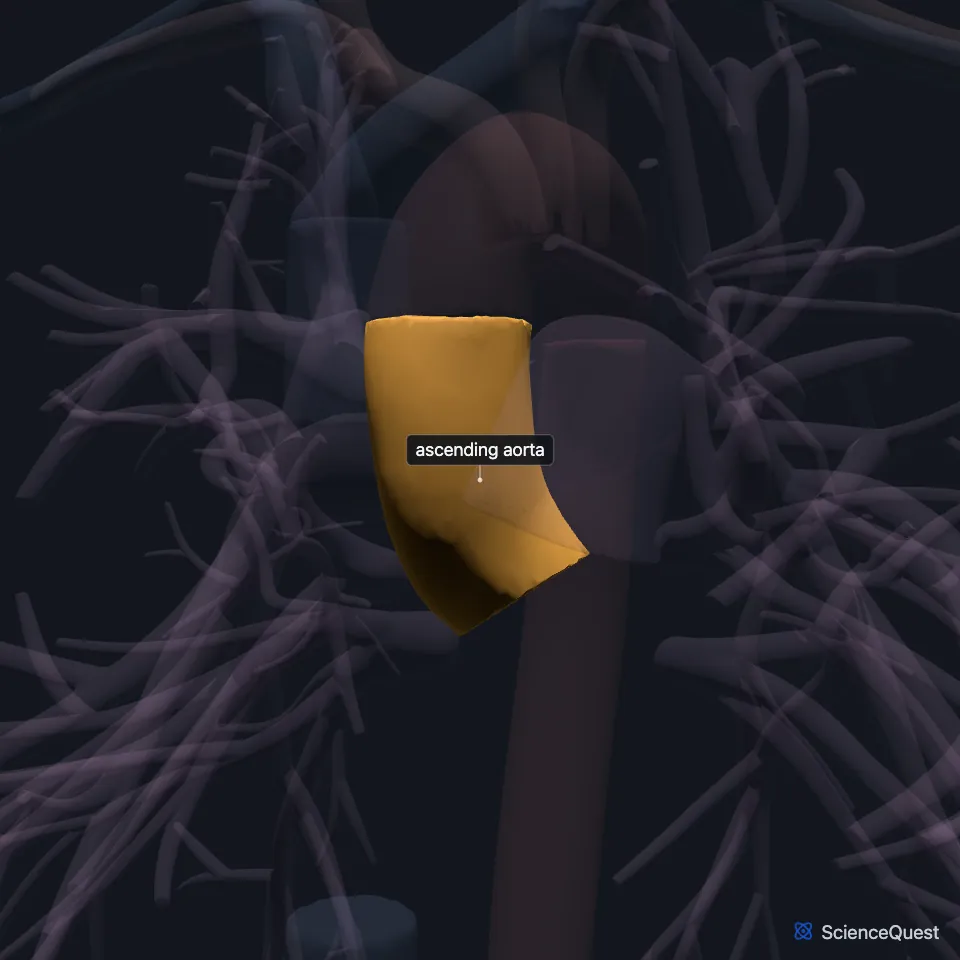
Where is the ascending aorta?
It climbs behind the sternum. OpenStax ends it at the sternal angle; StatPearls gives its upper limit as about the level of the body of the fourth thoracic vertebra (T4). (OpenStax A&P 2e, 20.5; StatPearls, Thorax, Heart Aorta)
It leaves the base of the heart alongside the pulmonary trunk, starting level with the lower border of the third costal cartilage, behind the left half of the sternum. (OpenStax A&P 2e, 19.1; Gray’s Anatomy (1918), The Ascending Aorta)
What does the ascending aorta do?
The aorta receives oxygenated blood from the left ventricle and, as the main artery of the systemic circulation, distributes it to the body. (OpenStax A&P 2e, 19.1; StatPearls, Thorax, Heart Aorta)
The aortic semilunar valve at its base closes in diastole, once pressure in the left ventricle falls below aortic pressure, and so keeps blood from flowing back into the ventricle. (OpenStax A&P 2e, 20.5; StatPearls, Thorax, Aortic Valve)
Elastin fibers in the middle layer of the aortic wall give it the strength to take the pulsing flow from the heart. (StatPearls, Abdomen and Pelvis: Abdominal Aorta)
What branches leave the ascending aorta?
Its first branches are the two coronary arteries. Each starts in one of the aortic sinuses, small bulges of the wall just above the valve; of the three sinuses, only two give off an artery. (OpenStax A&P 2e, 20.5; Gray’s Anatomy (1918), The Ascending Aorta; StatPearls, Thorax, Heart Aorta)
The left coronary artery leaves the left coronary sinus and the right coronary artery the right coronary sinus, and the third, non-coronary sinus gives off no vessel. OpenStax and StatPearls give the anatomical names left posterior, anterior and right posterior; Gray’s Anatomy (1918) calls the two artery-bearing sinuses left anterior and right anterior. (OpenStax A&P 2e, 20.5; Gray’s Anatomy (1918), The Ascending Aorta; StatPearls, Thorax, Aortic Valve)
OpenStax places the aortic baroreceptors and chemoreceptors in these sinuses, while StatPearls puts the aortic baroreceptor endings in the wall of the aortic arch. (OpenStax A&P 2e, 20.5; StatPearls, Physiology, Baroreceptors)
What lies next to the ascending aorta?
The main pulmonary artery runs along its left side as the great vessels leave the heart, and the right pulmonary artery passes behind it. (StatPearls, Thorax, Heart Pulmonary Arteries)
Its top joins the arch of aorta, which then becomes the descending aorta. (OpenStax A&P 2e, 20.5; StatPearls, Thorax, Heart Aorta)
How does the ascending aorta develop?
The ascending aorta and the pulmonary trunk start as one outflow tract, the truncus arteriosus. In the embryo a septum divides it into the two vessels. (StatPearls, Thorax, Heart Aorta)
Where does an aortic dissection usually start?
The tear that starts an aortic dissection most often lies in the first part of the ascending aorta, just beyond the aortic valve. (StatPearls, Thorax, Heart Aorta)
Where the sources differ
The sources name the coronary sinuses differently. OpenStax calls them the left posterior and anterior aortic sinuses; StatPearls (Heart Left Anterior Descending Artery) calls them the left anterior and right anterior aortic sinuses. (OpenStax A&P 2e, 20.5; StatPearls, Heart Left Anterior Descending Artery)
The sources place the aortic receptors differently. OpenStax puts the aortic baroreceptors and chemoreceptors in the aortic sinuses just above the aortic valve. StatPearls (Aortic Arch) puts the baroreceptors in the wall of the arch and the chemoreceptors, the aortic bodies, on the arch. (OpenStax A&P 2e, 20.5; StatPearls, Thorax, Aortic Arch)
| Feature | Detail and source |
|---|---|
| Arises from | Left ventricle, through the aortic semilunar valve (OpenStax A&P 2e, 20.5; StatPearls, Thorax, Heart Aorta) |
| Length | About 5 cm (OpenStax A&P 2e, 20.5; Gray’s Anatomy (1918), The Ascending Aorta) |
| Branches | Left coronary artery and right coronary artery (OpenStax A&P 2e, 20.5; Gray’s Anatomy (1918), The Ascending Aorta; StatPearls, Thorax, Heart Aorta) |
| Continues as | Arch of aorta (OpenStax A&P 2e, 20.5; StatPearls, Thorax, Heart Aorta) |
Touches in this model
Measured on the BodyParts3D meshes: surfaces within 2 mm of the ascending aorta, nearest first.
- Arch of aorta in contact
- Pulmonary artery in contact
- Superior vena cava in contact
- Left lobe of thymus in contact
- Right lobe of thymus in contact
- Stem of left coronary artery in contact
- Trunk of right coronary artery in contact
- Wall of heart in contact
- Pulmonary valve 1.1 mm away
Sources
- OpenStax Anatomy and Physiology 2e, section 20.5, Circulatory Pathways. CC BY-NC-SA 4.0. Read 2026-10-25.
- StatPearls, Anatomy, Thorax, Heart Aorta. James S. Shahoud; Julia H. Miao; Srinivasa Rao Bolla. Last update July 24, 2023. CC BY-NC-ND 4.0. Read 2026-10-25.
- Anatomy of the Human Body (Gray’s Anatomy), 20th US edition, 1918, Angiology, The Aorta and The Ascending Aorta (Aorta Ascendens), with the coronary arteries; Internet Archive scan of the 1918 Lea and Febiger printing, terminology of 1918. Henry Gray; edited by Warren H. Lewis. Public domain. Read 2026-10-25.
- OpenStax Anatomy and Physiology 2e, section 19.1, Heart Anatomy. CC BY-NC-SA 4.0. Read 2026-10-25.
- StatPearls, Anatomy, Thorax, Aortic Valve. Phillip T. Crawford; Tafline C. Arbor; Bruno Bordoni. Last update September 4, 2023. CC BY-NC-ND 4.0. Read 2026-10-25.
- StatPearls, Anatomy, Abdomen and Pelvis: Abdominal Aorta. Clement T. Tran; Cheng Ying Wu; Stephen J. Bordes; Forshing Lui. Last update July 25, 2023. CC BY-NC-ND 4.0. Read 2026-10-25.
- StatPearls, Physiology, Baroreceptors. Deanna Denault; Bassem Khalil. Last update August 7, 2026. CC BY-NC-ND 4.0. Read 2026-10-25.
- StatPearls, Anatomy, Thorax, Heart Pulmonary Arteries. William D. Tucker; Carly Weber; Bracken Burns. Last update July 24, 2023. CC BY-NC-ND 4.0. Read 2026-10-25.
- StatPearls, Anatomy, Thorax, Heart Left Anterior Descending (LAD) Artery. Himanshu Jindal; Adegbenro O. Fakoya. Last update April 12, 2026. CC BY-NC-ND 4.0. Read 2026-10-25.
- StatPearls, Anatomy, Thorax, Aortic Arch. Jonathan D. Kelley; John V. Ashurst. Last update August 8, 2023. CC BY-NC-ND 4.0. Read 2026-10-25.
The values are facts and free to use; this page’s selection and presentation are © 2026 ScienceQuest.