Descending aorta
The descending aorta is the part of the aorta that runs down from the end of the arch. Above the diaphragm it is the thoracic aorta, and below it the abdominal aorta. (OpenStax A&P 2e, 20.5; StatPearls, Abdomen and Pelvis: Aorta)
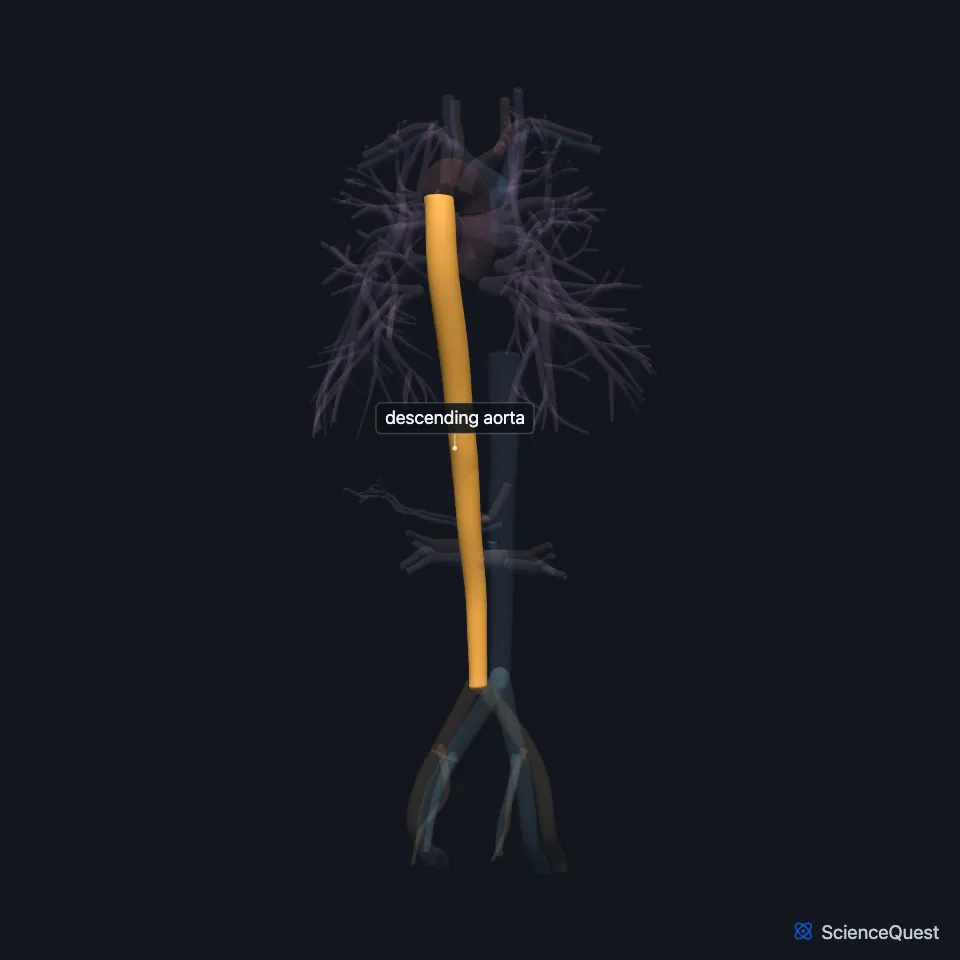
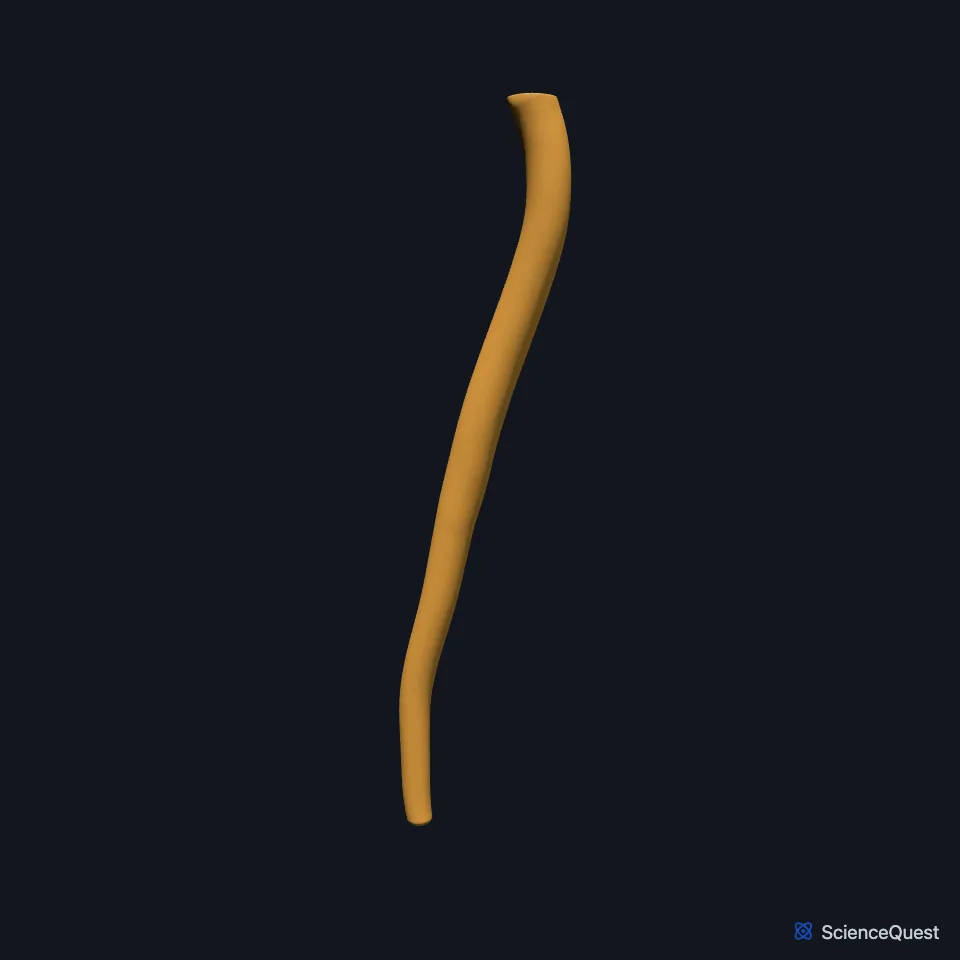
Where does the descending aorta run?
The thoracic aorta starts on the left of the vertebral column and moves toward the midline as it descends, leaving the thorax through the aortic hiatus at T12. OpenStax starts it at T5; StatPearls and Gray’s Anatomy (1918) start it at T4. (OpenStax A&P 2e, 20.5; StatPearls, Thorax, Heart Aorta and Abdomen and Pelvis: Aorta; Gray’s Anatomy (1918), The Thoracic Aorta)
The abdominal aorta runs down in front of the lumbar vertebrae, a little to the left, embedded in fat behind the peritoneal cavity. It ends at about L4, where it splits into the two common iliac arteries. (StatPearls, Abdomen and Pelvis: Abdominal Aorta and Thorax, Heart Aorta; OpenStax A&P 2e, 20.5)
The inferior vena cava lies to its right in the abdomen. (StatPearls, Abdomen and Pelvis: Abdominal Aorta)
What does the thoracic aorta supply?
Its visceral branches, the bronchial, pericardial, esophageal and mediastinal arteries, supply organs in the thorax. Its parietal branches are the intercostal, subcostal and superior phrenic arteries. (OpenStax A&P 2e, 20.5; StatPearls, Abdomen and Pelvis: Aorta)
The bronchial arteries, usually two on the left and one on the right, bring systemic blood to the airways and tissue of the lungs. (OpenStax A&P 2e, 20.5; StatPearls, Abdomen and Pelvis: Aorta; Gray’s Anatomy (1918), The Thoracic Aorta)
What branches leave the abdominal aorta?
Three unpaired branches leave it for the gut: the celiac trunk, the superior mesenteric artery and the inferior mesenteric artery. (OpenStax A&P 2e, 20.5; StatPearls, Abdomen and Pelvis: Abdominal Aorta and Abdomen and Pelvis: Aorta)
Paired branches include the inferior phrenic, adrenal, renal, gonadal and lumbar arteries. (OpenStax A&P 2e, 20.5; StatPearls, Abdomen and Pelvis: Abdominal Aorta)
A small vessel, the median sacral artery, runs down to the sacrum. OpenStax describes it as the aorta’s continuation past its split into the common iliac arteries; Gray’s Anatomy (1918), which calls it the middle sacral artery, and StatPearls treat it as a branch leaving the back of the aorta a little above the split. (OpenStax A&P 2e, 20.5; Gray’s Anatomy (1918), The Abdominal Aorta; StatPearls, Abdomen and Pelvis: Abdominal Aorta and Abdomen and Pelvis: Internal Iliac Arteries)
What crosses the abdominal aorta?
The splenic vein and the body of the pancreas cross it between the celiac and superior mesenteric origins. The left renal vein, the uncinate process of the pancreas and the third part of the duodenum cross it below the superior mesenteric origin. (StatPearls, Abdomen and Pelvis: Abdominal Aorta)
The inferior vena cava runs beside the abdominal aorta, on its right and just beneath the parietal peritoneum, and collects blood from the abdominal veins. (OpenStax A&P 2e, 20.5; StatPearls, Abdomen and Pelvis: Abdominal Aorta and Abdomen and Pelvis: Inferior Vena Cava)
Where the sources differ
OpenStax starts the thoracic aorta at T5, after an arch that ends at the disc between T4 and T5. StatPearls has the descending thoracic aorta begin at the level of the T4 vertebral body. (OpenStax A&P 2e, 20.5; StatPearls, Thorax, Heart Aorta)
OpenStax says the abdominal aorta stays to the left of the vertebral column. StatPearls (Abdominal Aorta) puts it in front of the lumbar vertebrae and slightly to the left. (OpenStax A&P 2e, 20.5; StatPearls, Abdomen and Pelvis: Abdominal Aorta)
| Feature | Detail and source |
|---|---|
| Begins | End of the arch of aorta (OpenStax A&P 2e, 20.5; StatPearls, Abdomen and Pelvis: Aorta) |
| Parts | Thoracic aorta above the aortic hiatus, abdominal aorta below it (OpenStax A&P 2e, 20.5; StatPearls, Abdomen and Pelvis: Aorta) |
| Ends | At about L4, in the two common iliac arteries (OpenStax A&P 2e, 20.5; StatPearls, Thorax, Heart Aorta) |
Touches in this model
Measured on the BodyParts3D meshes: surfaces within 2 mm of the descending aorta, nearest first, 12 of 41.
- Arch of aorta in contact
- Celiac artery in contact
- Inferior mesenteric artery in contact
- Left common iliac artery in contact
- Left renal artery in contact
- Left renal vein in contact
- Right common iliac artery in contact
- Right renal artery in contact
- Superior mesenteric artery in contact
- Diaphragm in contact
- Eighth thoracic vertebra in contact
- Eleventh thoracic vertebra in contact
Sources
- OpenStax Anatomy and Physiology 2e, section 20.5, Circulatory Pathways. CC BY-NC-SA 4.0. Read 2026-10-25.
- StatPearls, Anatomy, Abdomen and Pelvis: Aorta. Hunter J. White; Stephen J. Bordes; Judith Borger. Last update July 25, 2023. CC BY-NC-ND 4.0. Read 2026-10-25.
- StatPearls, Anatomy, Thorax, Heart Aorta. James S. Shahoud; Julia H. Miao; Srinivasa Rao Bolla. Last update July 24, 2023. CC BY-NC-ND 4.0. Read 2026-10-25.
- Anatomy of the Human Body (Gray’s Anatomy), 20th US edition, 1918, Angiology, The Descending Aorta, The Thoracic Aorta (Aorta Thoracalis) and its branches; Internet Archive scan of the 1918 Lea and Febiger printing, terminology of 1918. Henry Gray; edited by Warren H. Lewis. Public domain. Read 2026-10-25.
- StatPearls, Anatomy, Abdomen and Pelvis: Abdominal Aorta. Clement T. Tran; Cheng Ying Wu; Stephen J. Bordes; Forshing Lui. Last update July 25, 2023. CC BY-NC-ND 4.0. Read 2026-10-25.
- Anatomy of the Human Body (Gray’s Anatomy), 20th US edition, 1918, Angiology, The Abdominal Aorta, its branches and the middle sacral artery; Internet Archive scan of the 1918 Lea and Febiger printing, terminology of 1918. Henry Gray; edited by Warren H. Lewis. Public domain. Read 2026-10-25.
- StatPearls, Anatomy, Abdomen and Pelvis: Internal Iliac Arteries. Nicolas Zaunbrecher; Tafline C. Arbor; Navdeep S. Samra. Last update January 17, 2023. CC BY-NC-ND 4.0. Read 2026-10-25.
- StatPearls, Anatomy, Abdomen and Pelvis: Inferior Vena Cava. William D. Tucker; Ribesh Shrestha; Bracken Burns. Last update July 24, 2023. CC BY-NC-ND 4.0. Read 2026-10-25.
The values are facts and free to use; this page’s selection and presentation are © 2026 ScienceQuest.