Buccinator
The buccinator is the main muscle of the cheek, a square muscle on each side of the face. It compresses the cheek, which lets you whistle, blow and suck, and it helps with chewing. (StatPearls, Buccinator Muscle; OpenStax A&P 2e, 11.3)
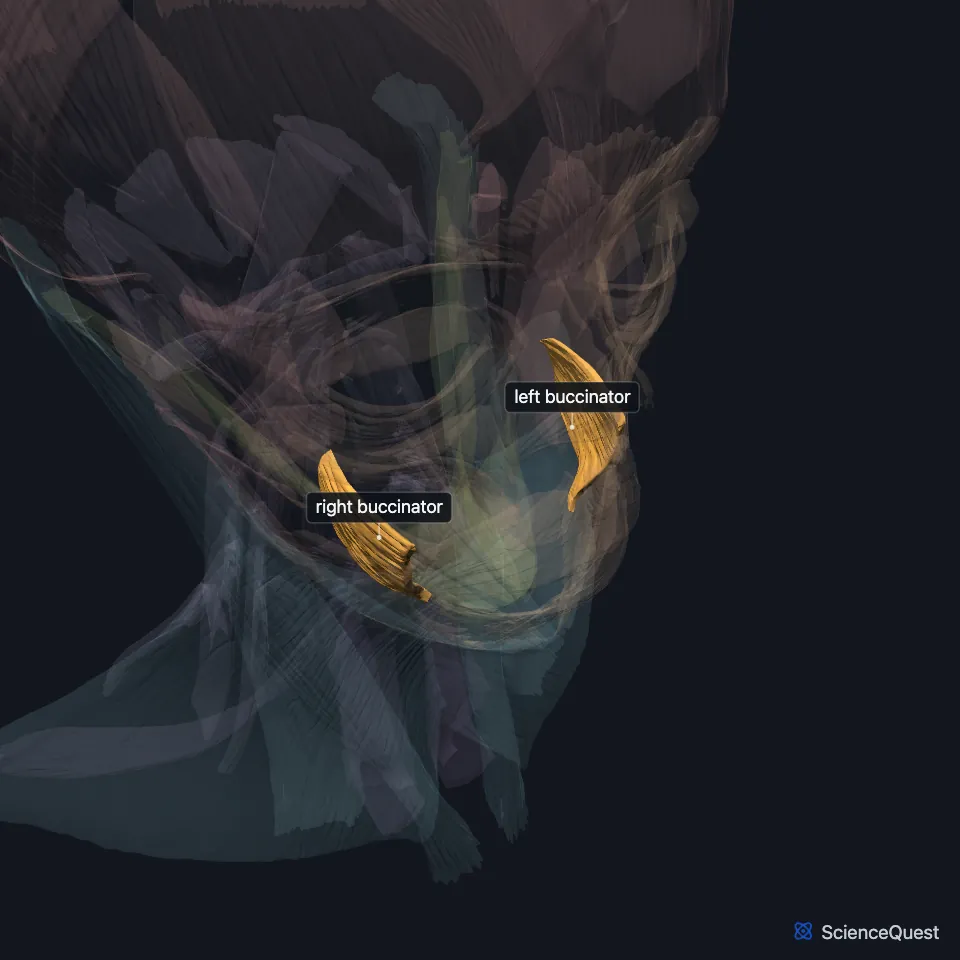
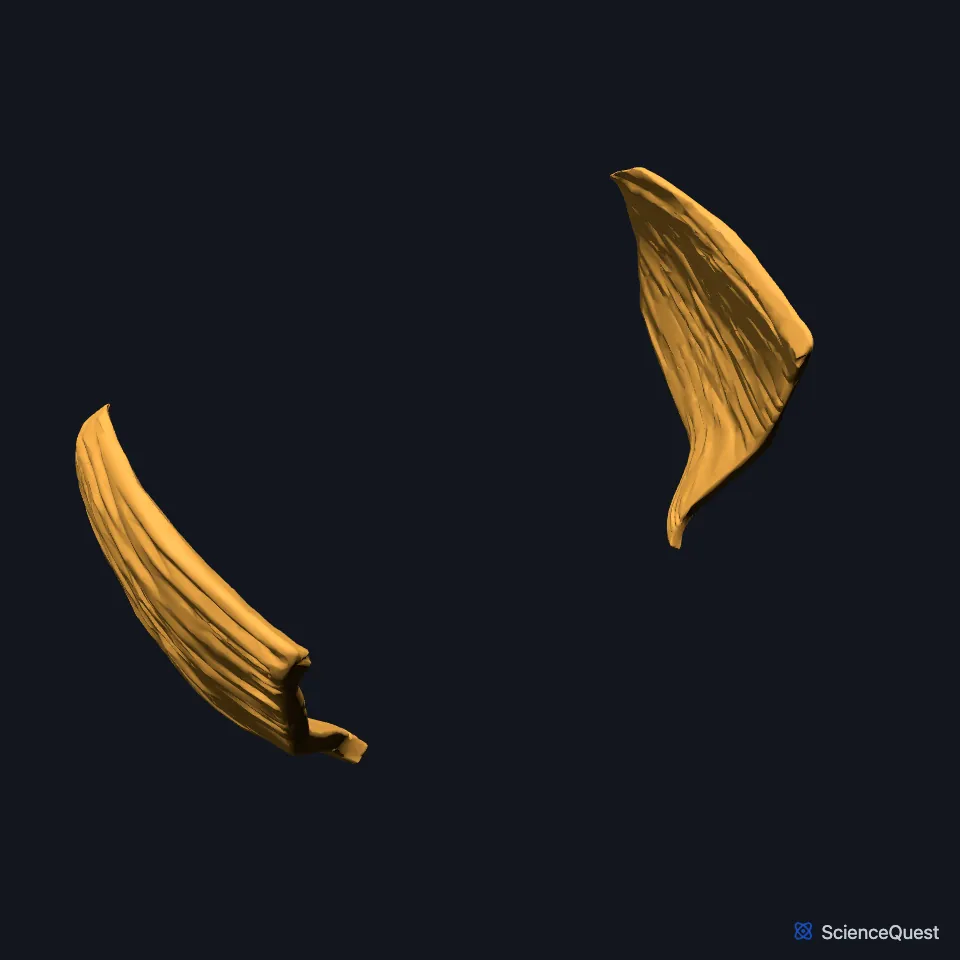
Open it in the Head and Neck Muscles Explorer See it alone in 3D
Where is the buccinator?
It lies deep to the skin of the face, the front border of the masseter and the more superficial facial muscles. On its inner side only the submucosa and lining of the cheek cover it. (StatPearls, Buccinator Muscle)
Of all the cheek muscles it lies deepest, closest to the mouth. (StatPearls, Cheeks)
What does the buccinator attach to?
Its fibers arise in three bundles: from the alveolar process of the maxilla, from the alveolar part of the mandible and from the pterygomandibular raphe. (StatPearls, Buccinator Muscle)
All three run forward through the modiolus at the corner of the mouth and blend with the orbicularis oris. Behind, the raphe ties it to the superior constrictor, the highest muscle of the pharynx. (StatPearls, Buccinator Muscle)
What does the buccinator do?
It presses the cheek in against the molars and draws the corner of the mouth outward. That keeps food against the teeth while you chew and swallow. (StatPearls, Buccinator Muscle and Cheeks)
It tightens as the mouth closes and relaxes as it opens, which keeps the cheek taut and protects its lining from injury. (StatPearls, Buccinator Muscle)
In the oral phase of swallowing, it and the orbicularis oris make a wave of contraction that passes on to the pharynx. (StatPearls, Buccinator Muscle)
Couper and Myot coined the name in 1694, from blowing a trumpet, and the muscle is also called the trumpeter’s muscle. It is one of the first muscles a baby uses, in sucking. (StatPearls, Buccinator Muscle)
What passes through the buccinator, and what supplies it?
The parotid duct crosses the masseter, pierces the buccinator and opens into the mouth on a small papilla opposite the upper second molar. (StatPearls, Buccinator Muscle)
On its outer side lie the ramus of the mandible, the masseter and medial pterygoid, the buccal fat pad and the buccopharyngeal fascia. (StatPearls, Buccinator Muscle)
The facial nerve gives its motor supply. Because the buccinator lies deep, the nerve’s branches enter it on its outer surface, unlike most facial muscles. (StatPearls, Buccinator Muscle and Facial Muscles)
The buccal nerve, a sensory nerve, reaches the outer face of the buccinator under the buccal fat pad. Its deep branches pierce the muscle to supply the lining of the cheek. (StatPearls, Buccal Nerve)
The buccal, facial and posterior superior alveolar arteries supply it. (StatPearls, Buccinator Muscle)
Where the sources differ
OpenStax treats the buccinator as a muscle of facial expression, as does StatPearls’ buccinator article. StatPearls’ article on the cheeks says most cheek muscles take part in facial expression, except the buccinator and the masseter. (OpenStax A&P 2e, 11.3; StatPearls, Buccinator Muscle and Cheeks)
StatPearls’ buccinator article names the long buccal nerve as a branch of the maxillary division (V2) of the trigeminal nerve. Its buccal nerve article calls the buccal nerve the only sensory branch of the anterior part of the mandibular division. (StatPearls, Buccinator Muscle and Buccal Nerve)
StatPearls’ buccinator article gives its motor supply as the temporal and cervical divisions of the facial nerve. Its cheeks article says the buccal branch of the facial nerve supplies most of the cheek muscles, all but the orbicularis oculi and the masseter. (StatPearls, Buccinator Muscle and Cheeks)
StatPearls’ buccinator article says the muscle presses the cheek in against the molars, and in another line that it puffs out the cheeks, which it gives as the reason for the name trumpeter’s muscle. OpenStax says it compresses the cheek. (StatPearls, Buccinator Muscle; OpenStax A&P 2e, 11.3)
| Feature | Detail and source |
|---|---|
| Origin | Alveolar processes of the maxilla and mandible; pterygomandibular raphe (StatPearls, Buccinator Muscle) |
| Insertion | Modiolus at the corner of the mouth; orbicularis oris (StatPearls, Buccinator Muscle) |
| Action | Presses the cheek against the teeth; draws the corner of the mouth outward (StatPearls, Buccinator Muscle) |
| Nerve | Facial nerve (CN VII), motor (StatPearls, Buccinator Muscle) |
Touches in this model
Measured on the BodyParts3D meshes: surfaces within 2 mm of the buccinator, nearest first, 12 of 25.
- Left depressor anguli oris in contact
- Left depressor labii inferioris in contact
- Left risorius in contact
- Left zygomaticus major in contact
- Orbicularis oris in contact
- Right depressor anguli oris in contact
- Right depressor labii inferioris in contact
- Right risorius in contact
- Right zygomaticus major in contact
- Gingiva of lower jaw in contact
- Gingiva of upper jaw in contact
- Left lower first secondary molar tooth in contact
Sources
- StatPearls, Anatomy, Head and Neck: Buccinator Muscle. Manu Rathee; Prachi Jain. Last update January 30, 2024. CC BY-NC-ND 4.0. Read 2026-10-25.
- OpenStax Anatomy and Physiology 2e, section 11.3, Axial Muscles of the Head, Neck, and Back. CC BY-NC-SA 4.0. Read 2026-10-25.
- StatPearls, Anatomy, Head and Neck, Cheeks. John D. Nguyen; Hieu Duong. Last update August 14, 2023. CC BY-NC-ND 4.0. Read 2026-10-25.
- StatPearls, Anatomy, Head and Neck: Facial Muscles. Adegbenro O. Fakoya; Marc H. Hohman; Katherine E. Westbrook; Matthew A. Varacallo. Last update April 20, 2024. CC BY-NC-ND 4.0. Read 2026-10-25.
- StatPearls, Anatomy, Head and Neck: Buccal Nerve. Abu Bakar Siddik; Amit Sapra. Last update August 14, 2023. CC BY-NC-ND 4.0. Read 2026-10-25.
The values are facts and free to use; this page’s selection and presentation are © 2026 ScienceQuest.