Inferior nasal concha
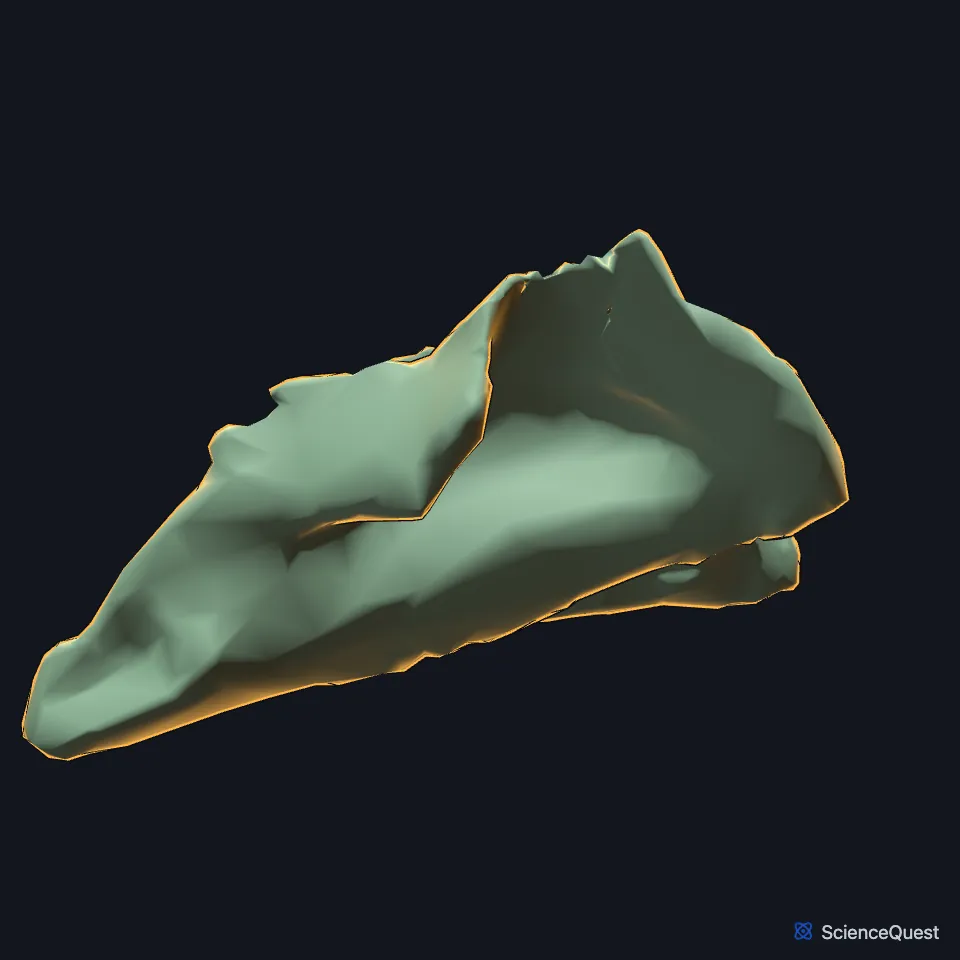
The inferior nasal concha is a curled plate of spongy bone that runs along the lower part of the side wall of the nasal cavity. Unlike the middle and superior conchae, which belong to the ethmoid, it is a bone of its own. (Gray 1918, 5b. 6. The Inferior Nasal Concha; StatPearls, Nasal Concha)
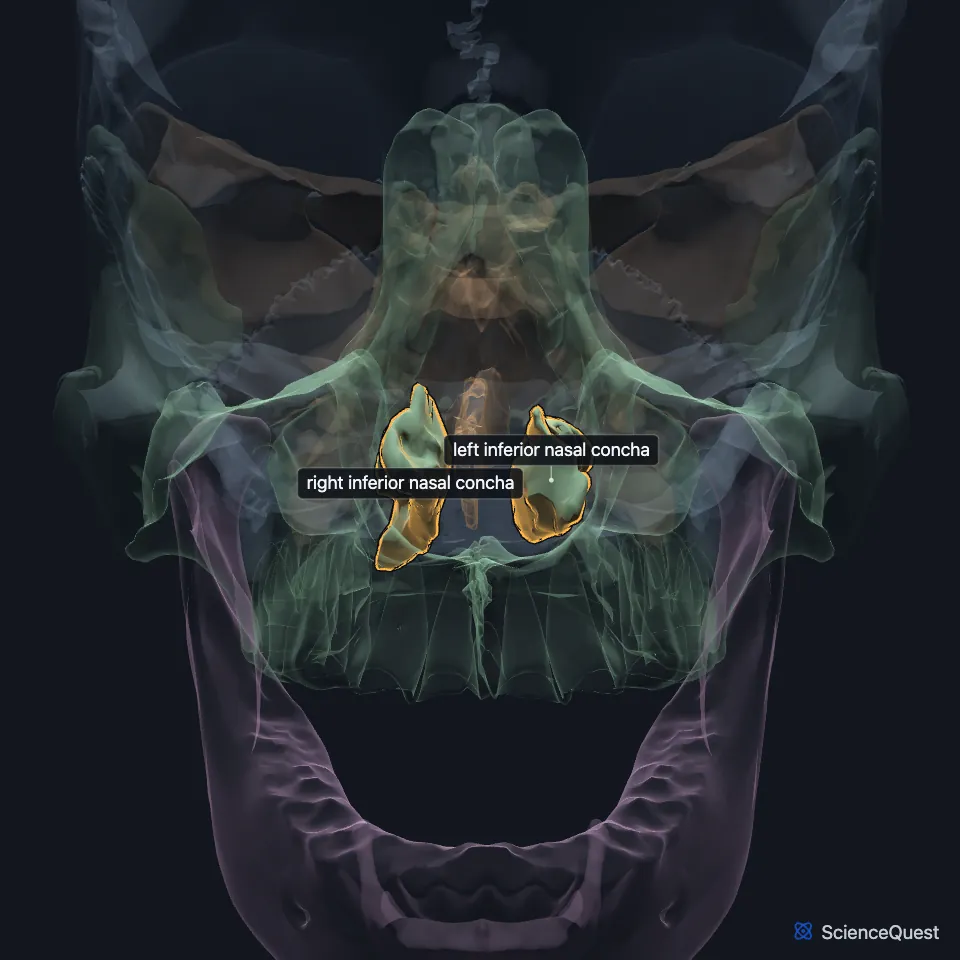
Where is the inferior nasal concha?
It lies low on the lateral wall of the nasal cavity. The inferior meatus is the channel under it, and the nasolacrimal duct opens there, carrying tears from the eye into the nose. (StatPearls, Nasal Concha and Nasal Cavity)
What is the difference between a concha and a turbinate?
The concha is the bone; covered by its mucosa it is called a turbinate. Of the three pairs commonly described, the inferior turbinate is the largest. (StatPearls, Nasal Cavity and Nasal Concha)
Its free lower border is thick and full of small spaces. Its medial surface is convex and pierced by many small openings, with grooves for vessels, and its lateral surface is concave and forms part of the inferior meatus. (Gray 1918, 5b. 6. The Inferior Nasal Concha)
What does the inferior nasal concha do?
The turbinates add surface area inside the nose, which helps warm and humidify the air. StatPearls notes that the inferior turbinates are the first structures inside the nose to meet outside air, and that their cells help detect harmful particles. (StatPearls, Nasal Cavity and Nasal Concha)
Erectile tissue over the bone swells and shrinks under autonomic control. Usually one inferior turbinate swells while the other shrinks, sending most air through one nostril at a time; this nasal cycle lasts from half an hour to 6 hours. (StatPearls, Nasal Concha)
Which bones meet the inferior nasal concha?
Its upper border attaches along the side wall of the nose. The front part meets the conchal crest of the maxilla and the back part the conchal crest of the palatine bone. (Gray 1918, 5b. 6. The Inferior Nasal Concha)
Its middle part carries three processes, which vary a lot in size and shape. The lacrimal process meets the lacrimal bone and helps form the canal for the nasolacrimal duct, the ethmoidal process joins the uncinate process of the ethmoid, and the maxillary process forms part of the medial wall of the maxillary sinus. (Gray 1918, 5b. 6. The Inferior Nasal Concha)
Why is the inferior turbinate often operated on?
Removing part or all of it is common, because it plays a part in nasal blockage. When it enlarges in allergic rhinitis, steroid and antihistamine sprays come first, and surgery reduces it when they are not enough. (StatPearls, Nasal Concha)
A badly deviated septum can enlarge it too. When the septum bends far to one side, the inferior turbinate on the concave side of the bend often grows markedly to regulate airflow through that side. (StatPearls, Nasal Concha)
Removing too much mucosa can leave the nose unable to sense airflow, so the person feels blocked even with open passages. StatPearls calls this empty nose syndrome. (StatPearls, Nasal Concha)
Where the sources differ
The sources count its joints differently. StatPearls names three bones, the maxillary, palatine and ethmoid, while Gray’s Anatomy (1918) lists four, adding the lacrimal bone. (StatPearls, Nasal Concha; Gray 1918, 5b. 6. The Inferior Nasal Concha)
| Feature | Detail and source |
|---|---|
| Articulates with | 4 bones in Gray (1918): ethmoid, maxilla, lacrimal, palatine (Gray 1918, 5b. 6. The Inferior Nasal Concha) |
| Covers | The inferior meatus, where the nasolacrimal duct opens (StatPearls, Nasal Concha) |
| Ossifies | From one center, at about the fifth month of fetal life (Gray 1918, 5b. 6. The Inferior Nasal Concha) |
Touches in this model
Measured on the BodyParts3D meshes: surfaces within 2 mm of the inferior nasal concha, nearest first.
- Left palatine bone in contact
- Right maxilla in contact
- Right palatine bone in contact
- Skin in contact
- Vomer 0.6 mm away
- Left maxilla 0.7 mm away
- Right lacrimal bone 1.4 mm away
- Ethmoid 1.9 mm away
Sources
Sources read
- Gray’s Anatomy of the Human Body, 20th US edition (1918), II. Osteology, 5b. 6. The Inferior Nasal Concha (1918 term: inferior turbinated bone). Henry Gray. Public domain. Read .
- StatPearls, Anatomy, Head and Neck, Nasal Concha. Adegbenro O. Fakoya; Marc H. Hohman; Bianca Georgakopoulos; Patrick H. Le. Last update . CC BY-NC-ND 4.0. Read .
- StatPearls, Anatomy, Head and Neck, Nasal Cavity. John L. Sobiesk; Sunil Munakomi. Last update . CC BY-NC-ND 4.0. Read .
The values are facts and free to use; this page’s selection and presentation are © 2026 ScienceQuest.