Intervertebral disk
An intervertebral disk, or disc, is the pad of fibrocartilage that joins the bodies of two neighbouring vertebrae. The adult spine has 23 of them. (StatPearls, Intervertebral Discs; Gray’s Anatomy (1918), Intervertebral fibrocartilages, p. 289)
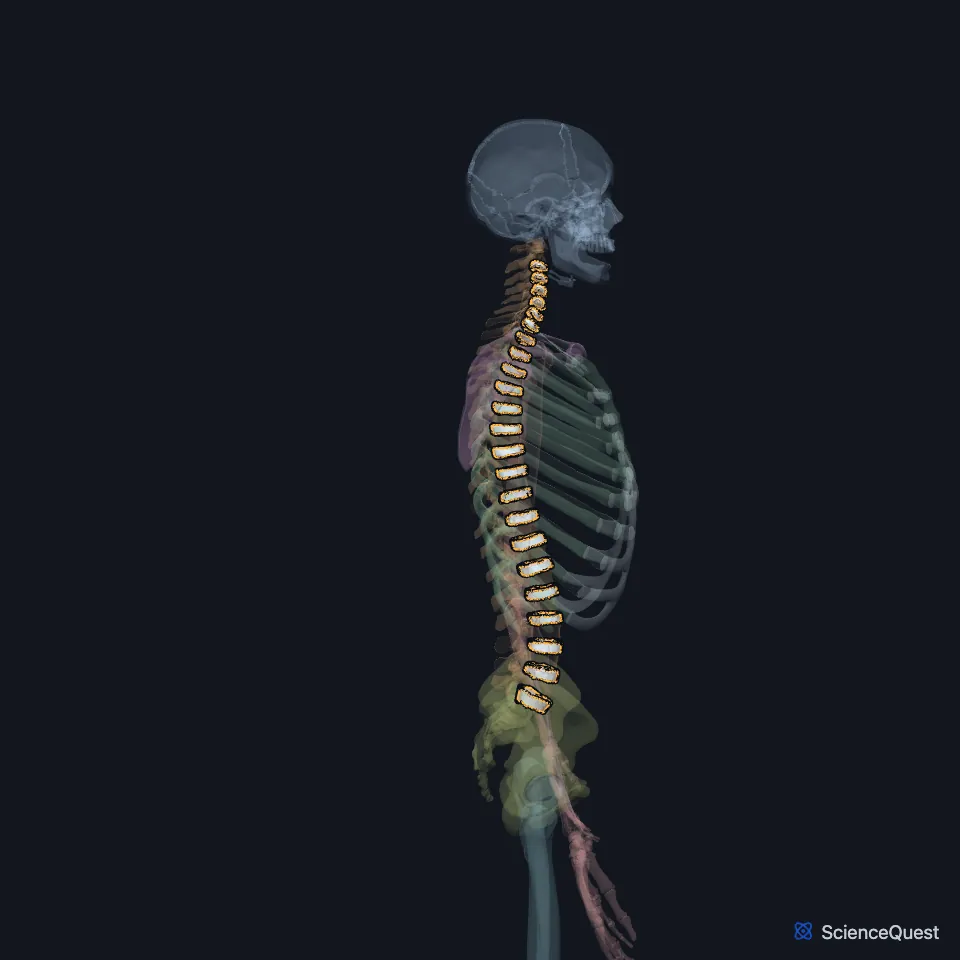
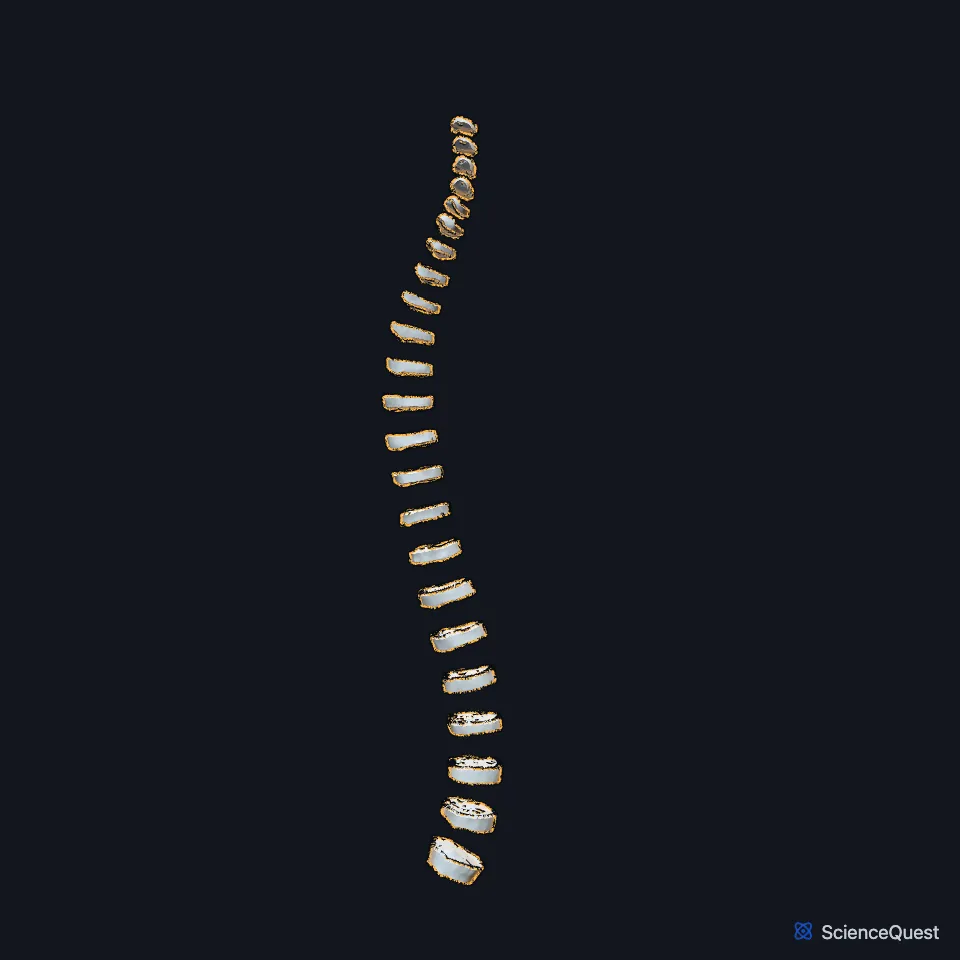
Where are the intervertebral disks?
Six are cervical, twelve thoracic and five lumbar. There is none between the atlas and the axis, so the first lies below the axis, and the last lies between L5 and the sacrum. (StatPearls, Intervertebral Discs; Gray’s Anatomy (1918), Intervertebral fibrocartilages, p. 289)
What is an intervertebral disk made of?
Each disk has a soft, gel-like core, the nucleus pulposus, inside a ring of 15 to 25 layers of collagen, the annulus fibrosus, and cartilaginous endplates that anchor it to the vertebrae. The nucleus is 66% to 86% water. (StatPearls, Intervertebral Discs)
The fibres of each layer of the annulus cross those of the next, like the limbs of the letter X. Gray’s Anatomy (1918) calls the nucleus the remains of the notochord. (Gray’s Anatomy (1918), Intervertebral fibrocartilages, p. 289; StatPearls, Intervertebral Discs)
The disk is the largest structure in the body with no blood vessels. Glucose and oxygen reach its centre by diffusing through the endplates from capillaries in the vertebrae. (StatPearls, Intervertebral Discs)
Together the disks make up about 25% to 33% of the length of the spine. Gray’s Anatomy (1918) gives about one fourth, leaving out the first two vertebrae, and finds more disk for their length in the neck and lower back than in the chest. (StatPearls, Intervertebral Discs; Gray’s Anatomy (1918), Intervertebral fibrocartilages, p. 289)
What does an intervertebral disk do?
Disks let the spine bend while keeping it strong, absorb shock, and stop the vertebral bodies touching. Under load the pressurized nucleus pushes outward and the annulus holds it in, turning that push into tension around its ring. (StatPearls, Intervertebral Discs; Gray’s Anatomy (1918), Intervertebral fibrocartilages, p. 289)
Standing through the day squeezes water out of the disks and costs them 10% to 20% of their height by evening. They take the water back while you lie down to sleep. (StatPearls, Intervertebral Discs)
What do the intervertebral disks attach to?
Each disk sticks to thin layers of hyaline cartilage on the vertebral bodies above and below, and its rim is bound to the anterior and posterior longitudinal ligaments. In the thoracic region it is joined to the heads of the ribs that meet two vertebrae. (Gray’s Anatomy (1918), Intervertebral fibrocartilages, p. 289)
Where do intervertebral disks herniate?
About 95% of lumbar disk herniations happen at L4 to L5 or L5 to S1. Thoracic herniations are less common, and most cause no symptoms. (StatPearls, Lumbar Disc Herniation and Disk Herniation)
| Feature | Detail and source |
|---|---|
| Number | 23: 6 cervical, 12 thoracic, 5 lumbar (StatPearls, Intervertebral Discs) |
| Tissue | Fibrocartilage ring around a gel-like core (Gray’s Anatomy (1918), Intervertebral fibrocartilages, p. 289; StatPearls, Intervertebral Discs) |
| Joins | The bodies of neighbouring vertebrae, from below the axis to the sacrum (Gray’s Anatomy (1918), Intervertebral fibrocartilages, p. 289) |
| Older name | Intervertebral fibrocartilage (Gray’s Anatomy, 1918) (Gray’s Anatomy (1918), Intervertebral fibrocartilages, p. 289) |
Touches in this model
Measured on the BodyParts3D meshes: surfaces within 2 mm of the intervertebral disk, nearest first, 12 of 60.
- Axis in contact
- Eighth thoracic vertebra in contact
- Eleventh thoracic vertebra in contact
- Fifth cervical vertebra in contact
- Fifth lumbar vertebra in contact
- Fifth thoracic vertebra in contact
- First lumbar vertebra in contact
- First thoracic vertebra in contact
- Fourth cervical vertebra in contact
- Fourth lumbar vertebra in contact
- Fourth thoracic vertebra in contact
- Ninth thoracic vertebra in contact
Sources
Sources read
- StatPearls, Anatomy, Back, Intervertebral Discs. Joshua A. Waxenbaum; Vamsi Reddy; Bennett Futterman. Last update . CC BY-NC-ND 4.0. Read .
- Gray’s Anatomy of the Human Body, 20th US edition (1918), edited by Warren H. Lewis, Syndesmology, The Intervertebral Fibrocartilages (pp. 289 to 290); 1918 name: intervertebral fibrocartilages for intervertebral disks. Henry Gray; Warren H. Lewis (editor). Public domain. Read .
- StatPearls, Lumbar Disc Herniation. Mustafa I. Al Qaraghli; Orlando De Jesus. Last update . CC BY-NC-ND 4.0. Read .
- StatPearls, Disk Herniation. Michael F. Stretanski; Young Hu; Fassil B. Mesfin. Last update . CC BY-NC-ND 4.0. Read .
The values are facts and free to use; this page’s selection and presentation are © 2026 ScienceQuest.