Cervical vertebrae
The cervical vertebrae are the seven bones of the neck, C1 to C7, and the smallest in the vertebral column. The model here shows C3 to C7, because C1, the atlas, and C2, the axis, have pages of their own. (StatPearls, Cervical Vertebrae (Back))
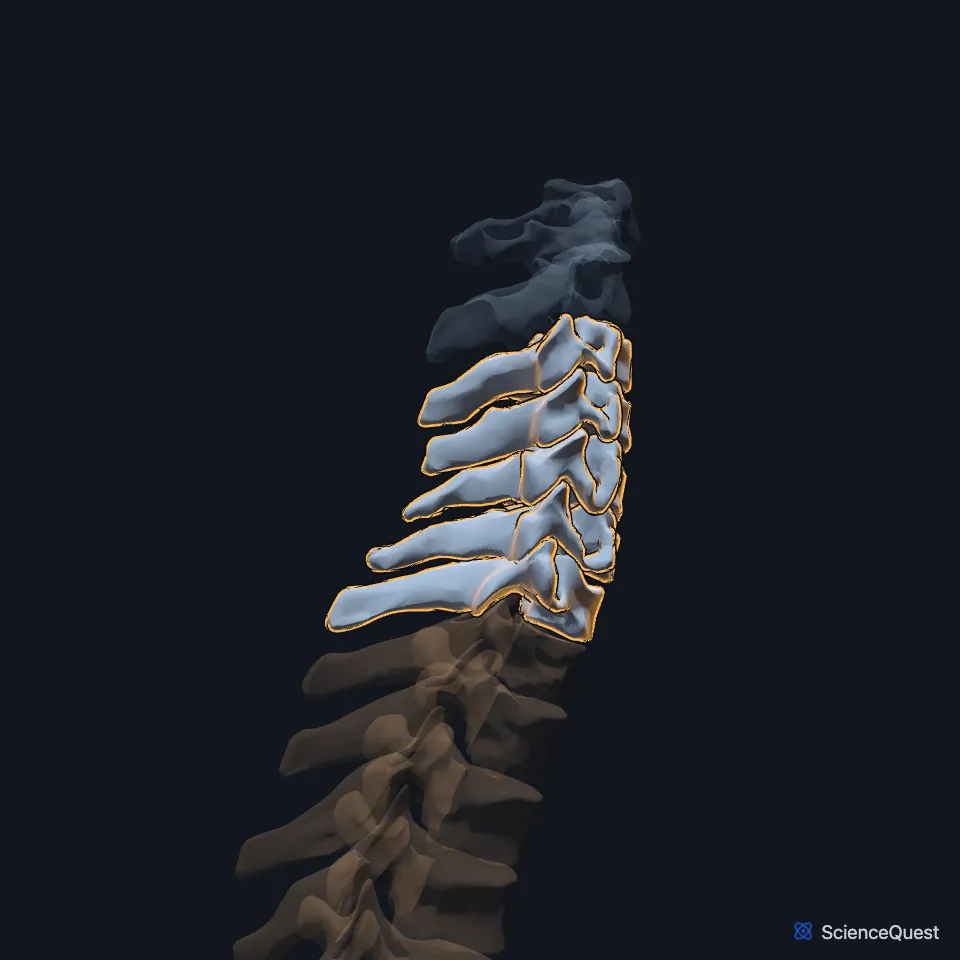
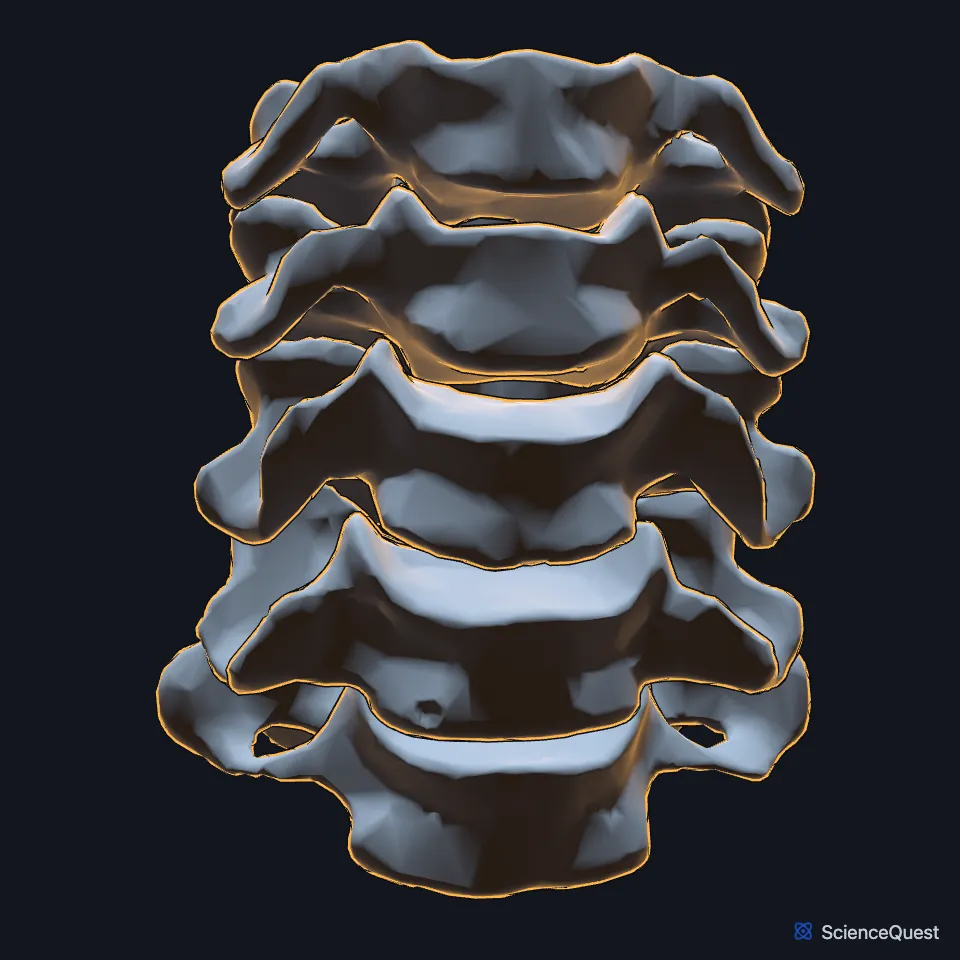
Open it in the Vertebral Column and Pelvis Explorer See it alone in 3D
Where are the cervical vertebrae?
They form the neck part of the spine, the first region below the skull, above the thoracic vertebrae. Together they make a lordotic curve. (StatPearls, Cervical Vertebrae (Back))
C3 to C7 make up what StatPearls calls the subaxial cervical spine. All five share nearly the same shape and function and have most of the parts of a typical vertebra. (StatPearls, Cervical Vertebrae (Head and Neck))
What makes a cervical vertebra different?
Each transverse process has a hole, the transverse foramen, which thoracic and lumbar vertebrae lack. In most people the vertebral artery enters at C6 and climbs through the foramina of C6 to C1. (Gray 1918, 3a. 1. The Cervical Vertebrae; StatPearls, Cervical Vertebrae (Back))
The body is small and wider from side to side than from front to back, and the vertebral foramen is large and triangular. Gray’s Anatomy (1918) describes the spinous process as short and split in two, a shape StatPearls says may give muscles more room to attach. (Gray 1918, 3a. 1. The Cervical Vertebrae; StatPearls, Cervical Vertebrae (Back))
The top of each body carries a raised lip on either side, which fits a shallow hollow on the vertebra above. StatPearls calls these lips uncinate processes and the joints they form the Luschka joints, which help keep one vertebra from slipping on the next. (Gray 1918, 3a. 1. The Cervical Vertebrae; StatPearls, Cervical Vertebrae (Head and Neck))
What do the cervical vertebrae do?
They are built for movement. Their small size reflects the lighter load they carry and gives the neck the widest range of motion of any part of the spine. (StatPearls, Cervical Vertebrae (Back))
Most of the neck’s bending forward, backward and to the side happens at C3 to C7. Turning the head happens mainly higher up, where C1 rotates around the dens of C2. (StatPearls, Cervical Vertebrae (Back))
They also shield the spinal cord and spinal nerves. Each nerve leaves through an intervertebral foramen between two vertebrae, bounded in front by the vertebral bodies and disc, above and below by the pedicles, and behind by the facet joints, their capsules and the ligamentum flavum. (StatPearls, Cervical Vertebrae (Back))
What attaches to the cervical vertebrae?
Their transverse and spinous processes give muscles of the neck and upper back attachment and leverage. A groove on the top of each transverse process carries the spinal nerve of that level. (StatPearls, Cervical Vertebrae (Back); Gray 1918, 3a. 1. The Cervical Vertebrae)
In the neck the interspinous ligaments merge with the ligamentum nuchae, which runs down from the base of the skull. Its lower end attaches to the tip of the C7 spine. (StatPearls, Cervical Vertebrae (Back); Gray 1918, 3a. 1. The Cervical Vertebrae)
Why is C7 called the vertebra prominens?
The seventh cervical vertebra has a long, prominent spinous process that ends in a single tubercle instead of splitting. StatPearls calls it a transitional vertebra, with a spine, lower facets and a larger body like those of the thoracic vertebrae. (Gray 1918, 3a. 1. The Cervical Vertebrae; StatPearls, Cervical Vertebrae (Head and Neck))
Its transverse foramina are the smallest in the neck and sometimes absent. The vertebral artery usually passes in front of the C7 transverse process rather than through it. (StatPearls, Cervical Vertebrae (Head and Neck); Gray 1918, 3a. 1. The Cervical Vertebrae)
What is a cervical rib?
Sometimes the front root of the C7 transverse process grows large enough to be a separate bone, a cervical rib. One meta-analysis cited by StatPearls puts it in 1.1% of healthy people and 29.5% of people with thoracic outlet syndrome, where it can press on the brachial plexus or the subclavian vessels. (Gray 1918, 3a. 1. The Cervical Vertebrae; StatPearls, Cervical Vertebrae (Back))
Where the sources differ
Gray’s Anatomy (1918) describes the spinous process of a typical cervical vertebra as split in two. StatPearls reports that the split is reliable only at C2 to C4, that C6 has a single tip in nearly half of people, and that a split C7 spine occurs in about 0.3%. (Gray 1918, 3a. 1. The Cervical Vertebrae; StatPearls, Cervical Vertebrae (Back))
| Feature | Detail and source |
|---|---|
| Number | 7, C1 to C7; this model shows C3 to C7 (StatPearls, Cervical Vertebrae (Back)) |
| Hallmark | A transverse foramen in each transverse process (Gray 1918, 3a. 1. The Cervical Vertebrae) |
| Vertebral artery | Usually enters at C6 and rises through C6 to C1 (StatPearls, Cervical Vertebrae (Back)) |
Touches in this model
Measured on the BodyParts3D meshes: surfaces within 2 mm of the cervical vertebrae, nearest first, 12 of 60.
- First thoracic vertebra in contact
- Descending part of right trapezius in contact
- Esophagus in contact
- Inferior oblique part of left longus colli in contact
- Inferior oblique part of right longus colli in contact
- Intervertebral disk of axis in contact
- Intervertebral disk of fifth cervical vertebra in contact
- Intervertebral disk of fourth cervical vertebra in contact
- Intervertebral disk of seventh cervical vertebra in contact
- Intervertebral disk of sixth cervical vertebra in contact
- Intervertebral disk of third cervical vertebra in contact
- Left cervical rotator in contact
Sources
Sources read
- StatPearls, Anatomy, Back, Cervical Vertebrae. Joshua A. Waxenbaum; Vamsi Reddy; Konstantinos Margetis. Last update . CC BY-NC-ND 4.0. Read .
- StatPearls, Anatomy, Head and Neck: Cervical Vertebrae. Joshua T. Kaiser; Vamsi Reddy; Marjorie V. Launico; Julian G. Lugo-Pico. Last update . CC BY-NC-ND 4.0. Read .
- Gray’s Anatomy of the Human Body, 20th US edition (1918), II. Osteology, 3a. 1. The Cervical Vertebrae. Henry Gray. Public domain. Read .
The values are facts and free to use; this page’s selection and presentation are © 2026 ScienceQuest.