Lumbar vertebrae
The lumbar vertebrae are the five vertebrae of the lower back, L1 to L5. They are the largest bones of the movable column and have no facets for ribs. (StatPearls, Lumbar Vertebrae; Gray’s Anatomy (1918), Lumbar vertebrae, p. 104)
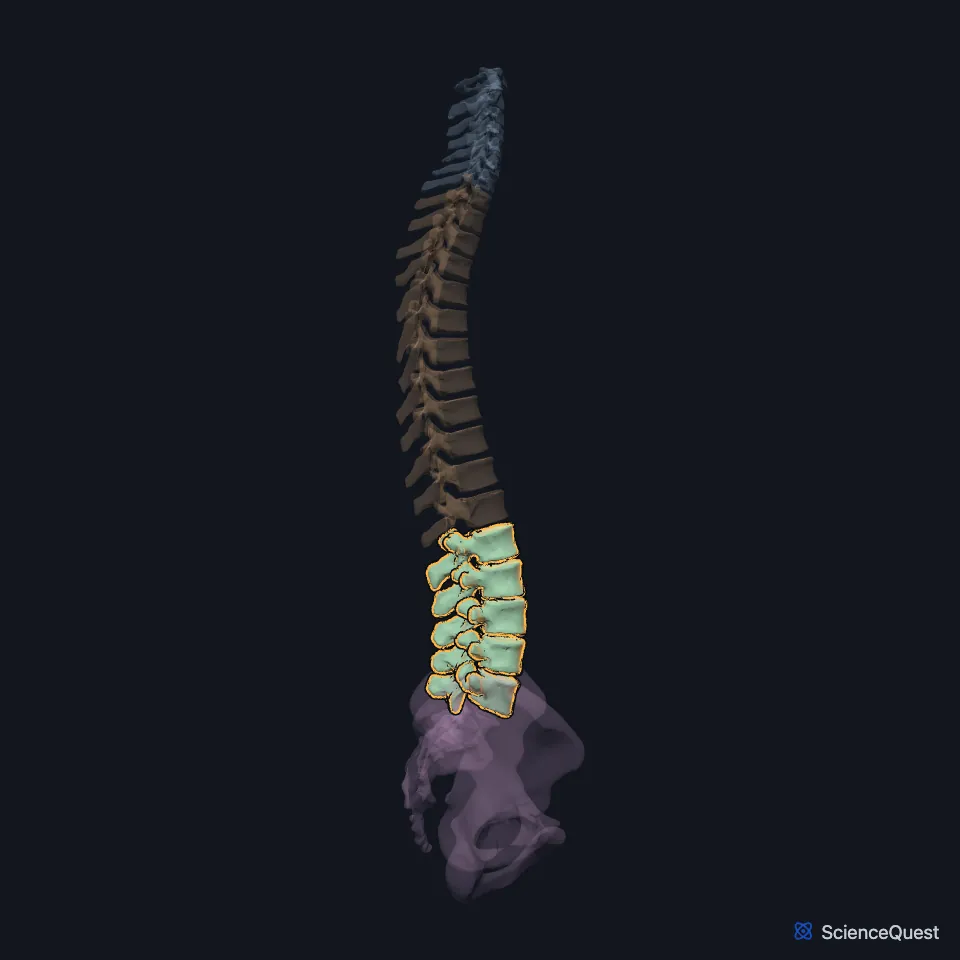
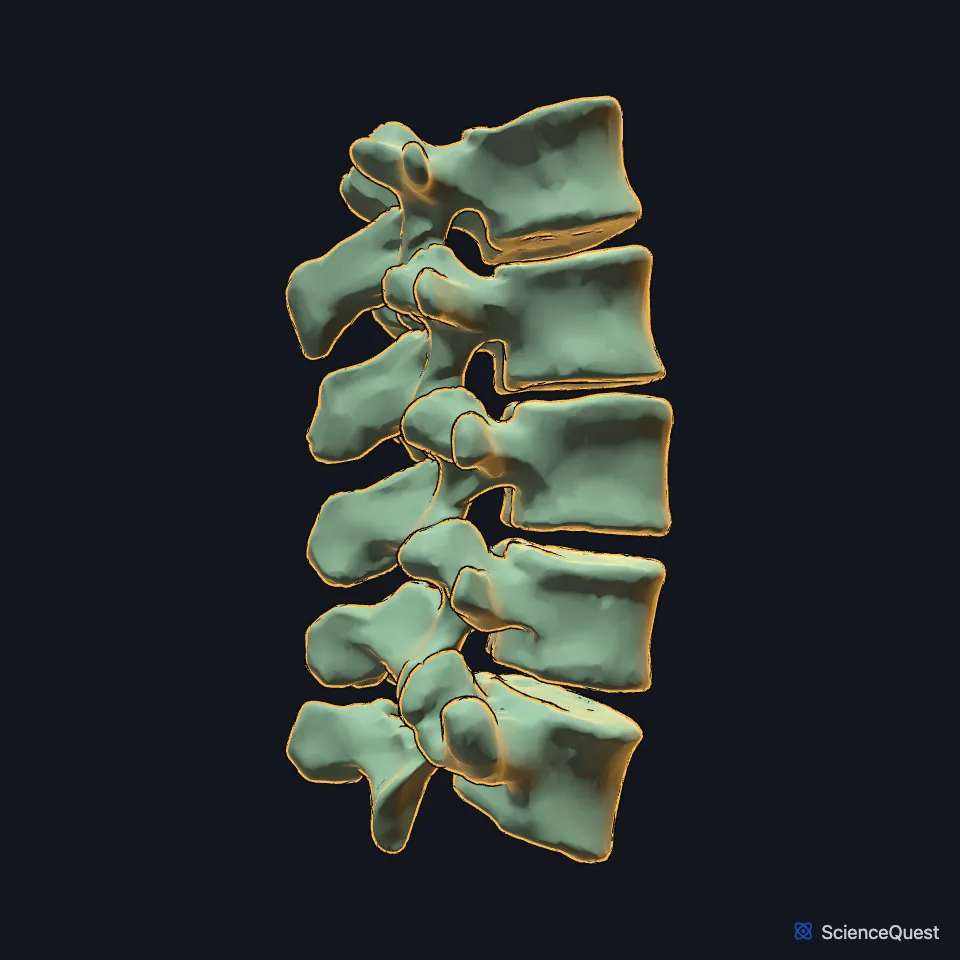
Open it in the Vertebral Column and Pelvis Explorer See it alone in 3D
Where are the lumbar vertebrae?
They sit below the thoracic vertebrae and above the sacrum, and together they curve the lower back forward in a lordosis. The lowest disc of the spine lies between L5 and the sacrum. (StatPearls, Lumbar Vertebrae and Intervertebral Discs)
What does a lumbar vertebra look like?
Each has a large body, wider from side to side than front to back, and a short, thick spinous process that points straight back. Its joint facets stand nearly vertical and curve, and a mammillary process sits on the back of each upper articular process. (StatPearls, Lumbar Vertebrae; Gray’s Anatomy (1918), Lumbar vertebrae, p. 104)
A meta-analysis found the spinal canal widening from 22.04 mm at L1 to 26.46 mm at L5. (StatPearls, Lumbar Vertebrae)
L5 is the one atypical lumbar vertebra. It has the largest body and transverse processes of all vertebrae, and its body is taller in front than behind, which helps form the angle between the lumbar spine and the sacrum. (StatPearls, Lumbar Vertebrae; Gray’s Anatomy (1918), Lumbar vertebrae, p. 104)
What do the lumbar vertebrae do?
The bodies carry the load of the spine above and grow larger towards the bottom as that load rises. (StatPearls, Lumbar Vertebrae)
The lumbar spine extends further than any other part of the column. Its near-vertical facets allow bending forward, back and to the side but restrict twisting. (StatPearls, Lumbar Vertebrae)
What attaches to the lumbar vertebrae, and what passes through them?
Each lumbar vertebra works with the intervertebral disk in front and the two facet joints behind as one motion segment. The mammillary processes anchor multifidus and the intertransversarii muscles. (StatPearls, Lumbar Vertebrae)
The spinal cord ends at about the level of L2, and below it the canal holds the nerve roots of the cauda equina. That is why a lumbar puncture needle goes in below L2. (StatPearls, Lumbar Vertebrae)
| Feature | Detail and source |
|---|---|
| Number | 5, L1 to L5 (StatPearls, Lumbar Vertebrae) |
| Articulate with | The vertebrae above and below; the sacrum under L5 (StatPearls, Lumbar Vertebrae; Gray’s Anatomy (1918), Lumbar vertebrae, p. 104) |
| Curve | Lordosis (StatPearls, Lumbar Vertebrae) |
Touches in this model
Measured on the BodyParts3D meshes: surfaces within 2 mm of the lumbar vertebrae, nearest first, 12 of 33.
- Descending aorta in contact
- Diaphragm in contact
- Intervertebral disk of fifth lumbar vertebra in contact
- Intervertebral disk of first lumbar vertebra in contact
- Intervertebral disk of fourth lumbar vertebra in contact
- Intervertebral disk of second lumbar vertebra in contact
- Intervertebral disk of third lumbar vertebra in contact
- Intervertebral disk of twelfth thoracic vertebra in contact
- Left common iliac vein in contact
- Left internal iliac vein in contact
- Left longissimus thoracis in contact
- Left lumbar rotator in contact
Sources
Sources read
- StatPearls, Anatomy, Back, Lumbar Vertebrae. Joshua A. Waxenbaum; Vamsi Reddy; Caroline Williams; Bennett Futterman. Last update . CC BY-NC-ND 4.0. Read .
- Gray’s Anatomy of the Human Body, 20th US edition (1918), edited by Warren H. Lewis, Osteology, The Lumbar Vertebrae (pp. 104 to 106), and the opening of The Sacrum (p. 106). Henry Gray; Warren H. Lewis (editor). Public domain. Read .
- StatPearls, Anatomy, Back, Intervertebral Discs. Joshua A. Waxenbaum; Vamsi Reddy; Bennett Futterman. Last update . CC BY-NC-ND 4.0. Read .
The values are facts and free to use; this page’s selection and presentation are © 2026 ScienceQuest.