Levator labii superioris
The levator labii superioris is a thin, four-sided facial muscle beside the nose, running from the lower rim of the orbit to the upper lip. Its main job is to raise the upper lip. (StatPearls, Levator Labii Superioris Muscle)
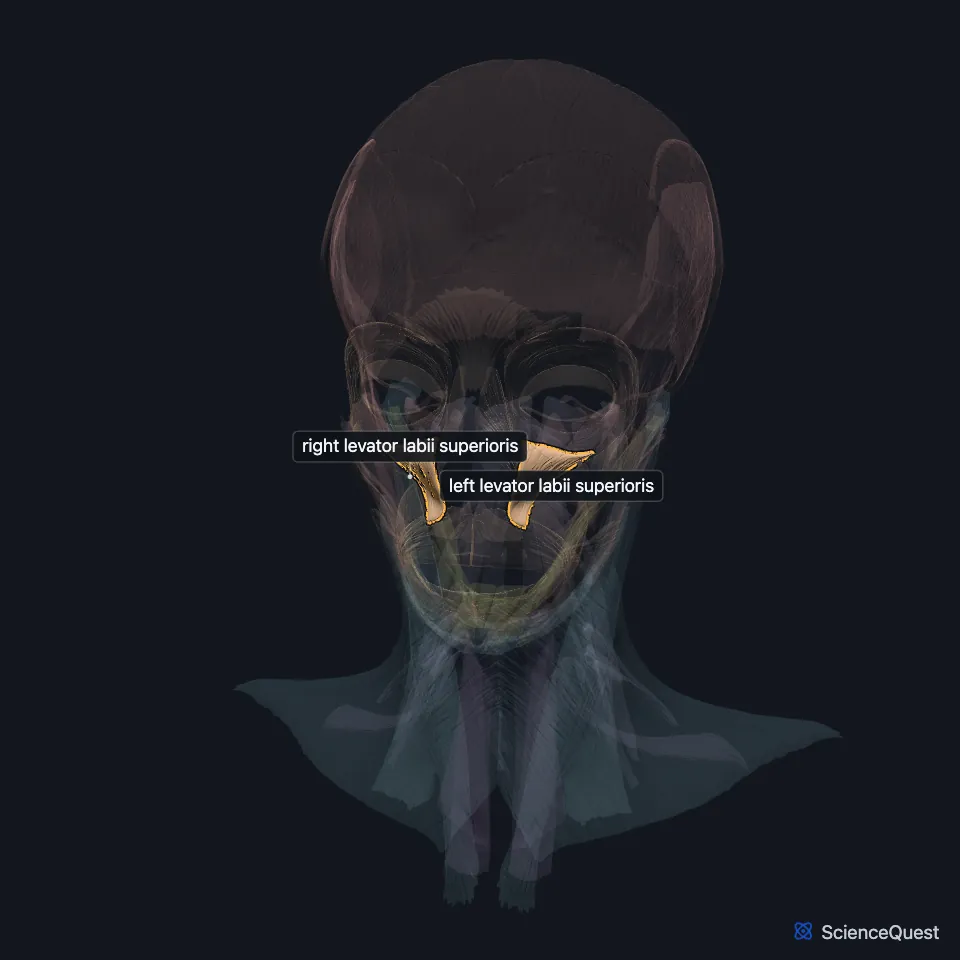
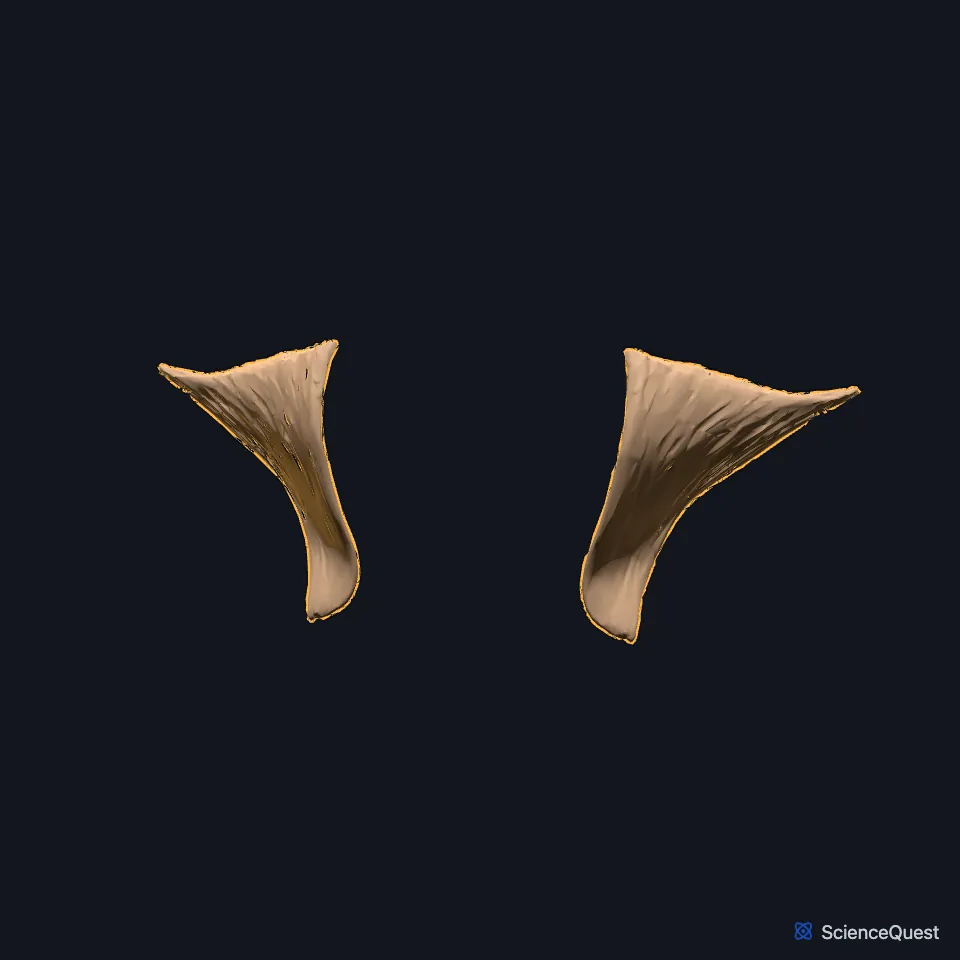
Open it in the Head and Neck Muscles Explorer See it alone in 3D
Where is the levator labii superioris?
It starts at the infraorbital margin of the maxilla. Its fibers lie between the levator labii superioris alaeque nasi and the zygomaticus minor, and they merge into the orbicularis oris of the upper lip. (StatPearls, Levator Labii Superioris Muscle)
Most of its fibers attach below the crease at the side of the nostril, and deeper ones reach the skin inside the lower nostril. (StatPearls, Levator Labii Superioris Muscle)
What group does the levator labii superioris belong to?
It is the middle one of three lip elevators. From the midline outward they are the levator labii superioris alaeque nasi, this muscle and the levator anguli oris, which lies deeper than the other two. (StatPearls, Facial Muscles)
StatPearls also calls it the quadratus labii. Gray 1918’s list of mouth muscles has no separate levator labii superioris: his quadratus labii superioris is one sheet with three heads, and its infraorbital head arises from the lower margin of the orbit, where StatPearls starts this muscle. (StatPearls, Levator Labii Superioris Muscle; Gray 1918, 4d. Muscles of the Mouth)
What does the levator labii superioris do?
It raises the upper lip and turns it out, most of all in smiling. By lifting the wing of the nose with the lip, it also widens the nostril. (StatPearls, Levator Labii Superioris Muscle)
It helps form expressions of disgust, sadness and disdain, and it acts in flaring the nostrils and in retching. (StatPearls, Levator Labii Superioris Muscle)
Rubin sorted the smiles of 100 people into three types. In the canine smile, seen in 31%, the levator labii superioris contracts first and leads, showing the canine teeth. (Iwanaga et al. 2022, PLOS ONE 17(7): e0272060)
Overactive upper lip elevators such as this one can cause a gummy smile. Botulinum toxin corrects it, but the effect lasts only 3 to 4 months. (StatPearls, Levator Labii Superioris Muscle)
What nerves and arteries supply the levator labii superioris?
The zygomatic branch of the facial nerve supplies it, helped by the buccal branch, and its nerve enters it from the deep surface. (StatPearls, Levator Labii Superioris Muscle)
Branches of the angular artery feed it from below, and the infraorbital artery feeds it from above. (StatPearls, Levator Labii Superioris Muscle)
What shapes does the levator labii superioris take?
It comes in three shapes: rectangular, the most common, fan-shaped and trapezoidal. The trapezoidal kind attaches to the wing of the nose much higher than the rectangular one. (StatPearls, Levator Labii Superioris Muscle)
| Feature | Detail and source |
|---|---|
| Origin | Infraorbital margin of the maxilla (StatPearls, Levator Labii Superioris Muscle) |
| Insertion | Upper lip, blending with the orbicularis oris; deeper fibers to the skin of the nostril (StatPearls, Levator Labii Superioris Muscle) |
| Action | Raises and everts the upper lip; widens the nostril (StatPearls, Levator Labii Superioris Muscle) |
| Nerve | Facial nerve (CN VII), zygomatic branch with buccal fibers (StatPearls, Levator Labii Superioris Muscle) |
Touches in this model
Measured on the BodyParts3D meshes: surfaces within 2 mm of the levator labii superioris, nearest first, 12 of 21.
- Left levator anguli oris in contact
- Left levator labii superioris alaeque nasi in contact
- Left zygomaticus minor in contact
- Orbicularis oris in contact
- Palpebral part of left orbicularis oculi in contact
- Palpebral part of right orbicularis oculi in contact
- Right levator anguli oris in contact
- Right levator labii superioris alaeque nasi in contact
- Right zygomaticus minor in contact
- Left maxilla in contact
- Left zygomatic bone in contact
- Right maxilla in contact
Sources
Sources read
- StatPearls, Anatomy, Head and Neck: Levator Labii Superioris Muscle. Jeffrey Bloom; Michael J. Lopez; Adegbenro O. Fakoya; Appaji Rayi. Last update . CC BY-NC-ND 4.0. Read .
- StatPearls, Anatomy, Head and Neck: Facial Muscles. Adegbenro O. Fakoya; Marc H. Hohman; Katherine E. Westbrook; Matthew A. Varacallo. Last update . CC BY-NC-ND 4.0. Read .
- Gray’s Anatomy of the Human Body, 20th US edition (1918), IV. Myology, 4d. The Muscles of the Mouth (1918 terms, as Gray pairs them: Caninus for levator anguli oris, Zygomaticus for zygomaticus major, Triangularis for depressor anguli oris, Quadratus labii inferioris for depressor labii inferioris; Mentalis keeps today’s name, with Levator menti as a second name. Gray’s Quadratus labii superioris is one sheet with angular, infraorbital and zygomatic heads, and his list of mouth muscles has no separate levator labii superioris, levator labii superioris alaeque nasi or zygomaticus minor). Henry Gray. Public domain. Read .
- PLOS ONE (peer-reviewed cadaver study), Anatomical contribution of the orbicularis oculi to the zygomaticus major: An improved understanding of the smile with consideration for facial cosmetic procedures (PMC9333313). Joe Iwanaga; Mi-Sun Hur; Shogo Kikuta; Soichiro Ibaragi; Koichi Watanabe; R. Shane Tubbs. CC BY 4.0. Read .
The values are facts and free to use; this page’s selection and presentation are © 2026 ScienceQuest.