Vanadium
- Atomic number
- 23
- Atomic mass
- 50.942
- Configuration
- [Ar] 3d3 4s2
- Category
- Transition metal
- Group
- 5
Vanadium (V) is a transition metal with atomic number 23 and an atomic mass of 50.942. Its electron configuration is [Ar] 3d3 4s2.
Interactive periodic tableOrbital shapesMolar mass calculator
Vanadium key data
| Symbol | V |
|---|---|
| Atomic number | 23 |
| Atomic mass (standard atomic weight) | 50.942 |
| Molar mass | 50.942 g/mol |
| Protons | 23 |
|---|---|
| Neutrons (most abundant isotope, vanadium-51) | 28 |
| Abundance of vanadium-51 | 99.75% |
| Electrons (neutral atom) | 23 |
| Category | Transition metal |
|---|---|
| Period | 4 |
| Group | 5 |
| Block | d-block |
| Noble gas notation | [Ar] 3d3 4s2 |
|---|---|
| Full electron configuration | 1s2 2s2 2p6 3s2 3p6 3d3 4s2 |
| Electrons per shell | 2, 8, 11, 2 |
Atomic mass: IUPAC CIAAW abridged standard atomic weights, 2024. Most abundant isotope: NIST Atomic Weights and Isotopic Compositions.
The values are facts and free to use; this page’s selection and presentation are © 2026 ScienceQuest.
Updated
Measured properties of vanadium
From PubChem, the US National Institutes of Health. Public domain. The electron affinity is the measured value for vanadium, from Wikipedia’s electron affinity data page, in place of PubChem’s 0.525 eV.
| Melting point | 2183 K (1909.9 °C), 14th of 103 by melting point |
|---|---|
| Boiling point | 3680 K (3406.9 °C), 22nd of 93 by boiling point |
| Density | 6 g/cm³, 58th of 96 by density |
| State at room temperature | Solid |
| Electronegativity | 1.63 (Pauling), 47th of 95 by electronegativity |
| Van der Waals radius | 179 pm, 83rd of 99 by atomic radius |
| First ionisation energy | 6.746 eV (650.9 kJ/mol), 56th of 102 by first ionisation energy |
| Electron affinity | 0.52766 eV (50.911 kJ/mol), 40th of 57 by electron affinity |
| Common oxidation states | +5, +4, +3, +2 |
| Discovered | 1801 |
Each rank counts down from the highest value, among the elements PubChem’s table gives one for, and links to that property ranked across the whole table. All of them are collected under periodic trends.
Vanadium electron configuration
The full electron configuration of vanadium is 1s2 2s2 2p6 3s2 3p6 3d3 4s2. With the noble-gas core collapsed it is [Ar] 3d3 4s2, and the outermost subshell is 4s2.
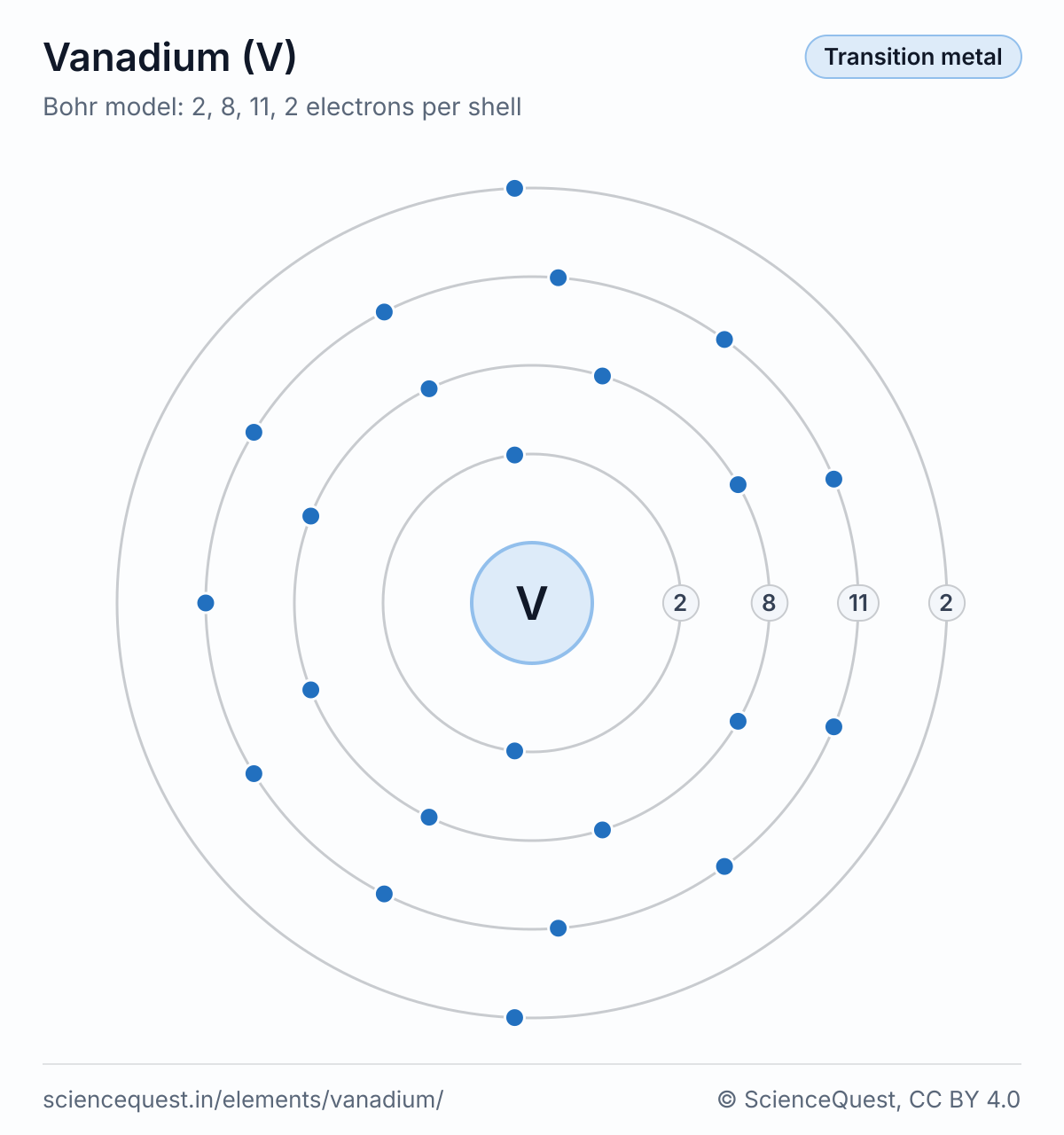
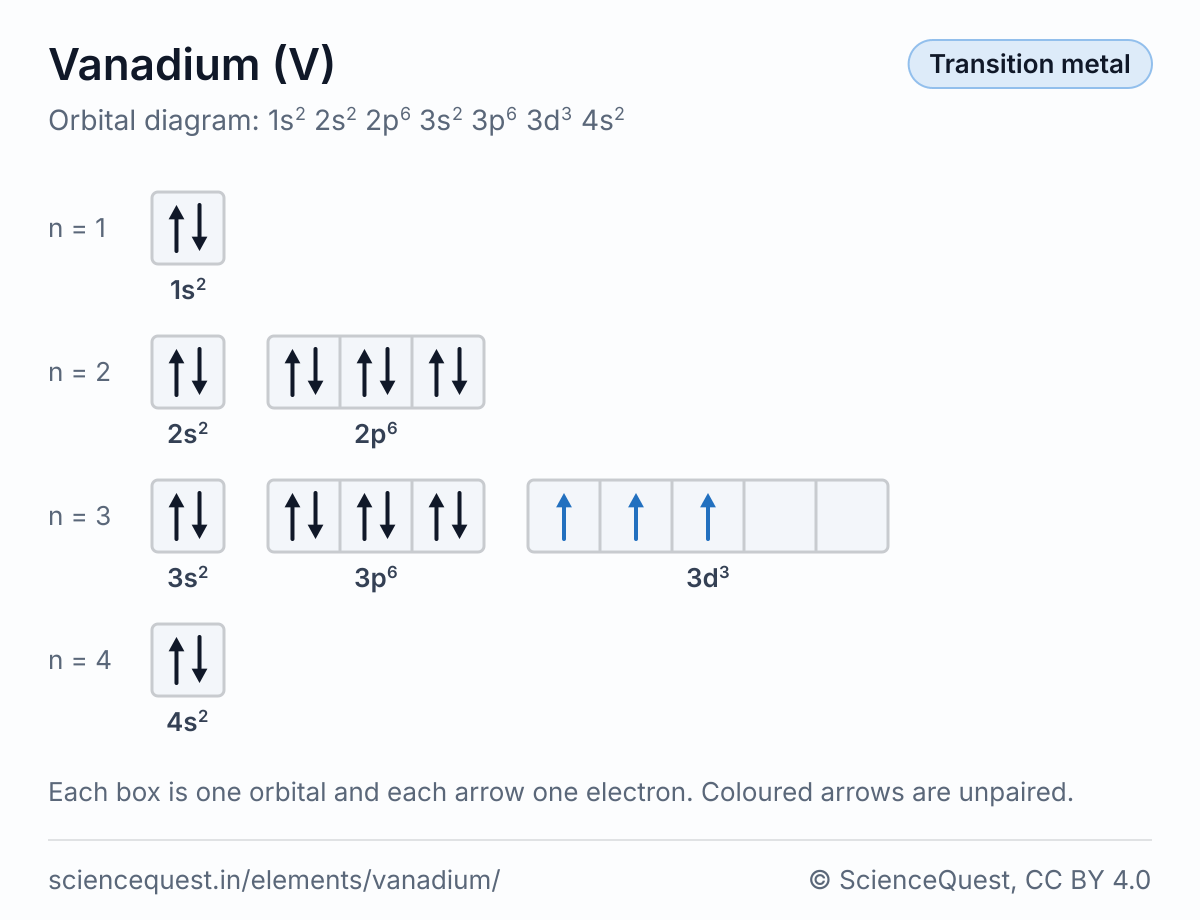
Why group and block follow from this is set out in how the periodic table maps electron configuration, and the electron configuration of every element is listed on one page. To write the configuration of an ion of vanadium, use the electron configuration calculator.
Electron configurations of vanadium ions
The table gives the vanadium atom and the ion for each common oxidation state listed above, in its ground state as a free ion in the gas phase.
| Atom or ion | Electrons | Configuration | Unpaired electrons |
|---|---|---|---|
| V (neutral atom) | 23 | [Ar] 3d3 4s2 | 3 |
| V²⁺ | 21 | [Ar] 3d3 | 3 |
| V³⁺ | 20 | [Ar] 3d2 | 2 |
| V⁴⁺ | 19 | [Ar] 3d1 | 1 |
| V⁵⁺ | 18 | [Ne] 3s2 3p6 | 0 |
Every positive ion matches its ground state in the NIST Atomic Spectra Database. Unpaired electrons are counted by Hund’s rule.
V⁵⁺ has the same electron configuration as an argon atom.
Vanadium: isotopes, discovery and uses
| Isotope | Atomic mass (Da) | Share of atoms (amount fraction) | Half-life |
|---|---|---|---|
| Vanadium-50 | 49.947 156(3) | 0.00250(10) | 271 × 10¹⁵ years |
| Vanadium-51 | 50.943 957(3) | 0.99750(10) | stable |
Atomic masses and shares of atoms: IUPAC CIAAW. Half-lives: NUBASE2020 (Kondev et al., Chin. Phys. C 45, 030001 (2021)).
Standard atomic weight 50.9415(1), the CIAAW value since 1977 (CIAAW).
- Discovered
- Andres Manuel del Rio y Fernandez, 1801, first discovery, named erythronium (CIAAW)
- Nils-Gabriel Sefström, 1830 (CIAAW)
- Name
- From the Scandinavian goddess of love and beauty, Freyja Vanadis, because of its many beautiful multi-coloured compounds (CIAAW)
- Isotopes in use
- Planetary science: The isotopic abundances of 50V and 51V have been used as an indicator of planetary core formation processes (IUPAC Periodic Table of the Elements and Isotopes via PubChem)
- Estimated crustal abundance
- 120 mg/kg (Jefferson Lab via PubChem)
Read at the sources on 26 October 2026. “via PubChem” marks text PubChem republishes from the publisher named.
Mass of one vanadium atom
A molar mass is grams per mole, so dividing by the Avogadro constant gives the average mass of vanadium’s atoms across its natural isotopes, and the reciprocal gives how many atoms sit in a gram.
Mass of one atom
- one atom = 50.942 / (6.02214076 × 10²³)
- = 8.4591 × 10⁻²³ g
Atoms in one gram
- atoms per gram = 6.02214076 × 10²³ / 50.942
- = 1.1822 × 10²² atoms
Vanadium on the periodic table
Vanadium is in period 4, group 5, in the d-block.
The other elements of group 5 are niobium, tantalum and dubnium.
In group 5, vanadium has the highest electronegativity, the lowest first ionisation energy and the smallest van der Waals radius. The comparison leaves out dubnium, of which only a few atoms have ever been made.
The rest of period 4
- 19 K Potassium
- 20 Ca Calcium
- 21 Sc Scandium
- 22 Ti Titanium
- 23 V Vanadium
- 24 Cr Chromium
- 25 Mn Manganese
- 26 Fe Iron
- 27 Co Cobalt
- 28 Ni Nickel
- 29 Cu Copper
- 30 Zn Zinc
- 31 Ga Gallium
- 32 Ge Germanium
- 33 As Arsenic
- 34 Se Selenium
- 35 Br Bromine
- 36 Kr Krypton
Work with vanadium
- The shapes of s, p and d orbitals, in the atomic orbitals visualizer
- Interactive periodic table
- Polyatomic ion table
- Molar mass calculator, prefilled with V
- Protons, neutrons and electrons in vanadium-51
- Vanadium on Wikipedia