Tantalum
- Atomic number
- 73
- Atomic mass
- 180.95
- Configuration
- [Xe] 4f14 5d3 6s2
- Category
- Transition metal
- Group
- 5
Tantalum (Ta) is a transition metal with atomic number 73 and an atomic mass of 180.95. Its electron configuration is [Xe] 4f14 5d3 6s2.
Interactive periodic tableOrbital shapesMolar mass calculator
Tantalum key data
| Symbol | Ta |
|---|---|
| Atomic number | 73 |
| Atomic mass (standard atomic weight) | 180.95 |
| Molar mass | 180.95 g/mol |
| Protons | 73 |
|---|---|
| Neutrons (most abundant isotope, tantalum-181) | 108 |
| Abundance of tantalum-181 | 99.98799% |
| Electrons (neutral atom) | 73 |
| Category | Transition metal |
|---|---|
| Period | 6 |
| Group | 5 |
| Block | d-block |
| Noble gas notation | [Xe] 4f14 5d3 6s2 |
|---|---|
| Full electron configuration | 1s2 2s2 2p6 3s2 3p6 3d10 4s2 4p6 4d10 4f14 5s2 5p6 5d3 6s2 |
| Electrons per shell | 2, 8, 18, 32, 11, 2 |
Atomic mass: IUPAC CIAAW abridged standard atomic weights, 2024. Most abundant isotope: NIST Atomic Weights and Isotopic Compositions.
The values are facts and free to use; this page’s selection and presentation are © 2026 ScienceQuest.
Updated
Measured properties of tantalum
From PubChem, the US National Institutes of Health. Public domain. The electron affinity is the measured value for tantalum, from Wikipedia’s electron affinity data page, in place of PubChem’s 0.322 eV. The first ionisation energy is the value for tantalum from the NIST Atomic Spectra Database, in place of PubChem’s 7.89 eV.
| Melting point | 3290 K (3016.9 °C), 5th of 103 by melting point |
|---|---|
| Boiling point | 5731 K (5457.9 °C), 3rd of 93 by boiling point |
| Density | 16.4 g/cm³, 10th of 96 by density |
| State at room temperature | Solid |
| Electronegativity | 1.5 (Pauling), joint 54th of 95 by electronegativity |
| Van der Waals radius | 217 pm, joint 37th of 99 by atomic radius |
| First ionisation energy | 7.5496 eV (728.43 kJ/mol), 43rd of 102 by first ionisation energy |
| Electron affinity | 0.32886 eV (31.73 kJ/mol), 49th of 57 by electron affinity |
| Common oxidation states | +5 |
| Discovered | 1802 |
Each rank counts down from the highest value, among the elements PubChem’s table gives one for, and links to that property ranked across the whole table. All of them are collected under periodic trends.
Tantalum electron configuration
The full electron configuration of tantalum is 1s2 2s2 2p6 3s2 3p6 3d10 4s2 4p6 4d10 4f14 5s2 5p6 5d3 6s2. With the noble-gas core collapsed it is [Xe] 4f14 5d3 6s2, and the outermost subshell is 6s2.
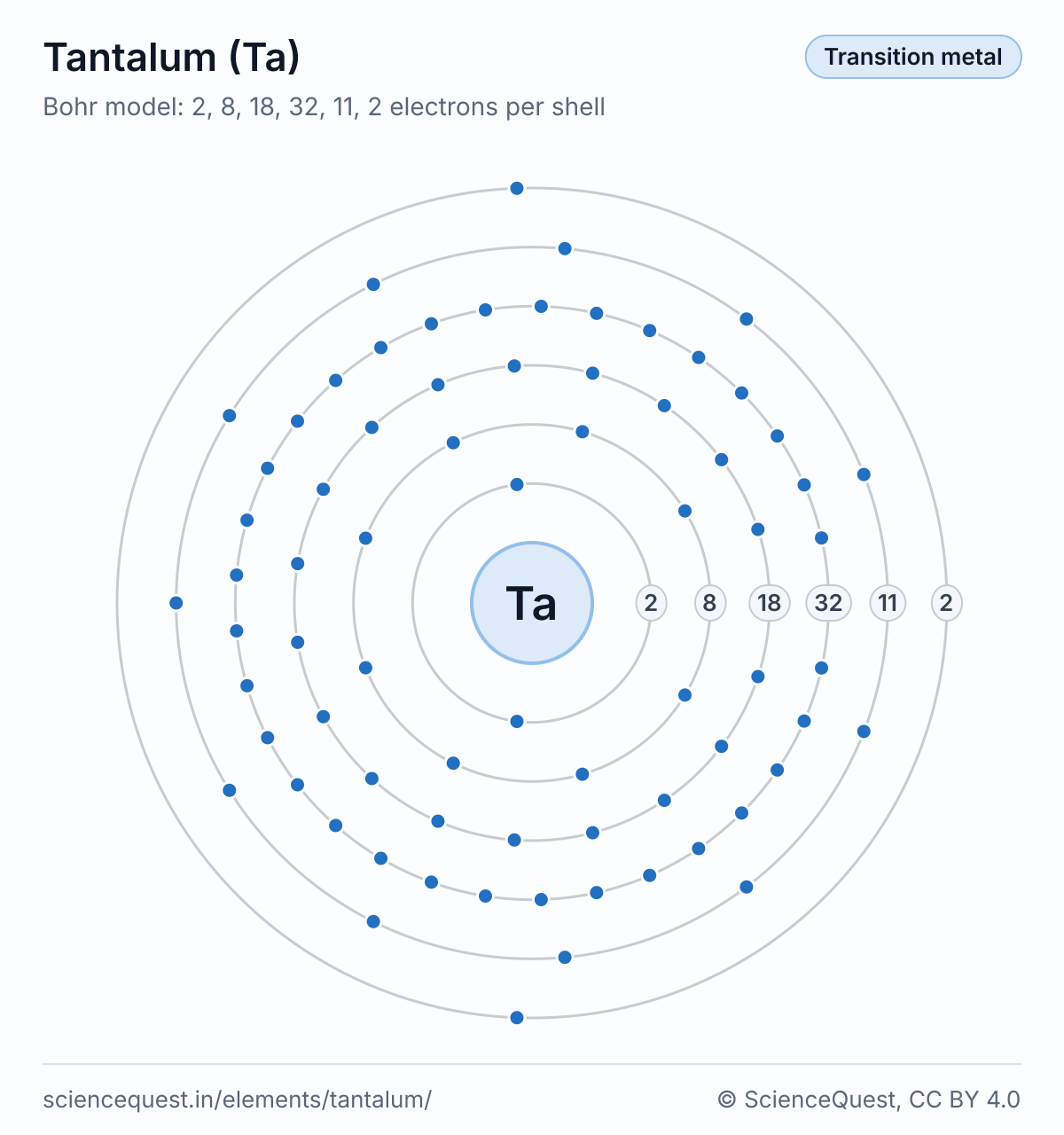
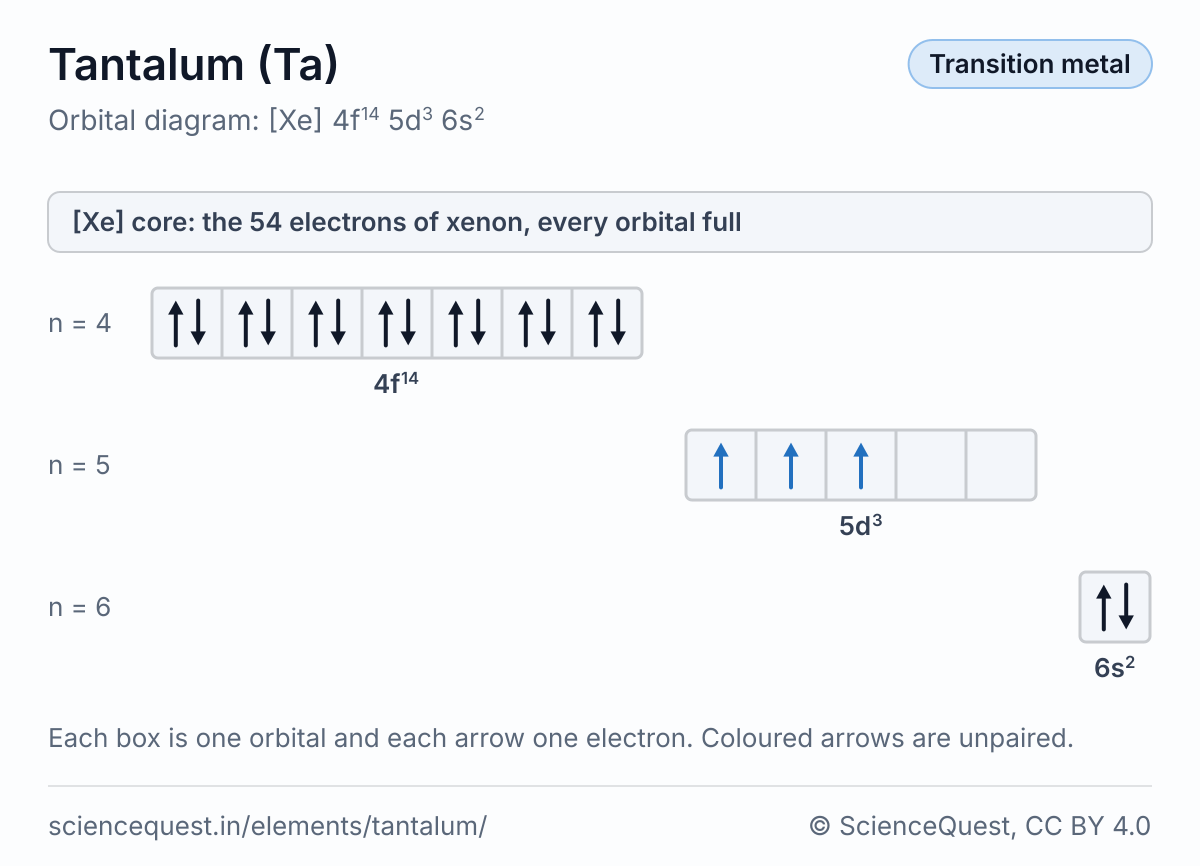
Why group and block follow from this is set out in how the periodic table maps electron configuration, and the electron configuration of every element is listed on one page. To write the configuration of an ion of tantalum, use the electron configuration calculator.
Electron configurations of tantalum ions
The table gives the tantalum atom and the ion for the common oxidation state listed above, in its ground state as a free ion in the gas phase.
| Atom or ion | Electrons | Configuration | Unpaired electrons |
|---|---|---|---|
| Ta (neutral atom) | 73 | [Xe] 4f14 5d3 6s2 | 3 |
| Ta⁵⁺ | 68 | [Xe] 4f14 | 0 |
The positive ion matches its ground state in the NIST Atomic Spectra Database. Unpaired electrons are counted by Hund’s rule.
Tantalum: isotopes, discovery and uses
| Isotope | Atomic mass (Da) | Share of atoms (amount fraction) | Half-life |
|---|---|---|---|
| Tantalum-180 | 179.947 47(2) | 0.0001176(23) | no decay observed (over 45 × 10¹⁵ years) |
| Tantalum-181 | 180.948 00(1) | 0.9998824(23) | stable |
Atomic masses and shares of atoms: IUPAC CIAAW. Half-lives: NUBASE2020 (Kondev et al., Chin. Phys. C 45, 030001 (2021)).
Natural tantalum-180 is the isomer 180mTa, not the ground state, so its half-life is the isomer’s (NUBASE2020).
Standard atomic weight 180.94788(2), the CIAAW value since 2005 (CIAAW).
- Discovered
- Anders Gustav Ekeberg, 1802 (CIAAW)
- Name
- From the Greek mythological character Tantalus who was banished to Hades, the region of lost souls where he was placed up to his chin in water, which receded whenever he tried to drink it, and under branches of fruit, which drew back whenever he tried to pick their fruit (CIAAW)
- Uses
- Tantalum: used to make components for chemical plants, nuclear power plants, aeroplanes and missiles (Jefferson Lab via PubChem)
- Isotopes in use
- Source of radioactive isotopes: 181Ta is used to produce 178W, which decays to 178Ta via the reaction 181Ta (p, 4 n) 178W, which is followed by a subsequent electron capture decay reaction of 178W to finally yield 178Ta (IUPAC Periodic Table of the Elements and Isotopes via PubChem)
- Estimated crustal abundance
- 2 mg/kg (Jefferson Lab via PubChem)
Read at the sources on 26 October 2026. “via PubChem” marks text PubChem republishes from the publisher named.
Mass of one tantalum atom
A molar mass is grams per mole, so dividing by the Avogadro constant gives the average mass of tantalum’s atoms across its natural isotopes, and the reciprocal gives how many atoms sit in a gram.
Mass of one atom
- one atom = 180.95 / (6.02214076 × 10²³)
- = 3.0047 × 10⁻²² g
Atoms in one gram
- atoms per gram = 6.02214076 × 10²³ / 180.95
- = 3.3281 × 10²¹ atoms
Tantalum on the periodic table
Tantalum is in period 6, group 5, in the d-block.
The other elements of group 5 are vanadium, niobium and dubnium.
In group 5, tantalum has the lowest electronegativity and electron affinity, the highest first ionisation energy, and the largest van der Waals radius. The comparison leaves out dubnium, of which only a few atoms have ever been made.
The rest of period 6
- 55 Cs Caesium
- 56 Ba Barium
- 57 La Lanthanum
- 58 Ce Cerium
- 59 Pr Praseodymium
- 60 Nd Neodymium
- 61 Pm Promethium
- 62 Sm Samarium
- 63 Eu Europium
- 64 Gd Gadolinium
- 65 Tb Terbium
- 66 Dy Dysprosium
- 67 Ho Holmium
- 68 Er Erbium
- 69 Tm Thulium
- 70 Yb Ytterbium
- 71 Lu Lutetium
- 72 Hf Hafnium
- 73 Ta Tantalum
- 74 W Tungsten
- 75 Re Rhenium
- 76 Os Osmium
- 77 Ir Iridium
- 78 Pt Platinum
- 79 Au Gold
- 80 Hg Mercury
- 81 Tl Thallium
- 82 Pb Lead
- 83 Bi Bismuth
- 84 Po Polonium
- 85 At Astatine
- 86 Rn Radon
Work with tantalum
- The shapes of s, p, d and f orbitals, in the atomic orbitals visualizer
- Interactive periodic table
- Polyatomic ion table
- Molar mass calculator, prefilled with Ta
- Protons, neutrons and electrons in tantalum-181
- Tantalum on Wikipedia