Iridium
- Atomic number
- 77
- Atomic mass
- 192.22
- Configuration
- [Xe] 4f14 5d7 6s2
- Category
- Transition metal
- Group
- 9
Iridium (Ir) is a transition metal with atomic number 77 and an atomic mass of 192.22. Its electron configuration is [Xe] 4f14 5d7 6s2.
Interactive periodic tableOrbital shapesMolar mass calculator
Iridium key data
| Symbol | Ir |
|---|---|
| Atomic number | 77 |
| Atomic mass (standard atomic weight) | 192.22 |
| Molar mass | 192.22 g/mol |
| Protons | 77 |
|---|---|
| Neutrons (most abundant isotope, iridium-193) | 116 |
| Abundance of iridium-193 | 62.7% |
| Electrons (neutral atom) | 77 |
| Category | Transition metal |
|---|---|
| Period | 6 |
| Group | 9 |
| Block | d-block |
| Noble gas notation | [Xe] 4f14 5d7 6s2 |
|---|---|
| Full electron configuration | 1s2 2s2 2p6 3s2 3p6 3d10 4s2 4p6 4d10 4f14 5s2 5p6 5d7 6s2 |
| Electrons per shell | 2, 8, 18, 32, 15, 2 |
Atomic mass: IUPAC CIAAW abridged standard atomic weights, 2024. Most abundant isotope: NIST Atomic Weights and Isotopic Compositions.
The values are facts and free to use; this page’s selection and presentation are © 2026 ScienceQuest.
Updated
Measured properties of iridium
From PubChem, the US National Institutes of Health. Public domain. The electron affinity is the measured value for iridium, from Wikipedia’s electron affinity data page, in place of PubChem’s 1.565 eV. The first ionisation energy is the value for iridium from the NIST Atomic Spectra Database, in place of PubChem’s 9.1 eV.
| Melting point | 2719 K (2445.9 °C), 8th of 103 by melting point |
|---|---|
| Boiling point | 4701 K (4427.9 °C), 9th of 93 by boiling point |
| Density | 22.42 g/cm³, 2nd of 96 by density |
| State at room temperature | Solid |
| Electronegativity | 2.2 (Pauling), joint 17th of 95 by electronegativity |
| Van der Waals radius | 202 pm, joint 57th of 99 by atomic radius |
| First ionisation energy | 8.967 eV (865.2 kJ/mol), 26th of 102 by first ionisation energy |
| Electron affinity | 1.5641 eV (150.91 kJ/mol), 12th of 57 by electron affinity |
| Common oxidation states | +4, +3 |
| Discovered | 1803 |
Each rank counts down from the highest value, among the elements PubChem’s table gives one for, and links to that property ranked across the whole table. All of them are collected under periodic trends.
Iridium electron configuration
The full electron configuration of iridium is 1s2 2s2 2p6 3s2 3p6 3d10 4s2 4p6 4d10 4f14 5s2 5p6 5d7 6s2. With the noble-gas core collapsed it is [Xe] 4f14 5d7 6s2, and the outermost subshell is 6s2.
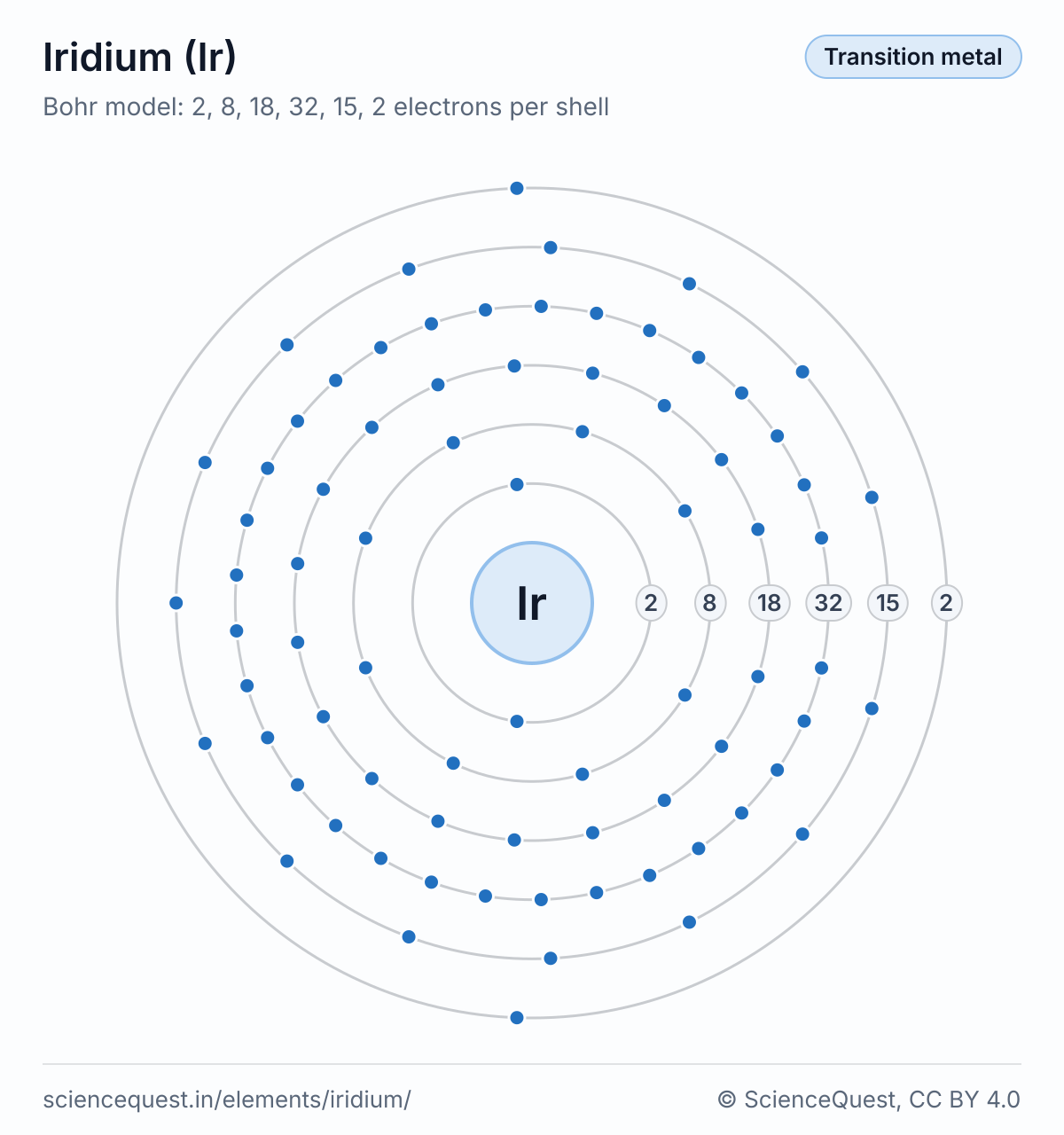
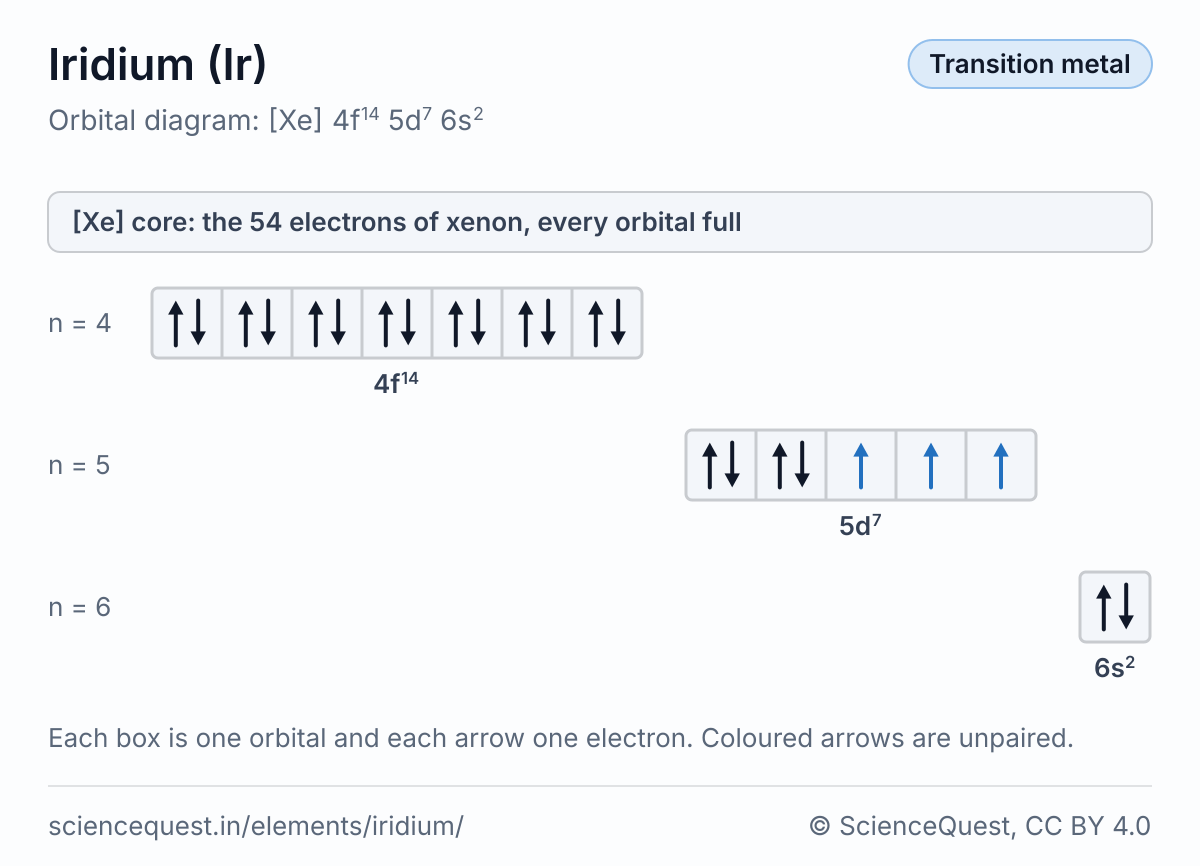
Why group and block follow from this is set out in how the periodic table maps electron configuration, and the electron configuration of every element is listed on one page. To write the configuration of an ion of iridium, use the electron configuration calculator.
Electron configurations of iridium ions
The table gives the iridium atom and the ion for each common oxidation state listed above, in its ground state as a free ion in the gas phase.
| Atom or ion | Electrons | Configuration | Unpaired electrons |
|---|---|---|---|
| Ir (neutral atom) | 77 | [Xe] 4f14 5d7 6s2 | 3 |
| Ir³⁺ | 74 | [Xe] 4f14 5d6 | 4 |
| Ir⁴⁺ | 73 | [Xe] 4f14 5d5 | 5 |
Every positive ion matches its ground state in the NIST Atomic Spectra Database. Unpaired electrons are counted by Hund’s rule.
Iridium: isotopes, discovery and uses
| Isotope | Atomic mass (Da) | Share of atoms (amount fraction) | Half-life |
|---|---|---|---|
| Iridium-191 | 190.960 591(9) | 0.3723(9) | stable |
| Iridium-193 | 192.962 924(9) | 0.6277(9) | stable |
Atomic masses and shares of atoms: IUPAC CIAAW. Half-lives: NUBASE2020 (Kondev et al., Chin. Phys. C 45, 030001 (2021)).
Standard atomic weight 192.217(2), the CIAAW value since 2017 (CIAAW).
- Discovered
- Smithson Tennant, 1803, in crude platinum ore (CIAAW)
- Name
- From the Latin Iris, the Greek goddess of rainbows, because of the variety of colours in the element’s salt solutions (CIAAW)
- Uses
- Platinum-iridium alloys: used to make crucibles and other high temperature equipment (Jefferson Lab via PubChem)
- Isotopes in use
- Industry: Metallic 192Ir (with a half-life of 74 days) is used as a radiation source in gamma cameras for non-destructive testing of products for manufacturing flaws, such as aircraft parts, boilers, and pipeline welds (IUPAC Periodic Table of the Elements and Isotopes via PubChem)
- Estimated crustal abundance
- 0.001 mg/kg (Jefferson Lab via PubChem)
Read at the sources on 26 October 2026. “via PubChem” marks text PubChem republishes from the publisher named.
Mass of one iridium atom
A molar mass is grams per mole, so dividing by the Avogadro constant gives the average mass of iridium’s atoms across its natural isotopes, and the reciprocal gives how many atoms sit in a gram.
Mass of one atom
- one atom = 192.22 / (6.02214076 × 10²³)
- = 3.1919 × 10⁻²² g
Atoms in one gram
- atoms per gram = 6.02214076 × 10²³ / 192.22
- = 3.1329 × 10²¹ atoms
Iridium on the periodic table
Iridium is in period 6, group 9, in the d-block.
The other elements of group 9 are cobalt, rhodium and meitnerium.
In group 9, iridium has the highest first ionisation energy and electron affinity, and the largest van der Waals radius. The comparison leaves out meitnerium, of which only a few atoms have ever been made.
The rest of period 6
- 55 Cs Caesium
- 56 Ba Barium
- 57 La Lanthanum
- 58 Ce Cerium
- 59 Pr Praseodymium
- 60 Nd Neodymium
- 61 Pm Promethium
- 62 Sm Samarium
- 63 Eu Europium
- 64 Gd Gadolinium
- 65 Tb Terbium
- 66 Dy Dysprosium
- 67 Ho Holmium
- 68 Er Erbium
- 69 Tm Thulium
- 70 Yb Ytterbium
- 71 Lu Lutetium
- 72 Hf Hafnium
- 73 Ta Tantalum
- 74 W Tungsten
- 75 Re Rhenium
- 76 Os Osmium
- 77 Ir Iridium
- 78 Pt Platinum
- 79 Au Gold
- 80 Hg Mercury
- 81 Tl Thallium
- 82 Pb Lead
- 83 Bi Bismuth
- 84 Po Polonium
- 85 At Astatine
- 86 Rn Radon
Work with iridium
- The shapes of s, p, d and f orbitals, in the atomic orbitals visualizer
- Interactive periodic table
- Polyatomic ion table
- Molar mass calculator, prefilled with Ir
- Protons, neutrons and electrons in iridium-193
- Iridium on Wikipedia