Depressor anguli oris
The depressor anguli oris is a triangular facial muscle below the corner of the mouth. It runs from the mandible to the angle of the mouth and pulls it down. (StatPearls, Congenital Unilateral Lower Lip Palsy and Facial Muscles)
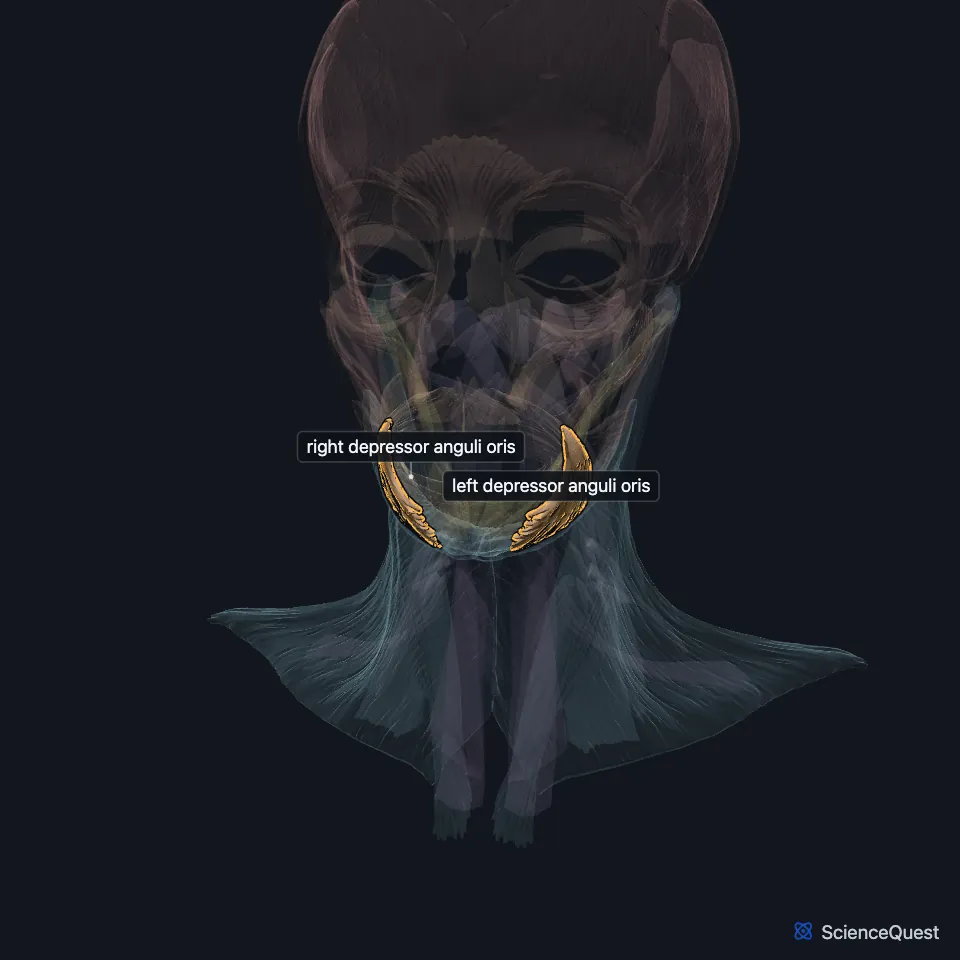
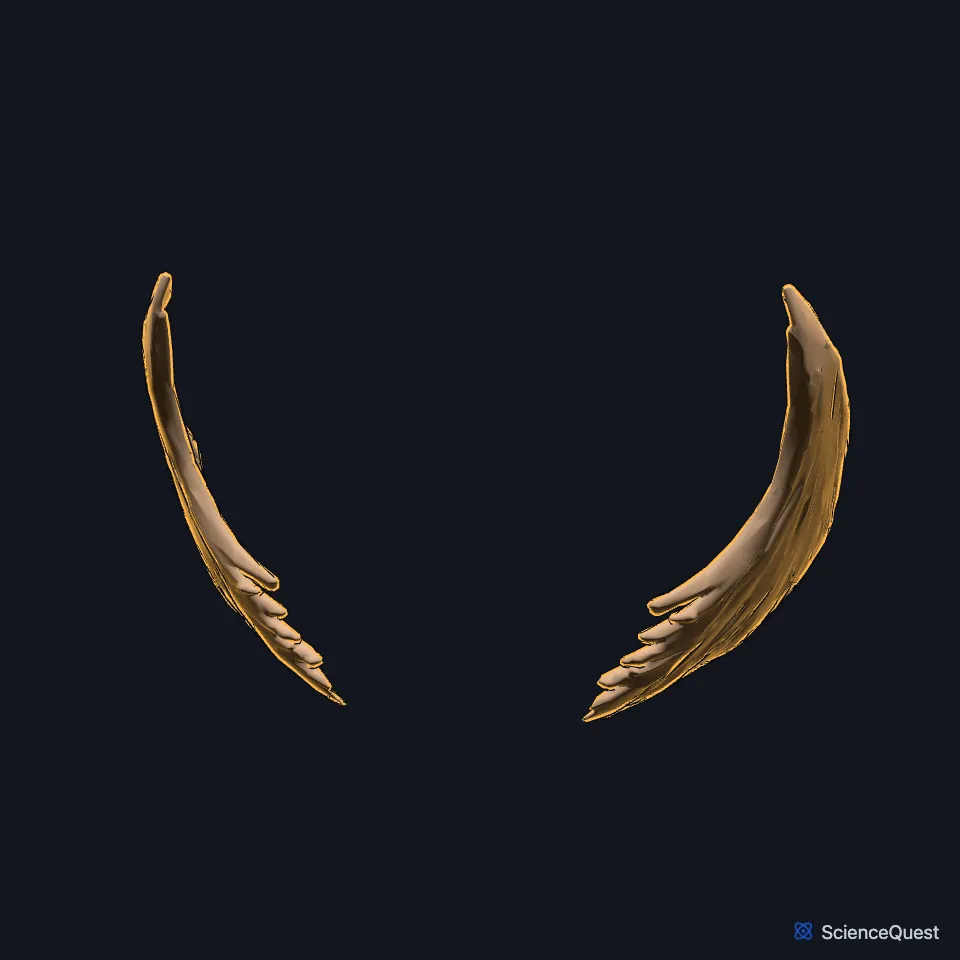
Open it in the Head and Neck Muscles Explorer See it alone in 3D
Where is the depressor anguli oris?
It sits in the most superficial layer of muscle around the mouth. In one set of 20 people it lay 2.5 to 4 mm under the skin. (Yi et al. 2023, Anat Cell Biol 56(2): 161 to 165)
Gray has it arise from the oblique line of the mandible, its fibers narrowing to a slim bundle at the angle of the mouth. At its origin it is continuous with the platysma. (Gray 1918, 4d. Muscles of the Mouth; StatPearls, Facial Muscles)
Its inner border overlaps the depressor labii inferioris, and its outer border lies next to the risorius, zygomaticus major and platysma. (Yi et al. 2023, Anat Cell Biol 56(2): 161 to 165)
What does the depressor anguli oris do?
It pulls the corner of the mouth down and out, which helps express sadness when you cry. (StatPearls, Congenital Unilateral Lower Lip Palsy)
Overactive muscles on both sides turn the corners of the mouth down, a look that StatPearls calls angry and Yi’s group calls gloomy. One side alone makes the mouth uneven. (StatPearls, Facial Muscles; Yi et al. 2023, Anat Cell Biol 56(2): 161 to 165)
Gray calls it the antagonist of the levator anguli oris and zygomaticus major. (Gray 1918, 4d. Muscles of the Mouth)
What nerves and vessels lie at the depressor anguli oris?
The marginal mandibular branch of the facial nerve supplies it, along with the depressor labii inferioris and mentalis. (StatPearls, Facial Muscles)
The facial artery runs along its outer edge and the inferior labial artery runs beneath it. In Hur et al.’s dissections the mental foramen lay within the area the muscle covers in 21 cases (67.7%). (Yi et al. 2023, Anat Cell Biol 56(2): 161 to 165; Hur et al. 2008, Surg Radiol Anat 30(5): 403 to 407)
What happens when a baby lacks the depressor anguli oris?
When the muscle is missing or underdeveloped on one side at birth, that side of the mouth stays still as the baby cries or smiles, and the lower lip on the normal side drops more than usual. The face looks even at rest. (StatPearls, Congenital Unilateral Lower Lip Palsy)
StatPearls calls this congenital unilateral lower lip palsy and puts it at 0.5 to 1% of newborns, about 1 in 160 live births. Its authors trace about 80% of cases to faulty development of the facial nerve or muscle and about 20% to pressure on the facial nerve. (StatPearls, Congenital Unilateral Lower Lip Palsy)
Where the sources differ
StatPearls’ facial muscles article names the marginal mandibular branch of the facial nerve as its supply. Its article on lower lip palsy says two branches supply it, the buccal and the mandibular. Hur’s group traced the buccal branch into the middle third of its outer border, and the marginal mandibular branch into the lower third in 17 cases (60.7%). (StatPearls, Facial Muscles and Congenital Unilateral Lower Lip Palsy; Hur et al. 2008, Surg Radiol Anat 30(5): 403 to 407)
Gray gives its origin as the oblique line of the mandible. Yi et al. give the mental tubercle. (Gray 1918, 4d. Muscles of the Mouth; Yi et al. 2023, Anat Cell Biol 56(2): 161 to 165)
| Feature | Detail and source |
|---|---|
| Origin | Mandible: the oblique line (Gray 1918), the mental tubercle (Yi et al.) (Gray 1918, 4d. Muscles of the Mouth; Yi et al. 2023, Anat Cell Biol 56(2): 161 to 165) |
| Insertion | Modiolus, at the angle of the mouth (Yi et al. 2023, Anat Cell Biol 56(2): 161 to 165) |
| Action | Pulls the corner of the mouth down and out (StatPearls, Congenital Unilateral Lower Lip Palsy) |
| Nerve | Facial nerve (CN VII), marginal mandibular branch (StatPearls, Facial Muscles) |
Touches in this model
Measured on the BodyParts3D meshes: surfaces within 2 mm of the depressor anguli oris, nearest first, 12 of 19.
- Left buccinator in contact
- Left depressor labii inferioris in contact
- Left platysma in contact
- Left risorius in contact
- Left zygomaticus major in contact
- Orbicularis oris in contact
- Right buccinator in contact
- Right depressor labii inferioris in contact
- Right platysma in contact
- Right risorius in contact
- Right zygomaticus major in contact
- Gingiva of lower jaw in contact
Sources
Sources read between and
- StatPearls, Congenital Unilateral Lower Lip Palsy. Ezgi Saylam; Kapil Arya. Last update . CC BY-NC-ND 4.0. Read .
- StatPearls, Anatomy, Head and Neck: Facial Muscles. Adegbenro O. Fakoya; Marc H. Hohman; Katherine E. Westbrook; Matthew A. Varacallo. Last update . CC BY-NC-ND 4.0. Read .
- Anatomy & Cell Biology (peer-reviewed review), Novel anatomical proposal for botulinum neurotoxin injection targeting depressor anguli oris for treating drooping mouth corner (PMC10319486). Kyu-Ho Yi; Ji-Hyun Lee; Hye-Won Hu; You-Jin Choi; Kangwoo Lee; Hyung-Jin Lee; Hee-Jin Kim. CC BY-NC 4.0. Read .
- Gray’s Anatomy of the Human Body, 20th US edition (1918), IV. Myology, 4d. The Muscles of the Mouth (1918 terms, as Gray pairs them: Caninus for levator anguli oris, Zygomaticus for zygomaticus major, Triangularis for depressor anguli oris, Quadratus labii inferioris for depressor labii inferioris; Mentalis keeps today’s name, with Levator menti as a second name. Gray’s Quadratus labii superioris is one sheet with angular, infraorbital and zygomatic heads, and his list of mouth muscles has no separate levator labii superioris, levator labii superioris alaeque nasi or zygomaticus minor). Henry Gray. Public domain. Read .
- Surgical and Radiologic Anatomy (peer-reviewed cadaver study), Topography and location of the depressor anguli oris muscle with a reference to the mental foramen (abstract, read through NCBI E-utilities, PMID 18385924). Hur MS, Hu KS, Cho JY, Kwak HH, Song WC, Koh KS, Lorente M, Kim HJ. Abstract read on PubMed; no reuse licence stated. Read .
The values are facts and free to use; this page’s selection and presentation are © 2026 ScienceQuest.