Zygomaticus major
The zygomaticus major is a facial muscle that runs from the zygomatic bone down to the corner of the mouth. It pulls the corner of the mouth up and out when you smile. (Gray 1918, 4d. Muscles of the Mouth; StatPearls, Facial Muscles)
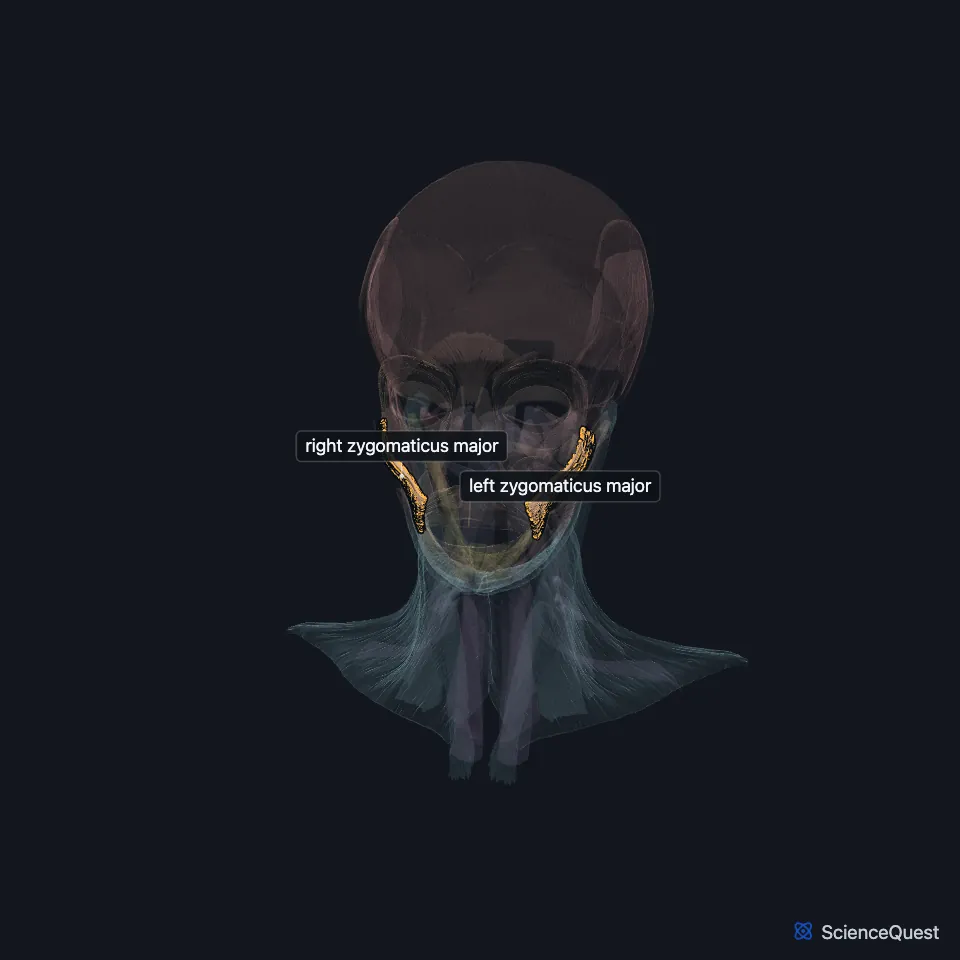
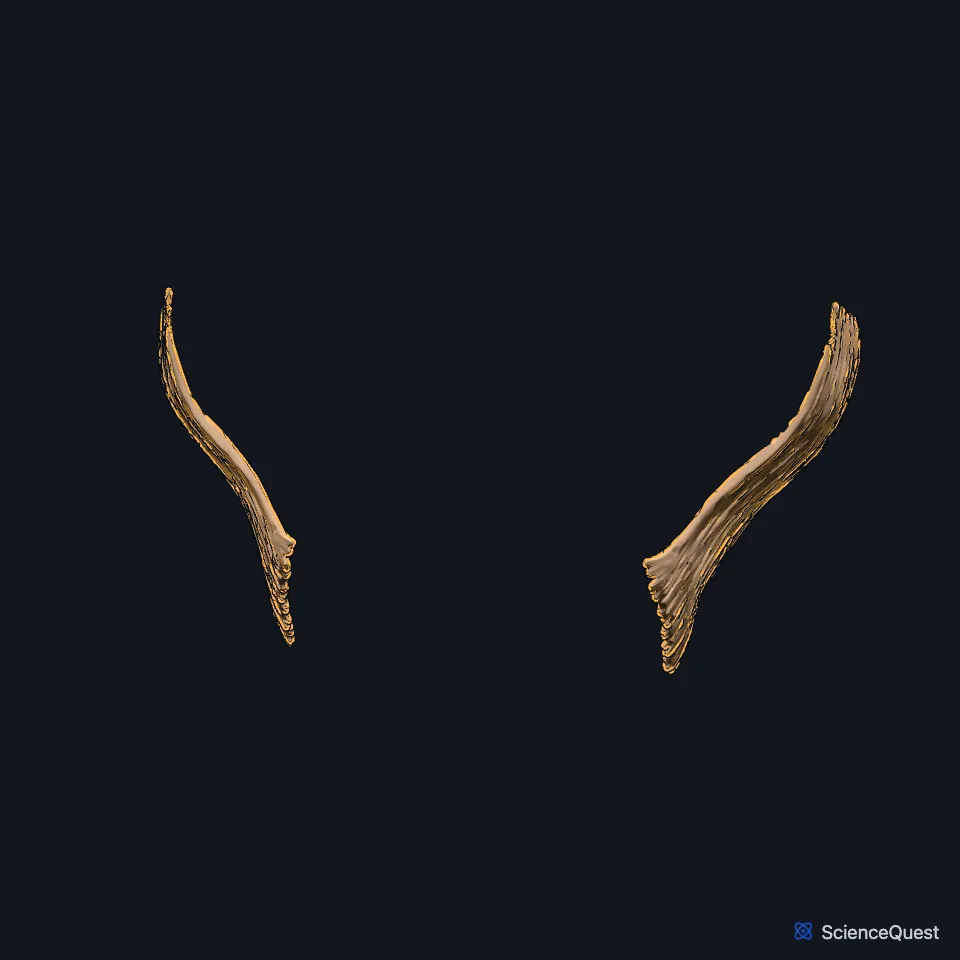
Open it in the Head and Neck Muscles Explorer See it alone in 3D
Where is the zygomaticus major?
It arises from the zygomatic bone in front of the zygomaticotemporal suture and runs down and toward the midline to the angle of the mouth. There it blends with the levator anguli oris, the orbicularis oris and the depressor anguli oris. (Gray 1918, 4d. Muscles of the Mouth)
Of the two zygomatic muscles it is the outer one; the zygomaticus minor lies medial to it. (StatPearls, Facial Muscles)
At the corner of the mouth it ends in the modiolus, a knot of fibers where the orbicularis oris, levator and depressor anguli oris, risorius, platysma and buccinator also meet. (StatPearls, Lips)
What group does the zygomaticus major belong to?
FMA places it with the zygomaticus minor under one parent class, zygomaticus. Gray 1918 calls it simply the zygomaticus. (FMA, Zygomaticus major and Zygomaticus minor; Gray 1918, 4d. Muscles of the Mouth)
What does the zygomaticus major do?
Gray describes it drawing the angle of the mouth back and up, as in laughing. With the levator anguli oris it lifts the corner of the mouth, and the mix between the two shapes each person’s smile. (Gray 1918, 4d. Muscles of the Mouth; StatPearls, Levator Anguli Oris Muscle)
A smile that uses the zygomaticus major alone is a non-Duchenne smile. A Duchenne smile adds the orbicularis oculi, which raises the cheeks. (Iwanaga et al. 2022, PLOS ONE 17(7): e0272060)
What lies next to the zygomaticus major, and what supplies it?
In 44 half-faces, surface fibers of the orbicularis oculi ran straight into the zygomaticus major in 6.8% and reached it by way of the zygomaticus minor in 15.9%. The other 77.3% had no link. (Iwanaga et al. 2022, PLOS ONE 17(7): e0272060)
It forms the long side of a triangular space whose other sides are the masseter, behind, and the risorius, below. (StatPearls, Risorius Muscle)
The facial nerve supplies it, as it does the levator anguli oris and the other muscles of this group. (Gray 1918, 4d. Muscles of the Mouth)
Surgeons follow it to find the modiolus when they restore a smile after facial paralysis, and it is the muscle replaced most often in facial reanimation surgery. (StatPearls, Facial Muscles)
Can the zygomaticus major be missing or doubled?
Gray records that it is rarely absent and that it may be doubled. (Gray 1918, 4d. Muscles of the Mouth)
Where the sources differ
Iwanaga’s group, citing earlier papers, calls the Duchenne smile a true sign of enjoyment. Girard et al. analyzed 751 smiles from 136 people and found that eye constriction carried some information about felt positive emotion, but little of it specific and much of it dependent on context. (Iwanaga et al. 2022, PLOS ONE 17(7): e0272060; Girard et al. 2021, Affect Sci 2(1): 32 to 47)
| Feature | Detail and source |
|---|---|
| Origin | Zygomatic bone, in front of the zygomaticotemporal suture (Gray 1918, 4d. Muscles of the Mouth) |
| Insertion | Modiolus, at the angle of the mouth (Gray 1918, 4d. Muscles of the Mouth; StatPearls, Facial Muscles) |
| Action | Draws the corner of the mouth up and out (StatPearls, Facial Muscles) |
| Nerve | Facial nerve (CN VII) (Gray 1918, 4d. Muscles of the Mouth) |
Touches in this model
Measured on the BodyParts3D meshes: surfaces within 2 mm of the zygomaticus major, nearest first, 12 of 23.
- Deep part of left masseter in contact
- Deep part of right masseter in contact
- Left buccinator in contact
- Left depressor anguli oris in contact
- Left depressor labii inferioris in contact
- Left risorius in contact
- Orbicularis oris in contact
- Right buccinator in contact
- Right depressor anguli oris in contact
- Right depressor labii inferioris in contact
- Right risorius in contact
- Left zygomatic bone in contact
Sources
Sources read between and
- Gray’s Anatomy of the Human Body, 20th US edition (1918), IV. Myology, 4d. The Muscles of the Mouth (1918 terms, as Gray pairs them: Caninus for levator anguli oris, Zygomaticus for zygomaticus major, Triangularis for depressor anguli oris, Quadratus labii inferioris for depressor labii inferioris; Mentalis keeps today’s name, with Levator menti as a second name. Gray’s Quadratus labii superioris is one sheet with angular, infraorbital and zygomatic heads, and his list of mouth muscles has no separate levator labii superioris, levator labii superioris alaeque nasi or zygomaticus minor). Henry Gray. Public domain. Read .
- StatPearls, Anatomy, Head and Neck: Facial Muscles. Adegbenro O. Fakoya; Marc H. Hohman; Katherine E. Westbrook; Matthew A. Varacallo. Last update . CC BY-NC-ND 4.0. Read .
- StatPearls, Anatomy, Head and Neck, Lips. Meghan A. Piccinin; Patrick M. Zito. Last update . CC BY-NC-ND 4.0. Read .
- Foundational Model of Anatomy, FMA46810, Zygomaticus major (read on EBI OLS). FMA release terms, University of Washington. Read .
- Foundational Model of Anatomy, FMA46811, Zygomaticus minor (read on EBI OLS). FMA release terms, University of Washington. Read .
- StatPearls, Anatomy, Head and Neck: Levator Anguli Oris Muscle. Diem-Phuong D. Dao; Adegbenro O. Fakoya; Patrick H. Le. Last update . CC BY-NC-ND 4.0. Read .
- PLOS ONE (peer-reviewed cadaver study), Anatomical contribution of the orbicularis oculi to the zygomaticus major: An improved understanding of the smile with consideration for facial cosmetic procedures (PMC9333313). Joe Iwanaga; Mi-Sun Hur; Shogo Kikuta; Soichiro Ibaragi; Koichi Watanabe; R. Shane Tubbs. CC BY 4.0. Read .
- StatPearls, Anatomy, Head and Neck, Risorius Muscle. Alex M. Germann; Yasir Al Khalili. Last update . CC BY-NC-ND 4.0. Read .
- Affective Science (peer-reviewed study), Reconsidering the Duchenne Smile: Formalizing and Testing Hypotheses About Eye Constriction and Positive Emotion (abstract, PMC8317937, PMID 34337430). Girard JM, Cohn JF, Yin L, Morency LP. Abstract read on PMC; © The Society for Affective Science 2021, no reuse licence stated. Read . Rechecked .
The values are facts and free to use; this page’s selection and presentation are © 2026 ScienceQuest.