Risorius
The risorius is a narrow strip of facial muscle that runs across the cheek to the corner of the mouth and pulls it sideways. Not everyone has one. (StatPearls, Risorius Muscle)
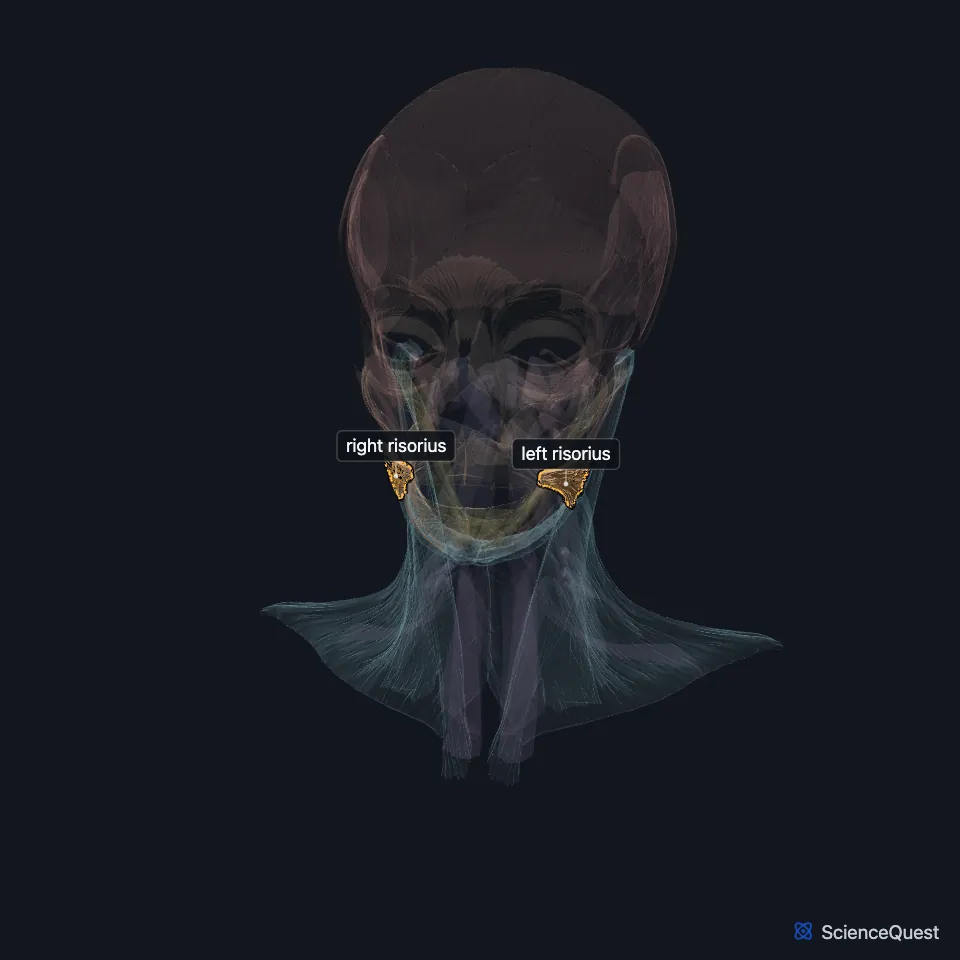
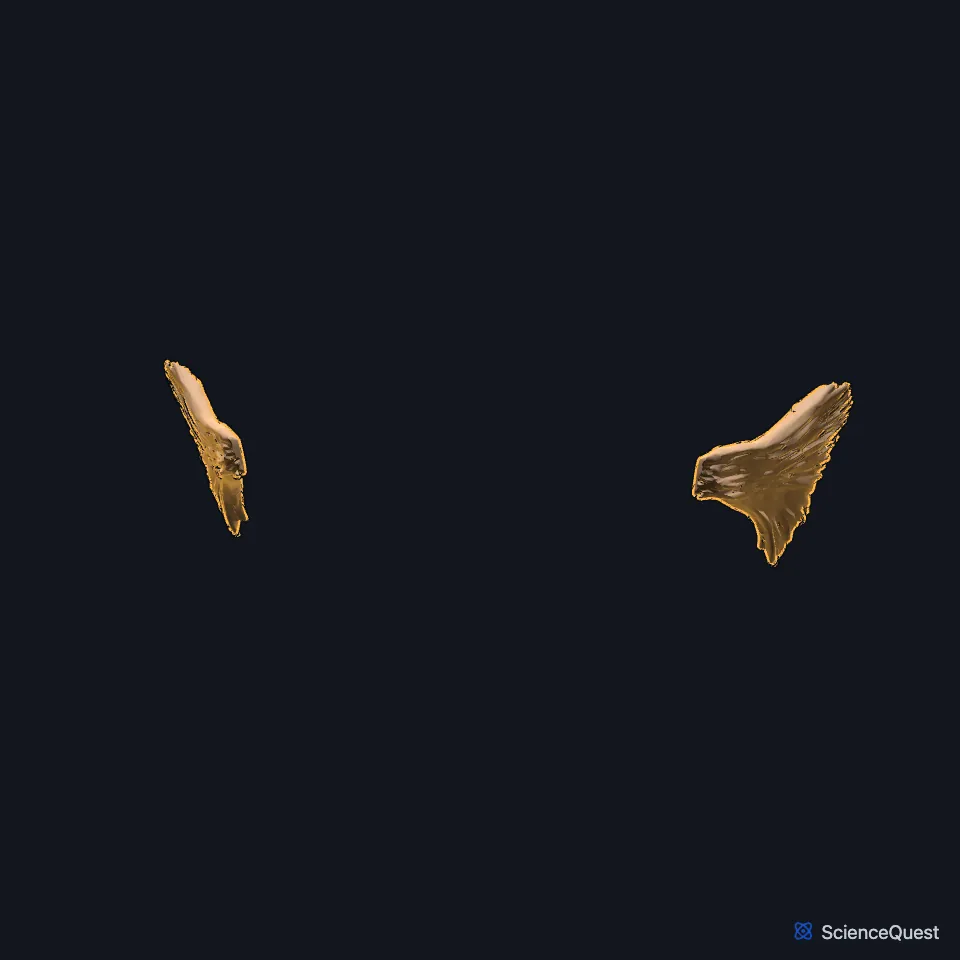
Open it in the Head and Neck Muscles Explorer See it alone in 3D
Where is the risorius?
It arises from the fascia of the side of the cheek over the parotid gland and the masseter, and it runs forward to the skin at the angle of the mouth, narrowing as it goes. (StatPearls, Risorius Muscle; Gray 1918, 4d. Muscles of the Mouth)
At its front end it lies on the orbicularis oris and the depressor anguli oris. Behind, it lies over the superficial part of the masseter. (StatPearls, Risorius Muscle)
It sits in the deep part of the superficial musculoaponeurotic system, the fibrous layer that holds the facial muscles. (StatPearls, Risorius Muscle)
What does the risorius do?
It pulls the corner of the mouth sideways and, in StatPearls’ risorius article, upward. With the other facial muscles it helps make a smile or a frown. (StatPearls, Risorius Muscle)
Gray says it draws the corner of the mouth back and makes an unpleasant grin. (Gray 1918, 4d. Muscles of the Mouth)
What lies around the risorius, and what supplies it?
Above it, a triangular space lies between it, the masseter and the zygomaticus major. Below it, a rectangular space bounded by the masseter, platysma and depressor anguli oris holds a buccal branch of the facial nerve and the facial artery and vein. (StatPearls, Risorius Muscle)
Which branch of the facial nerve supplies it is debated. Most authors name a buccal branch or the marginal mandibular branch, and it may receive both. (StatPearls, Risorius Muscle)
The facial artery and the transverse facial artery supply it. (StatPearls, Risorius Muscle)
How variable is the risorius?
People differ in whether they have a risorius at all and in whether the two sides match. Gray records that it varies a great deal in size and form and is often absent. (StatPearls, Risorius Muscle; Gray 1918, 4d. Muscles of the Mouth)
Gray adds that it may be doubled, greatly enlarged, or blended with the platysma. (Gray 1918, 4d. Muscles of the Mouth)
StatPearls reports the view that only humans and the African great apes have it, from a common ancestor. (StatPearls, Risorius Muscle)
Where the sources differ
StatPearls’ risorius article has it pull the corner of the mouth outward and upward. Its facial muscles article has it pull the corner straight outward. (StatPearls, Risorius Muscle and Facial Muscles)
StatPearls’ risorius article says the risorius, like other facial muscles, has a larger share of slow fibers than other skeletal muscles. Its facial muscles article says facial muscles have more fast-twitch fibers. (StatPearls, Risorius Muscle and Facial Muscles)
| Feature | Detail and source |
|---|---|
| Origin | Fascia of the side of the cheek, over the parotid gland and masseter (StatPearls, Risorius Muscle) |
| Insertion | Skin at the angle of the mouth (StatPearls, Risorius Muscle; Gray 1918, 4d. Muscles of the Mouth) |
| Action | Pulls the corner of the mouth sideways (StatPearls, Risorius Muscle) |
| Nerve | Facial nerve (CN VII), buccal or marginal mandibular branch, or both (StatPearls, Risorius Muscle) |
Touches in this model
Measured on the BodyParts3D meshes: surfaces within 2 mm of the risorius, nearest first, 12 of 18.
- Deep part of left masseter in contact
- Deep part of right masseter in contact
- Left buccinator in contact
- Left depressor anguli oris in contact
- Left platysma in contact
- Left zygomaticus major in contact
- Orbicularis oris in contact
- Right buccinator in contact
- Right depressor anguli oris in contact
- Right platysma in contact
- Right zygomaticus major in contact
- Skin in contact
Sources
Sources read
- StatPearls, Anatomy, Head and Neck, Risorius Muscle. Alex M. Germann; Yasir Al Khalili. Last update . CC BY-NC-ND 4.0. Read .
- Gray’s Anatomy of the Human Body, 20th US edition (1918), IV. Myology, 4d. The Muscles of the Mouth (1918 terms, as Gray pairs them: Caninus for levator anguli oris, Zygomaticus for zygomaticus major, Triangularis for depressor anguli oris, Quadratus labii inferioris for depressor labii inferioris; Mentalis keeps today’s name, with Levator menti as a second name. Gray’s Quadratus labii superioris is one sheet with angular, infraorbital and zygomatic heads, and his list of mouth muscles has no separate levator labii superioris, levator labii superioris alaeque nasi or zygomaticus minor). Henry Gray. Public domain. Read .
- StatPearls, Anatomy, Head and Neck: Facial Muscles. Adegbenro O. Fakoya; Marc H. Hohman; Katherine E. Westbrook; Matthew A. Varacallo. Last update . CC BY-NC-ND 4.0. Read .
The values are facts and free to use; this page’s selection and presentation are © 2026 ScienceQuest.