Inferior colliculus
The inferior colliculi are a pair of bumps on the back of the midbrain that relay sound on its way from the inner ear to the auditory cortex. They help locate sounds, trigger the startle response and turn the body toward a sound that matters. (StatPearls, Inferior Colliculus)
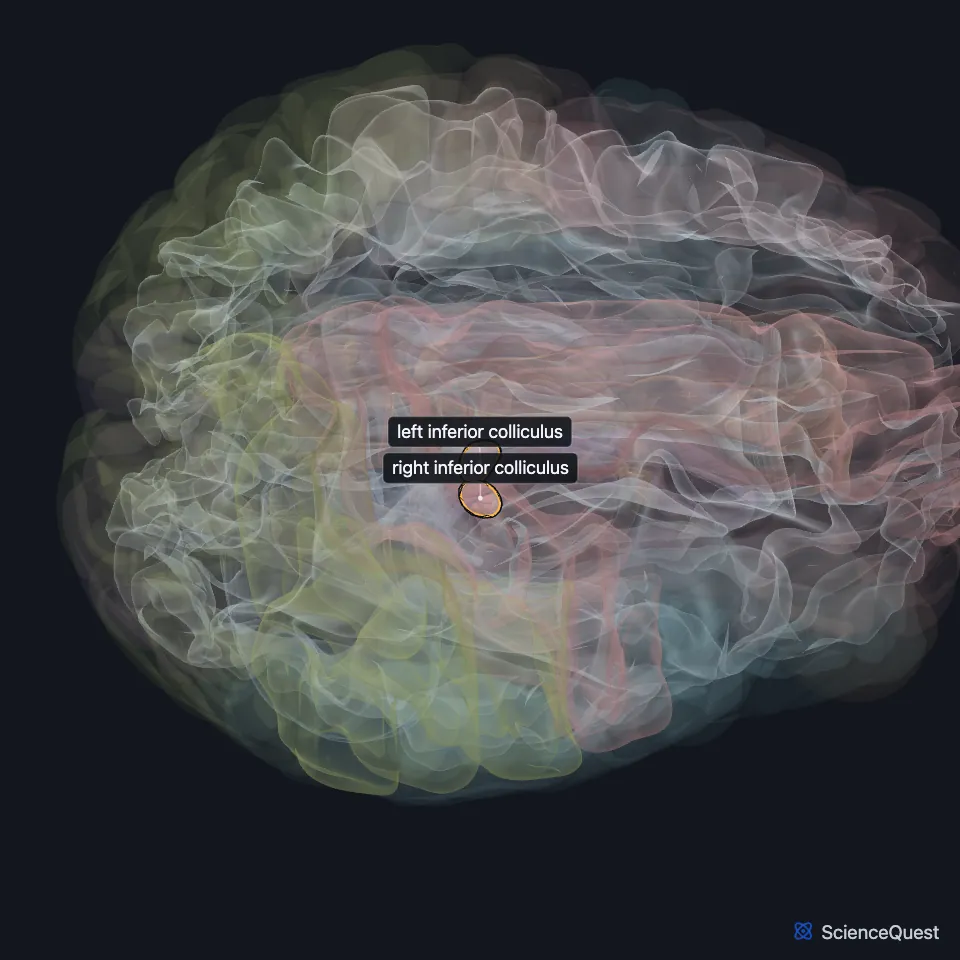
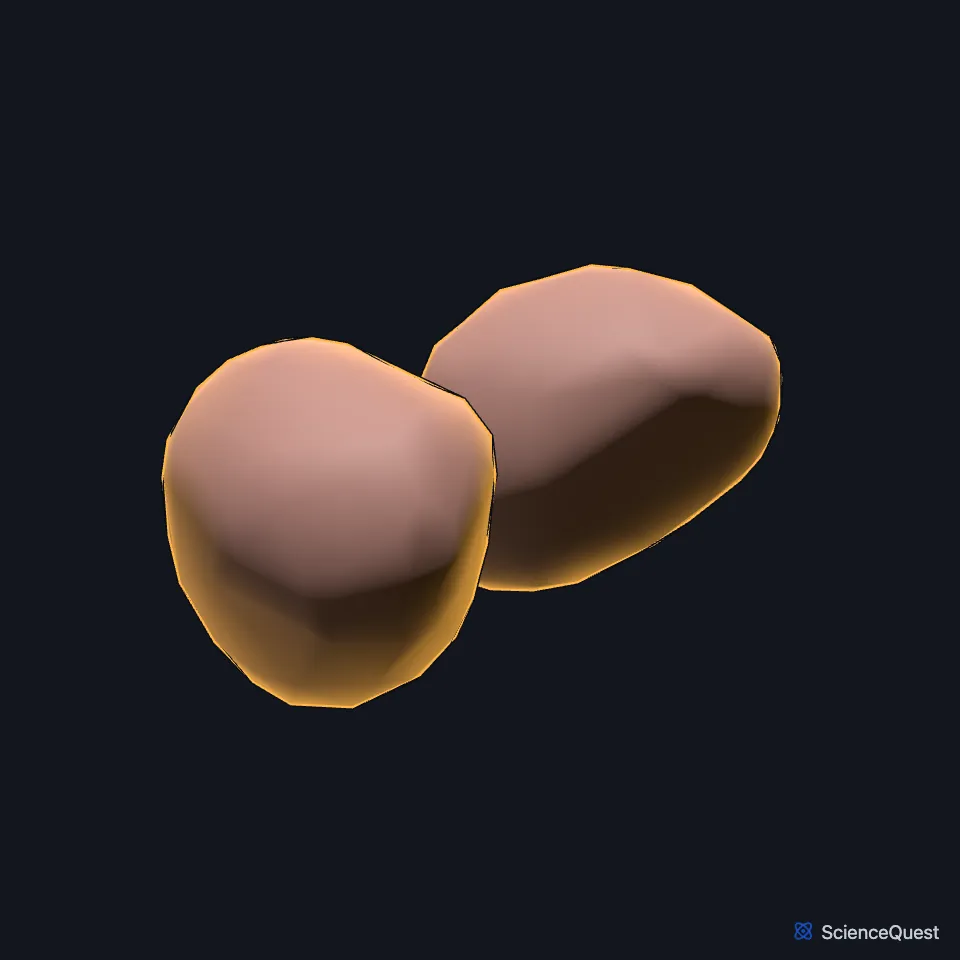
Where is the inferior colliculus?
The two lie on the back of the midbrain, just below the superior colliculi and above the point where the trochlear nerve leaves the brain stem. (StatPearls, Inferior Colliculus and Brainstem)
How is the inferior colliculus built?
It has three regions: a large central nucleus that takes most of the sound input, wrapped by a dorsal cortex and an external cortex that take input from other senses. Most of its cells are excitatory glutamate neurons, with a minority of inhibitory GABA neurons. (StatPearls, Inferior Colliculus)
What does the inferior colliculus do?
Its central nucleus keeps sound sorted by pitch, the tonotopic order that starts in the cochlea, and it helps tell two pitches apart. It also works out where a sound came from by combining input from both ears. (StatPearls, Inferior Colliculus and Auditory Pathway)
Input from the two ears first meets earlier on the pathway, in the superior olive. The inferior colliculus is the first site where each ear’s cues for a sound’s horizontal and vertical position converge. (Neuroscience Online, Auditory System: Pathways and Reflexes; StatPearls, Auditory Pathway and Inferior Colliculus)
It helps produce the startle response to a sudden loud sound, and helps filter out sounds you make yourself, such as chewing and breathing. (StatPearls, Inferior Colliculus)
Where does the inferior colliculus send sound?
Sound arrives through the lateral lemniscus from the cochlear nuclei and superior olive. Its main output runs through the brachium of the inferior colliculus to the medial geniculate body of the thalamus. (StatPearls, Inferior Colliculus and Brainstem; Neuroscience Online, Auditory System: Pathways and Reflexes)
It trades signals with the superior colliculi and gets input from the spinal cord and the trigeminal nerve, which may help it map where a sound sits in space and turn the body toward it. (StatPearls, Inferior Colliculus)
What happens when the inferior colliculus is damaged?
Damage to one inferior colliculus has caused tinnitus, oversensitivity to sound, and trouble placing sounds on the opposite side. Wave V of the auditory brain stem response is credited to the lateral lemniscus and inferior colliculus, so a lesion here shrinks it. (StatPearls, Inferior Colliculus)
Touches in this model
Measured on the BodyParts3D meshes: surfaces within 2 mm of the inferior colliculus, nearest first.
- Brachium of left inferior colliculus in contact
- Brachium of right inferior colliculus in contact
- Midbrain in contact
- Pons 0.2 mm away
- Brachium of left superior colliculus 0.4 mm away
- Brachium of right superior colliculus 0.4 mm away
- Cerebral aqueduct 0.6 mm away
- Left superior colliculus 1.0 mm away
- Right superior colliculus 1.0 mm away
- Fourth ventricle 1.6 mm away
Sources
Sources read
- StatPearls, Neuroanatomy, Inferior Colliculus. Margaret E. Driscoll; Prasanna Tadi. Last update . CC BY-NC-ND 4.0. Read .
- StatPearls, Neuroanatomy, Brainstem. Hayden Basinger; Jeffery P. Hogg. Last update . CC BY-NC-ND 4.0. Read .
- StatPearls, Auditory Pathway. Diana C. Peterson; Vamsi Reddy; Debra A. Mayes; Renee N. Hamel. Last update . CC BY-NC-ND 4.0. Read .
- Neuroscience Online, McGovern Medical School, Section 2, Chapter 13, Auditory System: Pathways and Reflexes. Lincoln Gray, Ph.D. Reviewed . Open access; no reuse licence stated. Read .
The values are facts and free to use; this page’s selection and presentation are © 2026 ScienceQuest.