Mentalis
The mentalis is a small muscle of the chin, one on each side of the midline. It raises and pushes out the lower lip and wrinkles the skin of the chin. (Yi et al. 2023, Anat Cell Biol 56(3): 293 to 298; StatPearls, Face; Gray 1918, 4d. Muscles of the Mouth)
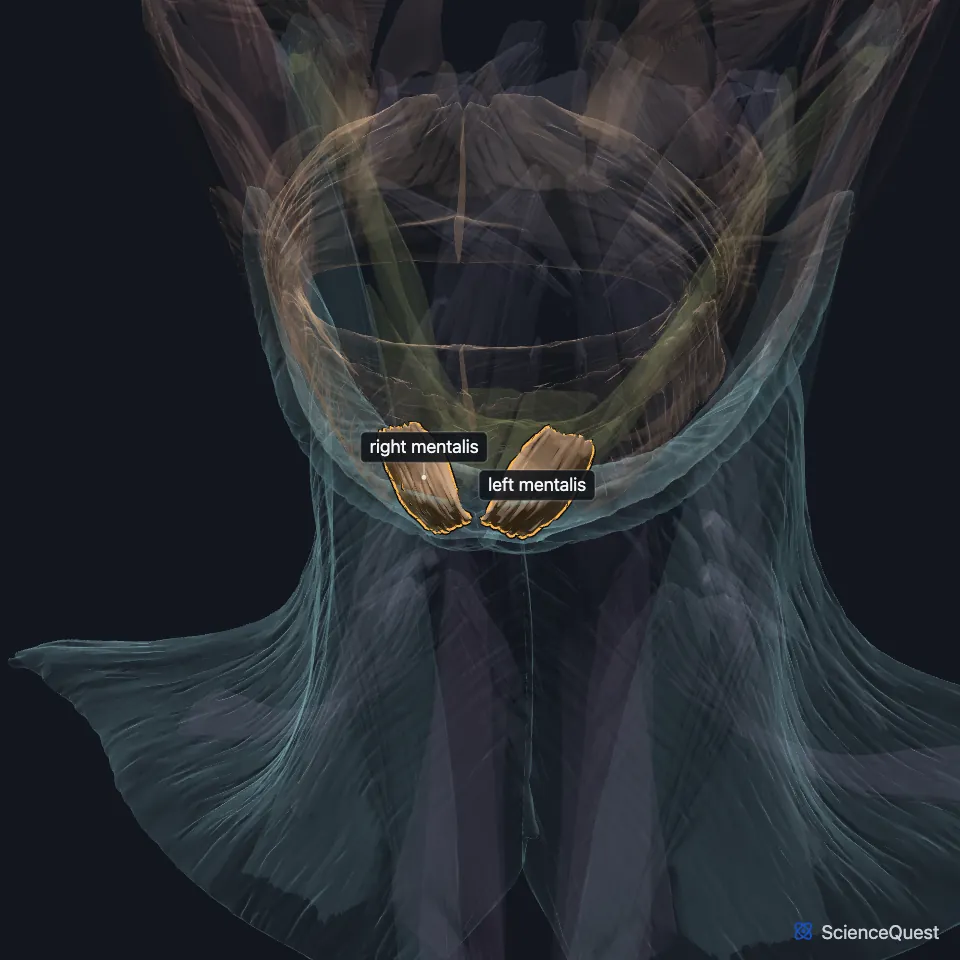
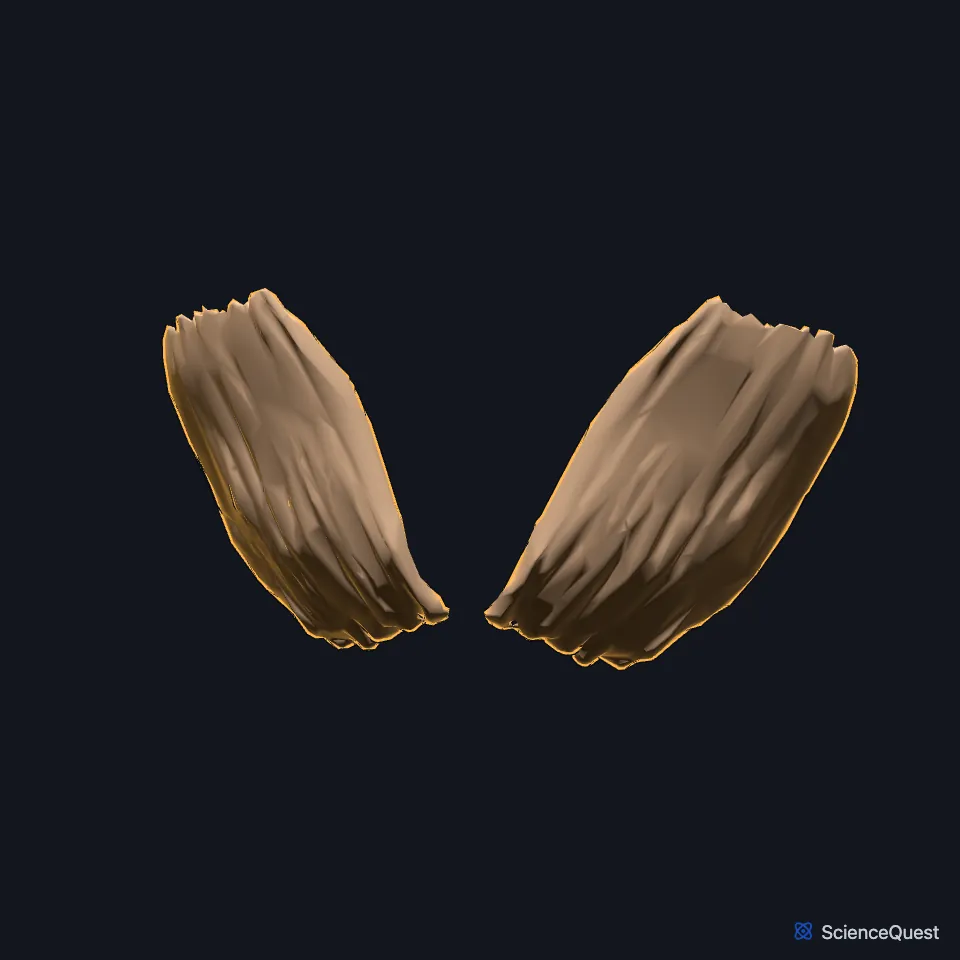
Open it in the Head and Neck Muscles Explorer See it alone in 3D
Where is the mentalis?
It arises from the incisive fossa of the mandible, beside the frenulum of the lower lip, and runs down into the skin of the chin. (Gray 1918, 4d. Muscles of the Mouth)
Its origin lies about 0.8 cm from the midline of the chin, and it inserts nearer the midline than it starts. Each belly averages 2.0 cm long and 1.2 cm wide. (Yi et al. 2023, Anat Cell Biol 56(3): 293 to 298)
How is the mentalis built?
The two bellies are usually separate, with fat between their origins. Each has medial, lateral, upper and lower fibers, and the upper fibers join the lower margin of the orbicularis oris. (Yi et al. 2023, Anat Cell Biol 56(3): 293 to 298)
Its lateral fibers partly mix with the depressor labii inferioris. (Yi et al. 2023, Anat Cell Biol 56(3): 293 to 298)
What does the mentalis do?
It lifts the chin and lower lip. Because some fibers end in the skin, an overactive mentalis gives a dimpled, cobblestone chin, and with age it deepens the crease between lip and chin. (Yi et al. 2023, Anat Cell Biol 56(3): 293 to 298)
Gray links the expression it makes to doubt or disdain. (Gray 1918, 4d. Muscles of the Mouth)
What supplies the mentalis?
The marginal mandibular branch of the facial nerve supplies it. It lies in the deepest layer of facial muscles, so the nerve reaches it on its superficial surface. (StatPearls, Facial Muscles and Levator Anguli Oris Muscle)
Botulinum toxin treats the cobblestone chin. If it spreads into the orbicularis oris or depressor labii inferioris, the lower lip can droop on one side. (Yi et al. 2023, Anat Cell Biol 56(3): 293 to 298)
Where the sources differ
StatPearls’ facial muscles article calls the mentalis an unpaired chin muscle. Yi et al. and StatPearls’ face article describe it as paired, one on each side. (StatPearls, Facial Muscles and Face; Yi et al. 2023, Anat Cell Biol 56(3): 293 to 298)
| Feature | Detail and source |
|---|---|
| Origin | Incisive fossa, on the alveolar bone of the front of the mandible (Gray 1918, 4d. Muscles of the Mouth; Yi et al. 2023, Anat Cell Biol 56(3): 293 to 298) |
| Insertion | Skin of the chin (Gray 1918, 4d. Muscles of the Mouth) |
| Action | Raises and protrudes the lower lip; wrinkles the chin (Gray 1918, 4d. Muscles of the Mouth) |
| Nerve | Facial nerve (CN VII), marginal mandibular branch (StatPearls, Facial Muscles) |
Touches in this model
Measured on the BodyParts3D meshes: surfaces within 2 mm of the mentalis, nearest first.
- Left depressor labii inferioris in contact
- Left platysma in contact
- Right depressor labii inferioris in contact
- Right platysma in contact
- Gingiva of lower jaw in contact
- Mandible in contact
- Skin in contact
- Left lower secondary canine tooth 0.2 mm away
- Right lower secondary canine tooth 0.2 mm away
- Left lower lateral secondary incisor tooth 0.7 mm away
- Right lower lateral secondary incisor tooth 0.7 mm away
- Orbicularis oris 1.1 mm away
Sources
Sources read
- Anatomy & Cell Biology (peer-reviewed review), Novel anatomical guidelines for botulinum neurotoxin injection in the mentalis muscle: a review (PMC10520866). Kyu-Ho Yi; Ji-Hyun Lee; Hye-Won Hu; Hyun-Jun Park; Hyungkyu Bae; Kangwoo Lee; Hee-Jin Kim. CC BY-NC 4.0. Read .
- StatPearls, Anatomy, Head and Neck: Face. John D. Nguyen; Hieu Duong. Last update . CC BY-NC-ND 4.0. Read .
- Gray’s Anatomy of the Human Body, 20th US edition (1918), IV. Myology, 4d. The Muscles of the Mouth (1918 terms, as Gray pairs them: Caninus for levator anguli oris, Zygomaticus for zygomaticus major, Triangularis for depressor anguli oris, Quadratus labii inferioris for depressor labii inferioris; Mentalis keeps today’s name, with Levator menti as a second name. Gray’s Quadratus labii superioris is one sheet with angular, infraorbital and zygomatic heads, and his list of mouth muscles has no separate levator labii superioris, levator labii superioris alaeque nasi or zygomaticus minor). Henry Gray. Public domain. Read .
- StatPearls, Anatomy, Head and Neck: Facial Muscles. Adegbenro O. Fakoya; Marc H. Hohman; Katherine E. Westbrook; Matthew A. Varacallo. Last update . CC BY-NC-ND 4.0. Read .
- StatPearls, Anatomy, Head and Neck: Levator Anguli Oris Muscle. Diem-Phuong D. Dao; Adegbenro O. Fakoya; Patrick H. Le. Last update . CC BY-NC-ND 4.0. Read .
The values are facts and free to use; this page’s selection and presentation are © 2026 ScienceQuest.