Multifidus
The multifidus is a series of short muscle and tendon bundles that fill the groove on each side of the spinous processes, from the sacrum to the axis. It belongs to the transversospinalis group. (Gray 1918, 6a. Deep Muscles of the Back; StatPearls, Back)
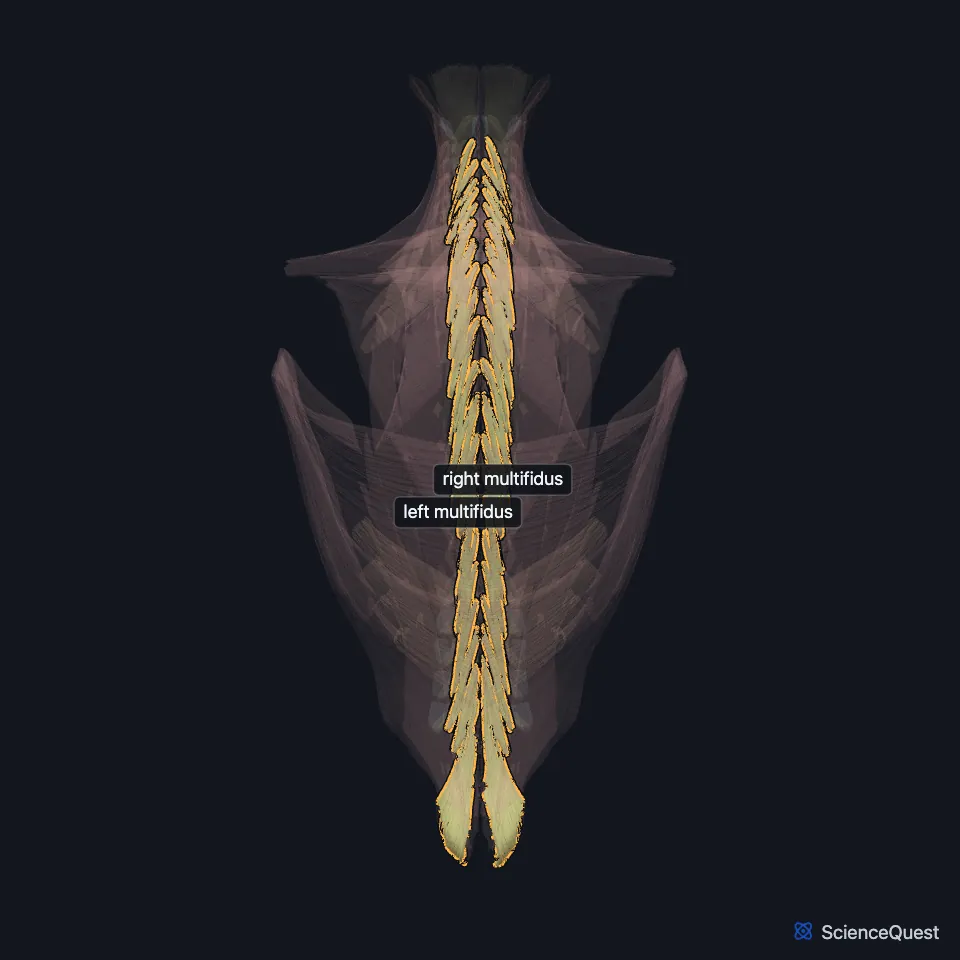
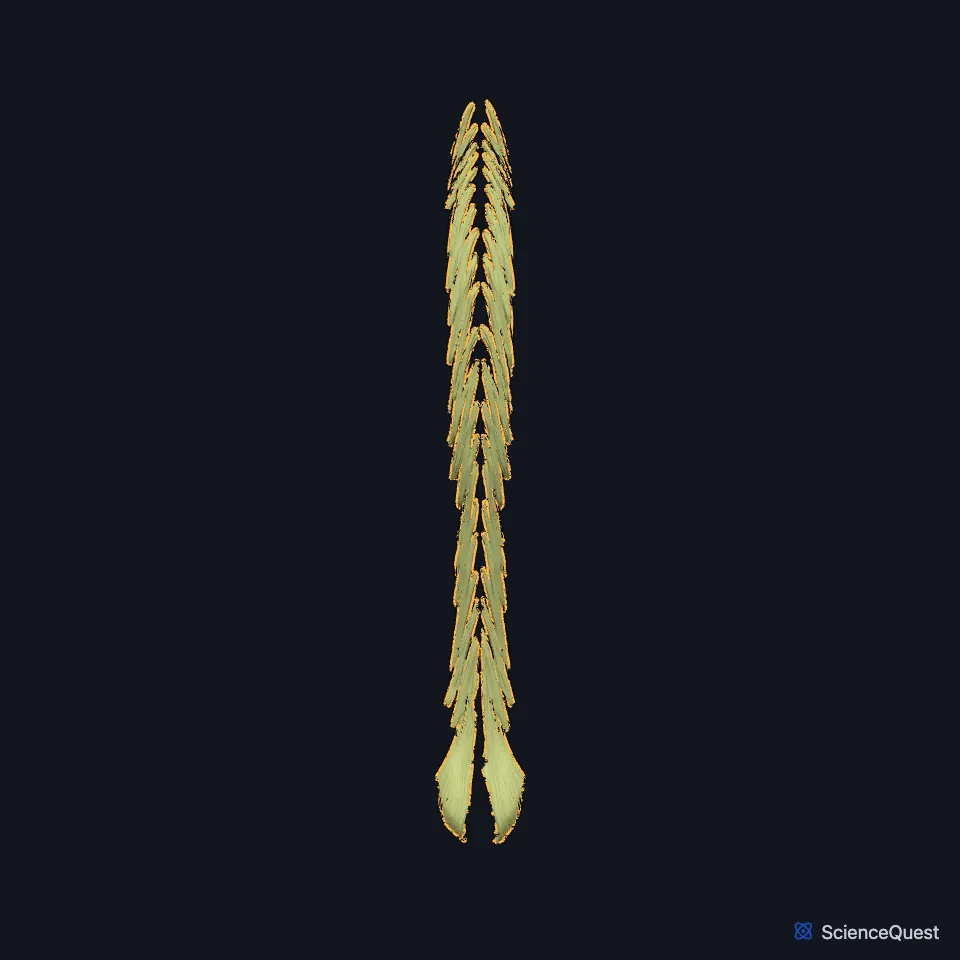
Where is the multifidus?
It lies deep to the semispinalis and runs the whole length of the spine, above all in the lumbar region. Its bundles cover the laminae of the vertebrae. (StatPearls, Back and Back, Muscles)
Deeper still lie the rotatores, the deepest part of the transversospinalis group. (Gray 1918, 6a. Deep Muscles of the Back; StatPearls, Back)
How are the multifidus bundles arranged?
Its bundles arise from the sacrum and ilium, the transverse processes of T1 to L5 and the articular processes of C4 to C7. Each inserts on a spinous process two to four segments higher. (StatPearls, Back, Muscles)
Gray’s 1918 text sorts the bundles by depth: the most superficial reach three or four vertebrae up, the next two or three, and the deepest join adjacent vertebrae. Each runs up and toward the midline. (Gray 1918, 6a. Deep Muscles of the Back)
Over the sacrum, the bundles arise from its back as low as the fourth sacral foramen, from the posterior superior iliac spine and from the posterior sacroiliac ligaments. (Gray 1918, 6a. Deep Muscles of the Back)
What does the multifidus do?
With the erector spinae it forms the extensor group behind the lumbar spine. It also takes part in rotating and side bending the lumbar spine. (StatPearls, Back, Lumbar Spine)
Researchers regard the lumbar multifidus as the main stabilizing muscle of the spine, and they attribute the effects of exercise therapy for low back pain to it. (Hofste et al. 2020, BMC Musculoskelet Disord; StatPearls, Back, Muscles)
What supplies and surrounds the multifidus?
Dorsal rami of the spinal nerves supply it. Only one branch of a dorsal ramus reaches the medial multifidus at each level, with no supply from neighboring segments, so StatPearls warns that spinal surgery can injure and paralyze these small muscles. (StatPearls, Back, Muscles)
In the lumbar region, three layers of the thoracolumbar fascia surround the erector spinae and the transversospinalis muscles, the multifidus among them. (StatPearls, Back)
Where the sources differ
StatPearls gives the transverse processes of T1 to L5 as origins. Gray’s 1918 text has the lumbar bundles arising from the mamillary processes and only the thoracic ones from the transverse processes. (StatPearls, Back, Muscles; Gray 1918, 6a. Deep Muscles of the Back)
StatPearls places the multifidus deep to the erector spinae, as most anatomy atlases draw it. A 2020 scoping review of 303 studies found that about half described the lumbar multifidus as a superficial muscle, a quarter as deep and about one in eight as both. (StatPearls, Back; Hofste et al. 2020, BMC Musculoskelet Disord)
| Feature | Detail and source |
|---|---|
| Origin | Sacrum and ilium, transverse processes of T1 to L5, articular processes of C4 to C7 (StatPearls, Back, Muscles) |
| Insertion | Spinous processes two to four segments higher (StatPearls, Back, Muscles) |
| Action | Extends the lumbar spine with the erector spinae; helps rotation and side bending (StatPearls, Back, Lumbar Spine) |
| Nerve | Dorsal rami of the spinal nerves, one branch per level (StatPearls, Back, Muscles) |
Touches in this model
Measured on the BodyParts3D meshes: surfaces within 2 mm of the multifidus, nearest first, 12 of 50.
- Left cervical rotator in contact
- Left iliocostalis lumborum in contact
- Left longissimus thoracis in contact
- Left lumbar rotator in contact
- Left semispinalis capitis in contact
- Left semispinalis cervicis in contact
- Left semispinalis thoracis in contact
- Left spinalis thoracis in contact
- Right cervical rotator in contact
- Right iliocostalis lumborum in contact
- Right longissimus thoracis in contact
- Right lumbar rotator in contact
Sources
Sources read
- Gray’s Anatomy of the Human Body, 20th US edition (1918), IV. Myology, 6a. The Deep Muscles of the Back (1918 terms: Sacrospinalis for erector spinae, Iliocostalis dorsi for iliocostalis thoracis, Longissimus dorsi for longissimus thoracis). Henry Gray. Public domain. Read .
- StatPearls, Anatomy, Back. Robert J. Modes; Sevda Lafci Fahrioglu. Last update . CC BY-NC-ND 4.0. Read .
- StatPearls, Anatomy, Back, Muscles. Brandi Henson; Bhavana Kadiyala; Mary Ann Edens. Last update . CC BY-NC-ND 4.0. Read .
- StatPearls, Anatomy, Back, Lumbar Spine. Brett Sassack; Jonathan D. Carrier. Last update . CC BY-NC-ND 4.0. Read .
- BMC Musculoskeletal Disorders, Inconsistent descriptions of lumbar multifidus morphology: A scoping review, BMC Musculoskelet Disord 21, article 312 (full text, PMC7236939, doi 10.1186/s12891-020-03257-7). Hofste A, Soer R, Hermens HJ, Wagner H, Oosterveld FGJ, Wolff AP, Groen GJ. CC BY 4.0. Read .
The values are facts and free to use; this page’s selection and presentation are © 2026 ScienceQuest.