Nasal bone
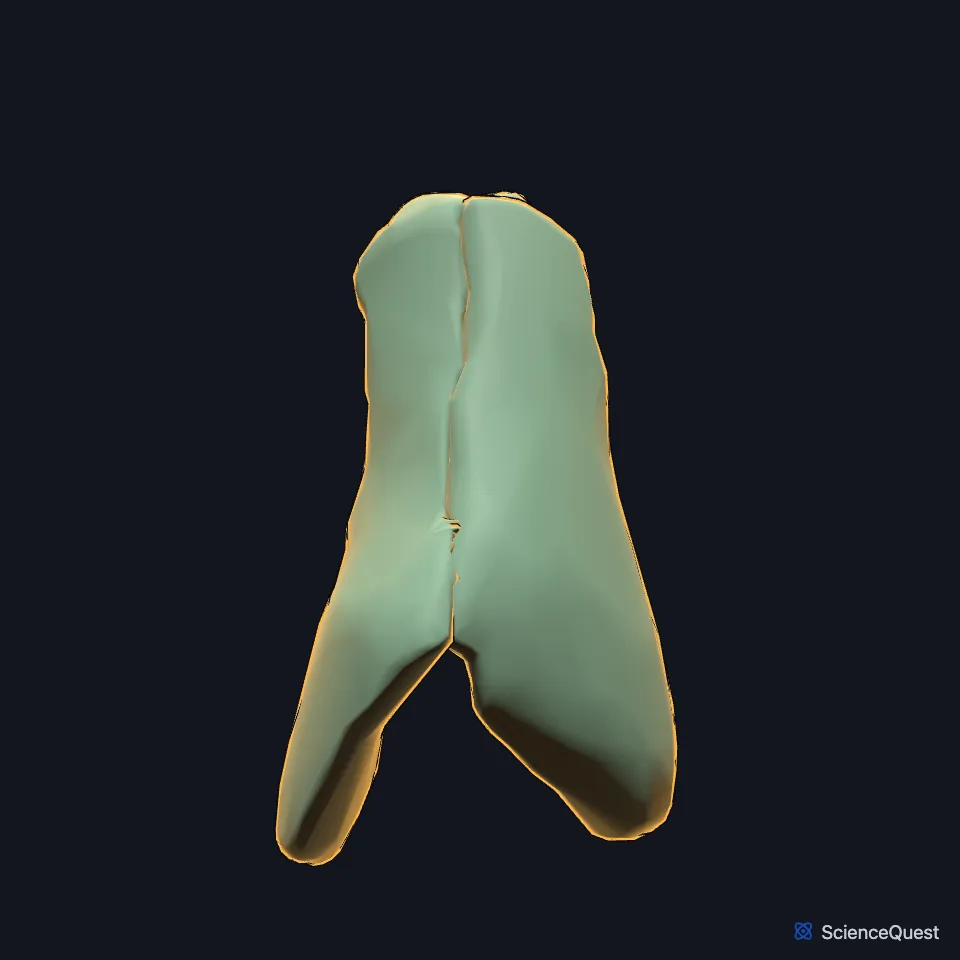
The nasal bones are two small, oblong bones that lie side by side at the top of the nose. Where they meet in the midline they form the bridge of the nose. (Gray 1918, 5b. 1. The Nasal Bones; StatPearls, Nasal Fractures)
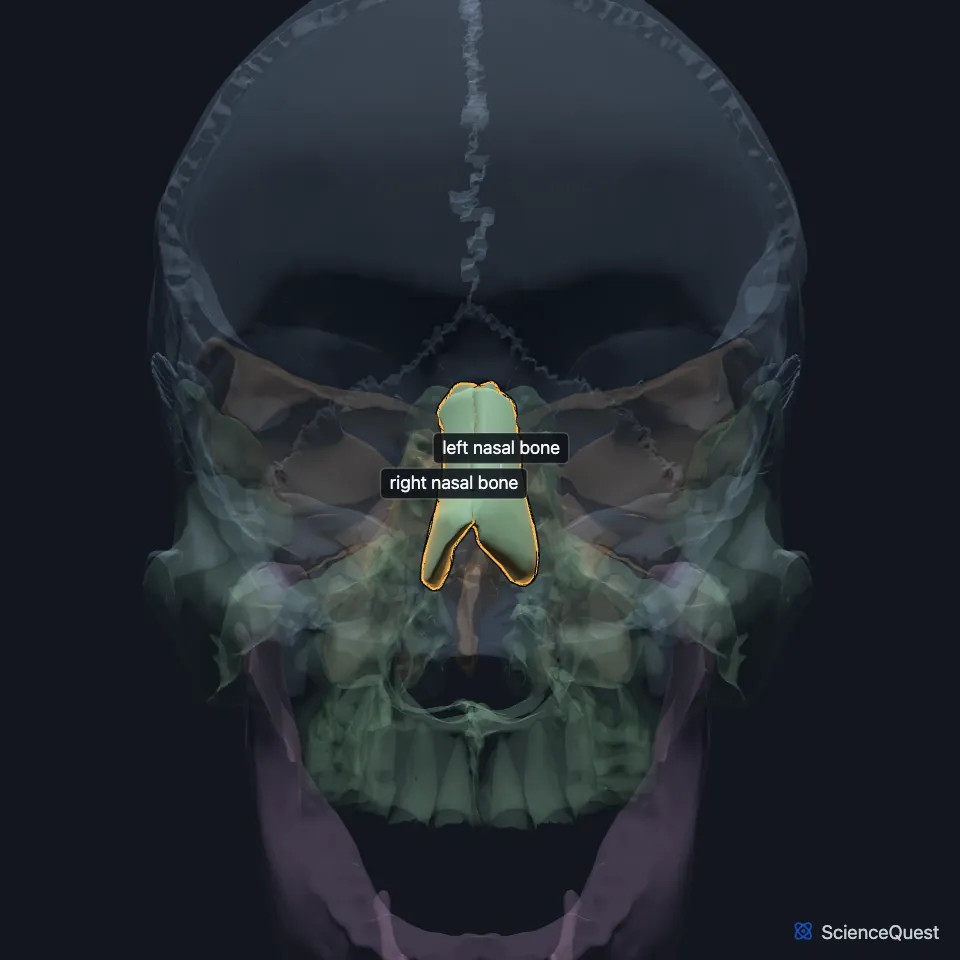
Where are the nasal bones?
Each one joins the frontal bone above at the nasofrontal suture, and the frontal process of the maxilla at its side along the nasomaxillary suture. (StatPearls, Nasal Fractures; Gray 1918, 5b. 1. The Nasal Bones)
The nasal bones and the nasal spine of the frontal bone make the front of the roof of the nasal cavity. The bones are thicker above the level of the medial canthi, the inner corners of the eyes. (StatPearls, Nasal Cavity and Nasal Fractures)
What are the parts of a nasal bone?
Each has two surfaces and four borders. The procerus muscle arises from the outer surface, which a small foramen for a vein pierces near its center, and a groove down the inner surface carries a branch of the nasociliary nerve. (Gray 1918, 5b. 1. The Nasal Bones; StatPearls, Nasal Cavity)
What do the nasal bones do?
They are the bony part of the nose’s frame, which is mostly cartilage, bone and skin. At the keystone area the upper lateral cartilages attach to their lower edges. (StatPearls, Nasal Fractures; Gray 1918, 5b. 1. The Nasal Bones)
The two bones meet along the midline, and a crest behind their inner borders forms part of the nasal septum. The septal cartilage attaches to the nasal bone at its upper end. (Gray 1918, 5b. 1. The Nasal Bones; StatPearls, Nasal Cavity)
Which bones meet the nasal bone?
Gray’s Anatomy (1918) lists four: the frontal and the ethmoid of the cranium, and the other nasal bone and the maxilla of the face. (Gray 1918, 5b. 1. The Nasal Bones)
The crest along its inner border meets, from above down, the spine of the frontal bone, the perpendicular plate of the ethmoid and the septal cartilage. (Gray 1918, 5b. 1. The Nasal Bones)
Why do the nasal bones break so often?
StatPearls says they are the face’s most often broken bones because they are fragile and the nose sticks out. The nasal septum is also fractured in 42% to 96% of these cases. (StatPearls, Nasal Fractures)
A blow to the front or side of the nose is the most common cause. A side blow usually pushes the bone in on the struck side and out on the other, while a blow straight onto the bridge tends to splay both bones outward. (StatPearls, Nasal Fractures)
| Feature | Detail and source |
|---|---|
| Forms | With its partner, the bridge of the nose (Gray 1918, 5b. 1. The Nasal Bones) |
| Articulates with | 4 bones: frontal, ethmoid, the other nasal bone, maxilla (Gray 1918, 5b. 1. The Nasal Bones) |
| Ossifies | From one center, at the start of the third month of fetal life (Gray 1918, 5b. 1. The Nasal Bones) |
Touches in this model
Measured on the BodyParts3D meshes: surfaces within 2 mm of the nasal bone, nearest first.
- Frontal bone in contact
- Left maxilla in contact
- Right maxilla in contact
- Left nasalis in contact
- Left procerus in contact
- Right nasalis in contact
- Right procerus in contact
- Skin in contact
Sources
Sources read
- Gray’s Anatomy of the Human Body, 20th US edition (1918), II. Osteology, 5b. The Facial Bones, 1. The Nasal Bones. Henry Gray. Public domain. Read .
- StatPearls, Nasal Fractures. Michael Klinginsmith; Marc H. Hohman; Ziad Katrib. Last update . CC BY-NC-ND 4.0. Read .
- StatPearls, Anatomy, Head and Neck, Nasal Cavity. John L. Sobiesk; Sunil Munakomi. Last update . CC BY-NC-ND 4.0. Read .
The values are facts and free to use; this page’s selection and presentation are © 2026 ScienceQuest.