Procerus
The procerus is a small, pyramid-shaped muscle over the root of the nose, running from the nasal bone up into the skin between the eyebrows. It pulls the inner ends of the eyebrows down and creases the skin across the bridge of the nose. (StatPearls, Procerus Muscle; Gray 1918, 4c. Muscles of the Nose)
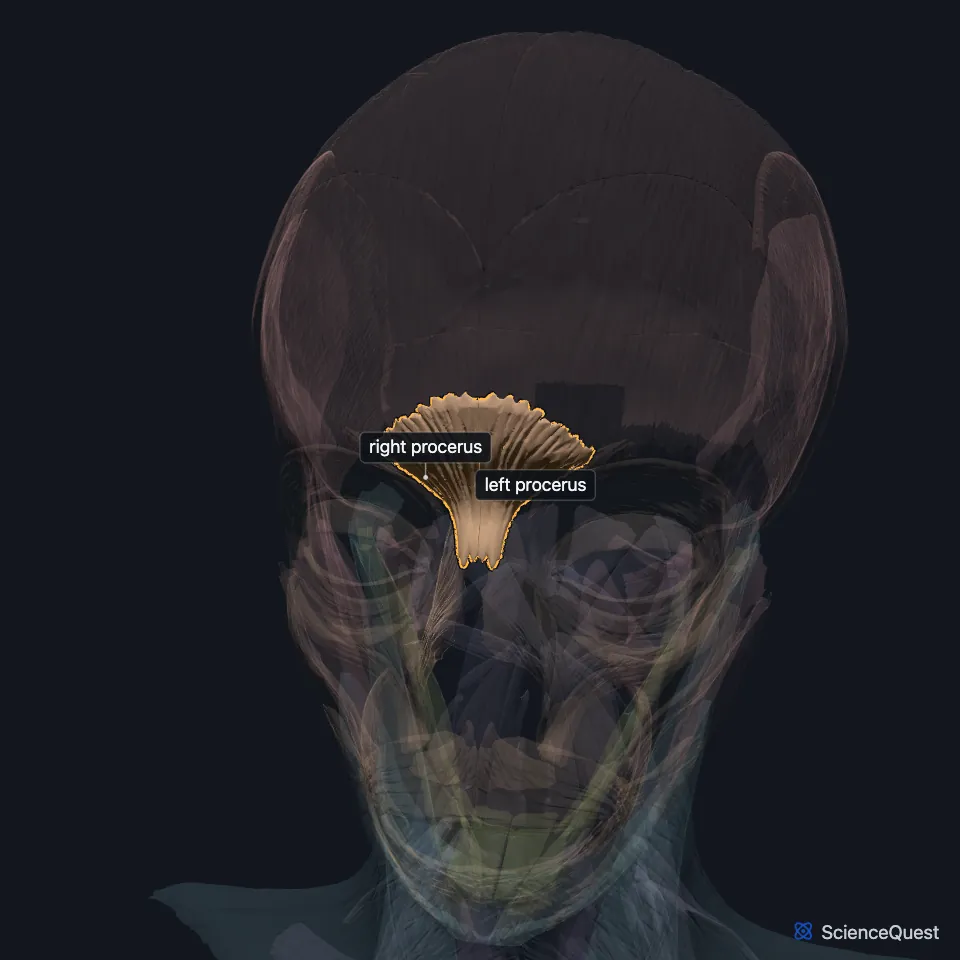
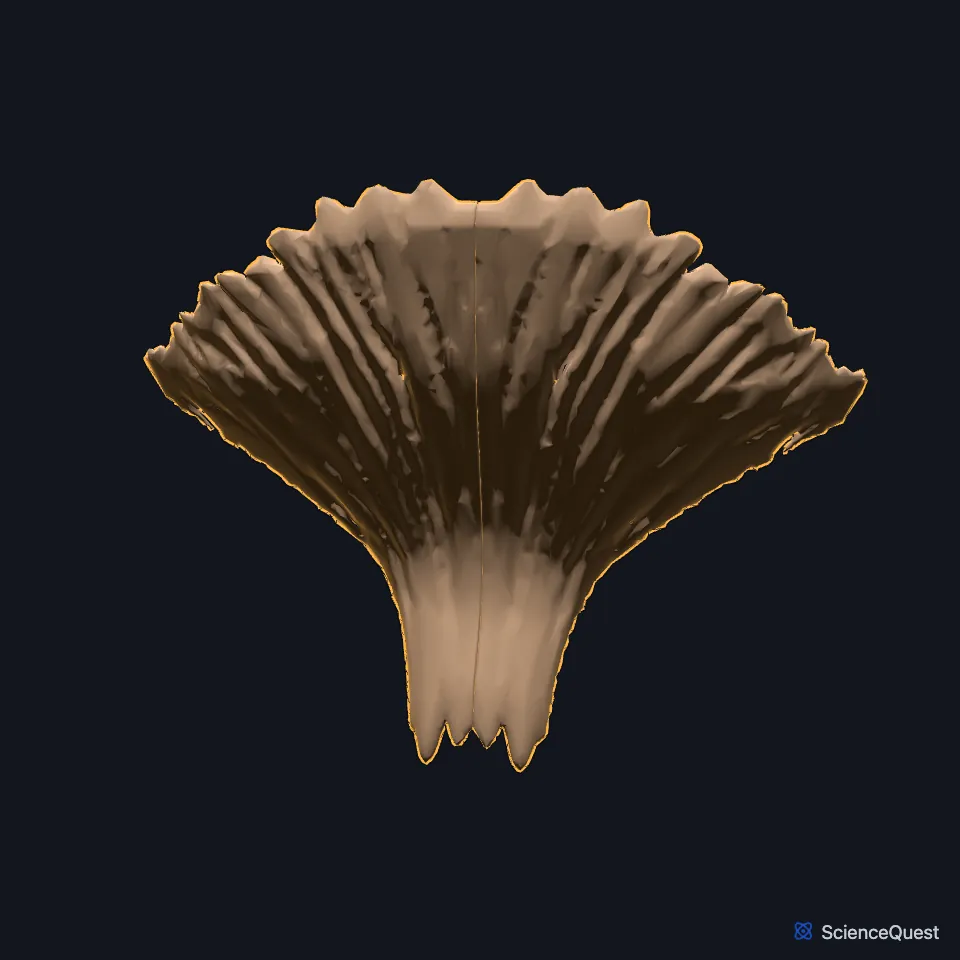
Open it in the Head and Neck Muscles Explorer See it alone in 3D
Where is the procerus?
It arises from the fascia over the lower part of the nasal bone and the upper part of the lateral nasal cartilage. It inserts into the skin of the lower forehead between the eyebrows, where its fibers cross with those of the frontalis. (Gray 1918, 4c. Muscles of the Nose)
It lies below and medial to the frontalis. The corrugator supercilii, depressor supercilii and orbicularis oculi lie just lateral to it, and the nasalis lies below it. (StatPearls, Procerus Muscle)
What is the procerus part of?
It belongs to the glabellar complex, the brow-lowering muscles between the eyebrows: the corrugator supercilii, depressor supercilii, procerus and the inner fibers of the orbicularis oculi. (StatPearls, Glabella)
FMA files it as a nasal muscle, and Gray 1918 describes it among the muscles of the nose, with pyramidalis nasi as its second name. (FMA, Procerus; Gray 1918, 4c. Muscles of the Nose)
What does the procerus do?
Its pull makes the horizontal lines at the root of the nose. A doctor can check it, and the facial nerve, by asking you to pull your eyebrows down as if angry. (StatPearls, Facial Muscles and Procerus Muscle)
The procerus sign, a tool for spotting early progressive supranuclear palsy, may be misnamed: the corrugator supercilii may be the main muscle involved. (StatPearls, Procerus Muscle)
What nerves supply the procerus, and why does the glabella matter for fillers?
The facial nerve supplies it, but sources differ on the branch. Studies have found the buccal, temporal and zygomatic branches supplying it, and one found an angular nerve formed from the buccal and zygomatic branches. (StatPearls, Procerus Muscle)
Filler injected straight into an artery can cause tissue death. That is uncommon, but the glabella is one of the commonest places it happens. (StatPearls, Procerus Muscle)
Where the sources differ
StatPearls’ procerus article says the facial artery supplies it. Its facial muscles article says branches of the superficial temporal artery join the supraorbital and supratrochlear arteries to supply it. (StatPearls, Procerus Muscle and Facial Muscles)
Gray and StatPearls’ glabella article make the procerus a depressor of the brow. StatPearls’ face article says its contraction raises the eyebrows. (Gray 1918, 4c. Muscles of the Nose; StatPearls, Glabella and Face)
StatPearls’ glabella article counts only the brow depressors in the glabellar complex: the corrugator supercilii, depressor supercilii, procerus and inner fibers of the orbicularis oculi. Its procerus article adds the frontalis. (StatPearls, Glabella and Procerus Muscle)
| Feature | Detail and source |
|---|---|
| Origin | Fascia over the lower nasal bone and upper lateral nasal cartilage (Gray 1918, 4c. Muscles of the Nose; StatPearls, Procerus Muscle) |
| Insertion | Skin between the eyebrows (StatPearls, Procerus Muscle) |
| Action | Pulls the inner ends of the eyebrows down; creases the bridge of the nose (Gray 1918, 4c. Muscles of the Nose) |
| Nerve | Facial nerve (CN VII); the branch varies (StatPearls, Procerus Muscle) |
Touches in this model
Measured on the BodyParts3D meshes: surfaces within 2 mm of the procerus, nearest first, 12 of 13.
- Left corrugator supercilii in contact
- Left frontalis in contact
- Left nasalis in contact
- Right corrugator supercilii in contact
- Right frontalis in contact
- Right nasalis in contact
- Frontal bone in contact
- Left nasal bone in contact
- Right nasal bone in contact
- Skin in contact
- Palpebral part of left orbicularis oculi 0.7 mm away
- Palpebral part of right orbicularis oculi 0.7 mm away
Sources
Sources read
- StatPearls, Anatomy, Head and Neck, Procerus Muscle. Thomas M. Brown; Taylor M. Drake; Karthik Krishnamurthy. Last update . CC BY-NC-ND 4.0. Read .
- Gray’s Anatomy of the Human Body, 20th US edition (1918), IV. Myology, 4c. The Muscles of the Nose (Gray’s headwords are today’s Procerus and Nasalis; he gives Pyramidalis nasi and Compressor naris as their second names). Henry Gray. Public domain. Read .
- StatPearls, Anatomy, Head and Neck: Glabella. Hannah M. Walker; Pradip R. Chauhan. Last update . CC BY-NC-ND 4.0. Read .
- Foundational Model of Anatomy, FMA46769, Procerus (read on EBI OLS). FMA release terms, University of Washington. Read .
- StatPearls, Anatomy, Head and Neck: Facial Muscles. Adegbenro O. Fakoya; Marc H. Hohman; Katherine E. Westbrook; Matthew A. Varacallo. Last update . CC BY-NC-ND 4.0. Read .
- StatPearls, Anatomy, Head and Neck: Face. John D. Nguyen; Hieu Duong. Last update . CC BY-NC-ND 4.0. Read .
The values are facts and free to use; this page’s selection and presentation are © 2026 ScienceQuest.