Nasalis
The nasalis is a muscle of the nose with two parts, transverse and alar. Between them it can both narrow and widen the nostrils. (Gray 1918, 4c. Muscles of the Nose; StatPearls, Nose)
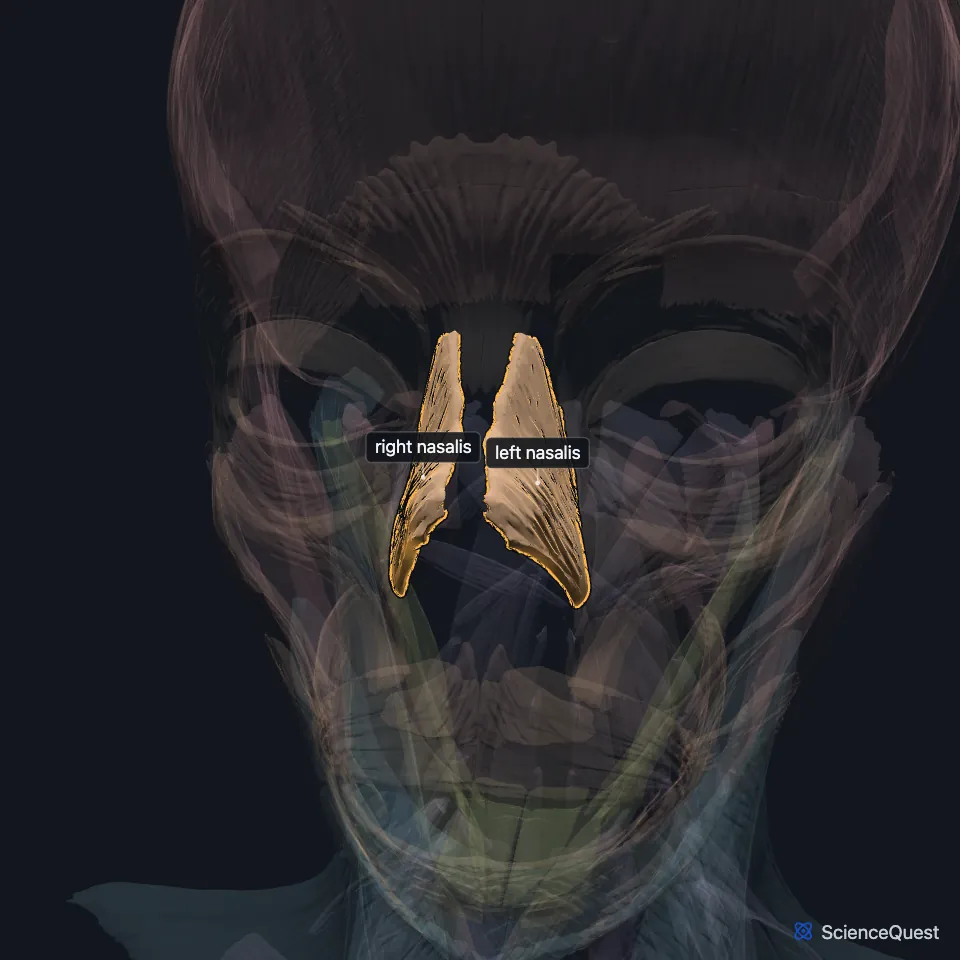
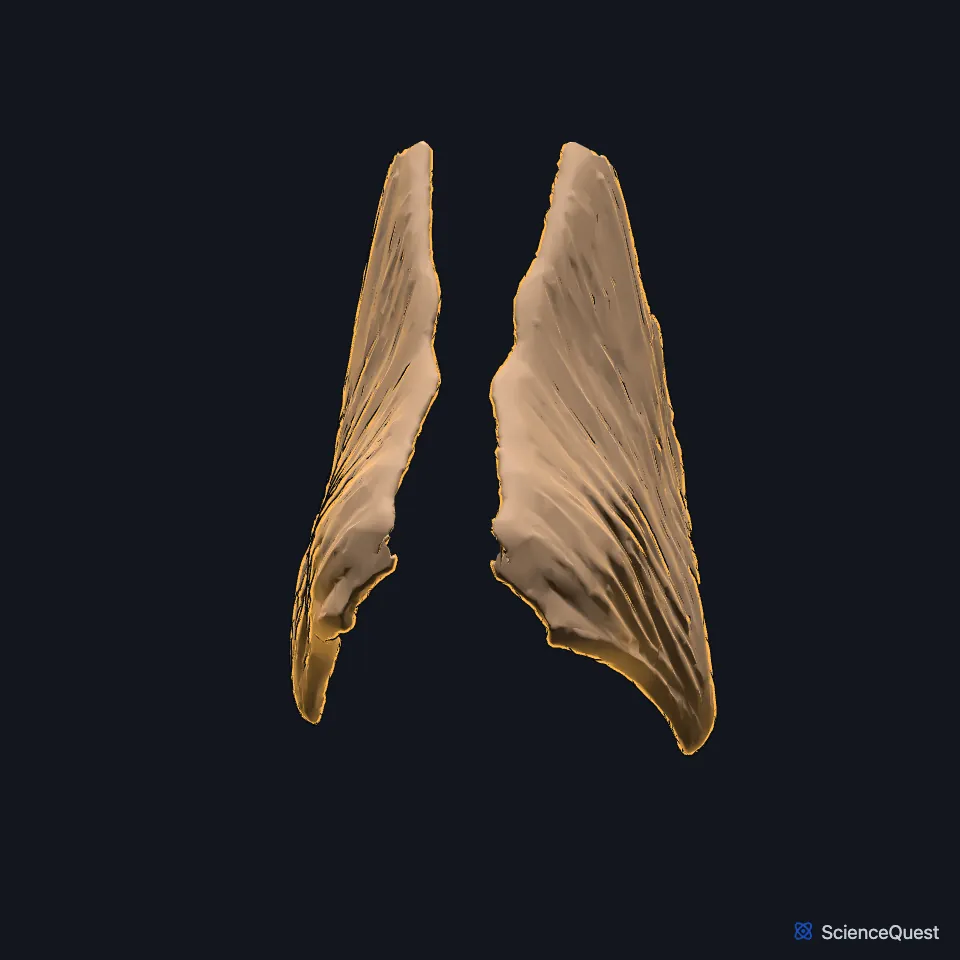
Open it in the Head and Neck Muscles Explorer See it alone in 3D
Where is the nasalis?
It lies over the middle two thirds of the nose, just below the procerus. (StatPearls, Nose and Procerus Muscle)
Gray has the transverse part arise from the maxilla above and lateral to the incisive fossa and fan up into a thin aponeurosis. On the bridge of the nose that sheet joins its partner from the other side and the aponeurosis of the procerus. (Gray 1918, 4c. Muscles of the Nose)
How is the nasalis built?
Yi et al. describe the transverse part as a triangle from the canine fossa of the maxilla to the lateral nasal cartilage, and the alar part as a square from the maxilla at the lateral incisor to the alar cartilage. (Yi et al. 2023, Anat Cell Biol 56(4): 409 to 414)
FMA files it as a nasal muscle. StatPearls groups it with the depressor septi and dilator naris as the muscles of the nose. (FMA, Nasalis; StatPearls, Facial Muscles)
What does the nasalis do?
The transverse part narrows the nostril and the alar part widens it. (Yi et al. 2023, Anat Cell Biol 56(4): 409 to 414)
When you snarl it draws vertical bunny lines on the sides of the nose, and overuse leaves them as wrinkles. (StatPearls, Facial Muscles)
A strong nasalis and depressor septi nasi give a nose tip that dips, more so in a smile, and botulinum toxin in these muscles can lift it. (Yi et al. 2023, Anat Cell Biol 56(4): 409 to 414)
What nerve supplies the nasalis?
The facial nerve supplies it. A nerve from the zygomatic or upper buccal branch climbs the side of the nose to the nasalis first, then on to the procerus and corrugator supercilii. (Gray 1918, 4c. Muscles of the Nose; StatPearls, Glabella)
In some people its fibers join the glabellar complex, the group of brow-lowering muscles between the eyebrows. (StatPearls, Glabella)
Where the sources differ
Gray attaches the alar part to the greater alar cartilage. Yi et al. attach it to the minor alar cartilage. (Gray 1918, 4c. Muscles of the Nose; Yi et al. 2023, Anat Cell Biol 56(4): 409 to 414)
Gray, who gives it the second name compressor naris, says it lowers the cartilage of the nose and draws the wing toward the septum. Yi et al. have the alar part widen the nostril. (Gray 1918, 4c. Muscles of the Nose; Yi et al. 2023, Anat Cell Biol 56(4): 409 to 414)
| Feature | Detail and source |
|---|---|
| Origin | Maxilla: transverse part above and lateral to the incisive fossa; alar part at the lateral incisor (Gray 1918, 4c. Muscles of the Nose; Yi et al. 2023, Anat Cell Biol 56(4): 409 to 414) |
| Insertion | Transverse part: aponeurosis over the bridge of the nose; alar part: alar cartilage (Gray 1918, 4c. Muscles of the Nose; Yi et al. 2023, Anat Cell Biol 56(4): 409 to 414) |
| Action | Transverse part narrows the nostril; alar part widens it (Yi et al. 2023, Anat Cell Biol 56(4): 409 to 414) |
| Nerve | Facial nerve (CN VII) (Gray 1918, 4c. Muscles of the Nose) |
Touches in this model
Measured on the BodyParts3D meshes: surfaces within 2 mm of the nasalis, nearest first, 12 of 14.
- Left levator labii superioris alaeque nasi in contact
- Left procerus in contact
- Palpebral part of left orbicularis oculi in contact
- Palpebral part of right orbicularis oculi in contact
- Right levator labii superioris alaeque nasi in contact
- Right procerus in contact
- Frontal bone in contact
- Left maxilla in contact
- Left nasal bone in contact
- Right maxilla in contact
- Right nasal bone in contact
- Skin in contact
Sources
Sources read
- Gray’s Anatomy of the Human Body, 20th US edition (1918), IV. Myology, 4c. The Muscles of the Nose (Gray’s headwords are today’s Procerus and Nasalis; he gives Pyramidalis nasi and Compressor naris as their second names). Henry Gray. Public domain. Read .
- StatPearls, Anatomy, Head and Neck, Nose. Laura Galarza-Paez; Geoffrey Marston; Brian W. Downs. Last update . CC BY-NC-ND 4.0. Read .
- StatPearls, Anatomy, Head and Neck, Procerus Muscle. Thomas M. Brown; Taylor M. Drake; Karthik Krishnamurthy. Last update . CC BY-NC-ND 4.0. Read .
- Anatomy & Cell Biology (peer-reviewed review), Botulinum neurotoxin injection for treating plunged nose and post-rhinoplasty: anatomical perspectives of depressor septi nasi, nasalis, leveator labii superioris alaeque nasi muscle (PMC10714083). Kyu-Ho Yi; Ji-Hyun Lee; Seon-Oh Kim; Hyewon Hu; Hyung-Jin Lee; You-Jin Choi; Tae-Hwan Ahn; Hee-Jin Kim. CC BY-NC 4.0. Read .
- Foundational Model of Anatomy, FMA46770, Nasalis (read on EBI OLS). FMA release terms, University of Washington. Read .
- StatPearls, Anatomy, Head and Neck: Facial Muscles. Adegbenro O. Fakoya; Marc H. Hohman; Katherine E. Westbrook; Matthew A. Varacallo. Last update . CC BY-NC-ND 4.0. Read .
- StatPearls, Anatomy, Head and Neck: Glabella. Hannah M. Walker; Pradip R. Chauhan. Last update . CC BY-NC-ND 4.0. Read .
The values are facts and free to use; this page’s selection and presentation are © 2026 ScienceQuest.