Bohr radius, a₀
The radius of the smallest orbit in Bohr’s model of hydrogen, with the nucleus held still, and the natural unit of length for atoms. Quantum mechanics keeps it as the most probable distance of the electron from the nucleus in hydrogen’s ground state.
a₀ = 5.29177210544(82) × 10⁻¹¹ m
CODATA 2022, measured. Standard uncertainty 0.00000000082 × 10⁻¹¹ m, which is 1.5 × 10⁻¹⁰ of the value.
Not a row of the physical constants table, which keeps to the exact constants and G.
Try it in Bohr Model and Hydrogen Spectrum Simulator and Atomic Orbitals Visualizer.
In other units
Measured values are in CODATA’s concise form: the digits in brackets are the standard uncertainty in the last two places, so 6.67430(15) means 6.67430 ± 0.00015.
| Unit | Value |
|---|---|
| m | 5.29177210544(82) × 10⁻¹¹ m |
| pm | 52.9177210544(82) pm |
| Å | 0.529177210544(82) Å |
a₀ in pm
- 5.29177210544(82) × 10⁻¹¹ m × 10¹² pm/m
- = 52.9177210544(82) pm
a₀ in Å
- 5.29177210544(82) × 10⁻¹¹ m × 10¹⁰ Å/m
- = 0.529177210544(82) Å
The ångström, 10⁻¹⁰ m, is the unit bond lengths are often given in.
Where the value comes from
Niels Bohr’s 1913 model of hydrogen put the electron on circular orbits whose angular momentum is a whole multiple of ℏ. For the smallest, the Coulomb attraction supplies the centripetal force at a radius of a₀ = 4πε₀ℏ²/(m_e e²). Quantum mechanics replaced the orbit with a cloud of probability, and in hydrogen’s ground state a₀ is the most probable distance between the electron and a nucleus held fixed.
CODATA gives it as a₀ = α/(4πR∞), the same length written with the fine-structure and Rydberg constants, so it carries α’s relative uncertainty, 1.5 × 10⁻¹⁰, and moves when α does. CODATA 2018 gave 5.29177210903(80) × 10⁻¹¹ m; the 2022 value is lower by 6.8 parts in 10¹⁰, 4.5 times the 2018 uncertainty.
a₀ from ε₀, ℏ, the electron mass and e
- a₀ = 4πε₀ℏ² ÷ (m_e e²)
- = 4π × 8.8541878188(14) × 10⁻¹² × (1.054571817… × 10⁻³⁴)² ÷ (9.1093837139(28) × 10⁻³¹ × (1.602176634 × 10⁻¹⁹)²)
- = 5.29177210544(82) × 10⁻¹¹ m
Which form to use
For a quick figure 52.9 pm, or 0.529 Å, is enough. Every length in the Bohr model scales from it: level n of a one-electron ion with nuclear charge Z has an orbit of radius a₀n²/Z, so hydrogen’s second orbit lies 212 pm from the nucleus, and the first orbit of He⁺ lies at a₀/2.
In atomic units a₀ is the unit of length, and the unit of energy that goes with it, e²/(4πε₀a₀), is the Hartree energy, 27.211 eV, twice the Rydberg energy.
Common mistakes
- Reading a₀ as the average distance of hydrogen’s electron. It is the most probable distance in the ground state; the mean distance is
(3n² − l(l + 1))/(2Z)Bohr radii, which for the 1s orbital is 1.5 a₀. - Forgetting the reduced mass. a₀ assumes an infinitely heavy nucleus; with the proton’s real mass every orbit of hydrogen is larger by 0.054 percent.
- Using a₀n²/Z for an atom with several electrons. Inner electrons screen the nucleus, so an outer electron feels much less than the full charge Z and sits further out than the formula says.
Tools and simulators that use it
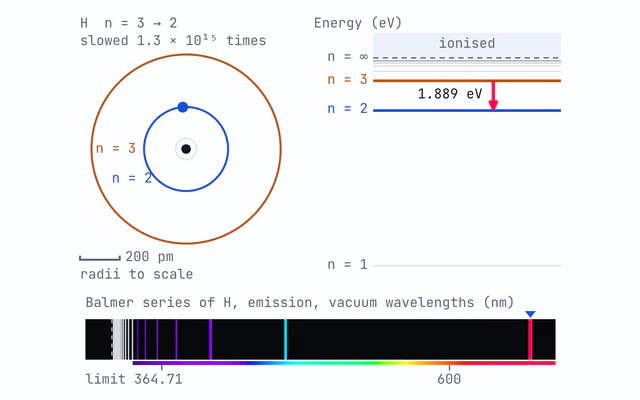
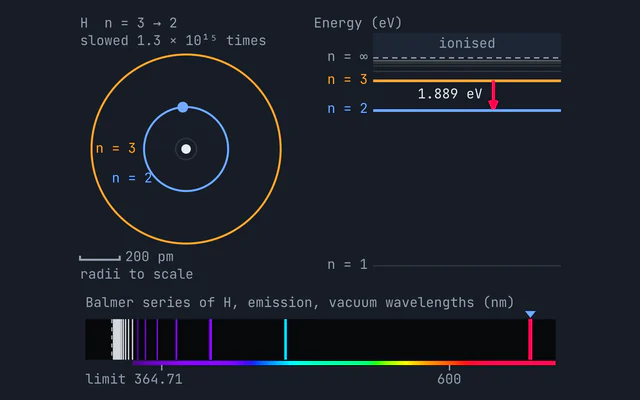
- Bohr Model and Hydrogen Spectrum Simulator places each orbit at r = a₀n²/Z, with the reduced-mass correction.
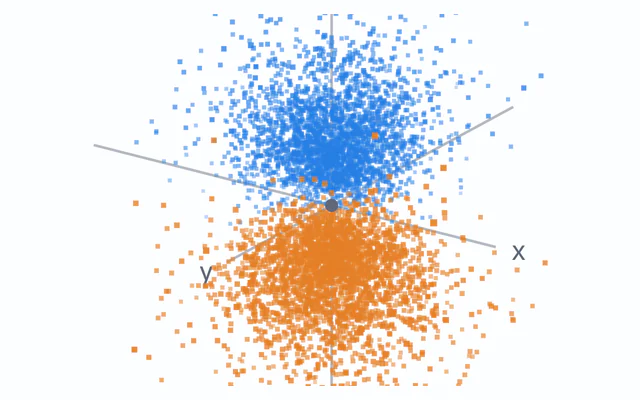
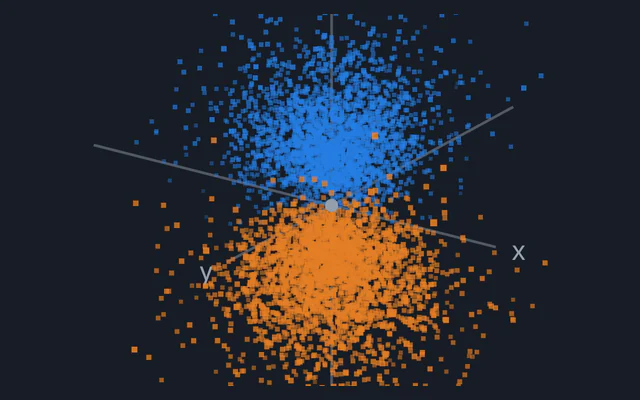
- Atomic Orbitals Visualizer gives every orbital’s distances in picometres from the Bohr radii they are computed in.
Related constants
- Rydberg constant, R∞ = 10,973,731.568157(12) m⁻¹
- Electron mass, me = 9.1093837139(28) × 10⁻³¹ kg
- Vacuum permittivity, ε₀ = 8.8541878188(14) × 10⁻¹² F/m
- Reduced Planck constant, ℏ = 1.054571817… × 10⁻³⁴ J·s
See also
- The physical constants table, every constant side by side
- Length conversion table
- Bohr radius on Wikipedia
Source: CODATA 2022 recommended values, published by NIST.
The values are facts and free to use; this page’s selection and presentation are © 2026 ScienceQuest.
Updated