Neutron mass, mn
The rest mass of the neutron, the uncharged particle that shares the nucleus with the proton. It is 0.14 percent heavier than the proton, enough that a neutron on its own is unstable.
mn = 1.67492750056(85) × 10⁻²⁷ kg
CODATA 2022, measured. Standard uncertainty 0.00000000085 × 10⁻²⁷ kg, which is 5.1 × 10⁻¹⁰ of the value.
Not a row of the physical constants table, which keeps to the exact constants and G.
Try it in De Broglie Wavelength Calculator.
In other units
Measured values are in CODATA’s concise form: the digits in brackets are the standard uncertainty in the last two places, so 6.67430(15) means 6.67430 ± 0.00015.
| Unit | Value |
|---|---|
| kg | 1.67492750056(85) × 10⁻²⁷ kg |
| g | 1.67492750056(85) × 10⁻²⁴ g |
| u | 1.00866491606(40) u |
Neutron mass in g
- 1.67492750056(85) × 10⁻²⁷ kg × 1000 g/kg
- = 1.67492750056(85) × 10⁻²⁴ g
Neutron mass in u
- 1.67492750056(85) × 10⁻²⁷ kg ÷ (1.66053906892(52) × 10⁻²⁷ kg/u)
- = 1.00866491606(40) u
The uncertainty is CODATA’s for the neutron’s relative atomic mass. It is smaller than the two in kilograms suggest, because the part of each that comes from the atomic mass constant cancels in the ratio.
Where the value comes from
With no charge, a neutron cannot be held in a Penning trap and weighed against a carbon ion the way the proton is. Its mass comes from a reaction instead: a proton that captures a slow neutron becomes a deuteron and gives off a gamma ray of about 2.22 MeV, whose wavelength is measured by diffraction from a crystal. The neutron’s mass is then the deuteron’s less the proton’s, plus the energy the capture releases over c², nearly all of it carried by the gamma ray.
The neutron is heavier than the proton by 1.293 MeV/c², more than the electron’s 0.511 MeV/c², so a free neutron can turn into a proton, an electron and an antineutrino, with 0.782 MeV to share among them.
CODATA 2018 gave 1.67492749804(95) × 10⁻²⁷ kg. The 2022 value is higher by 2.7 times that uncertainty, the upward shift the proton and electron masses share, since every particle mass in kilograms is tied to the electron’s through a measured mass ratio.
Which form to use
For a neutron’s matter wave use the mass in kilograms. At 2200 m/s, the conventional speed of a thermal neutron, its wavelength h/(m_n v) is 0.18 nm, close to the spacing of atoms in a crystal, which is why slow neutrons diffract.
As a rest energy the neutron is 939.56542 MeV. In a mass-defect calculation keep everything in u, with hydrogen-1 atoms rather than bare protons so that the electrons balance, and multiply the defect by 931.494 MeV per u for the binding energy.
Common mistakes
- Treating the neutron and the proton as one mass in a binding-energy sum. They differ by only 0.14 percent, but a nucleus’s binding energy is itself under one percent of its mass, so the error is a large share of the answer.
- Giving a neutron the energy of an accelerating voltage. With no charge it gains nothing from a voltage and is not bent by a magnetic field, so its speed has to come from its kinetic energy or a time of flight.
- Expecting a free neutron to last. It is heavier than a proton and an electron together, so on its own it decays; bound in a stable nucleus it does not, because there the decay would cost energy instead of releasing it.
Tools and simulators that use it
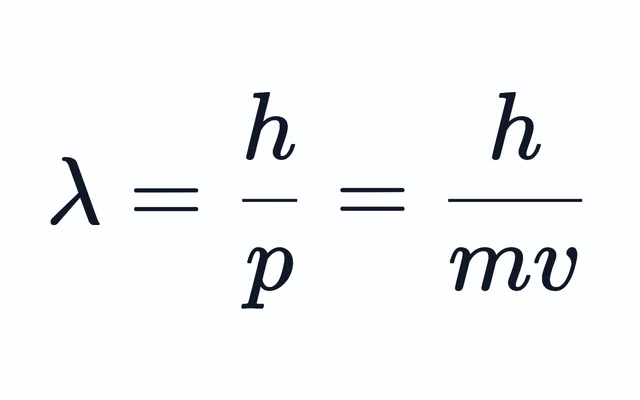
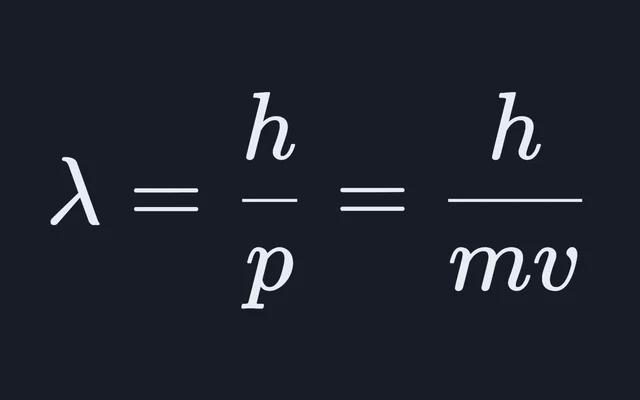
- De Broglie Wavelength Calculator gives the neutron, the one uncharged particle it offers, its mass in λ = h/p.
Related constants
- Proton mass, mp = 1.67262192595(52) × 10⁻²⁷ kg
- Atomic mass constant, mu = 1.66053906892(52) × 10⁻²⁷ kg
- Planck constant, h = 6.62607015 × 10⁻³⁴ J·s
See also
- The physical constants table, every constant side by side
- Mass conversion table
- Neutron mass on Wikipedia
Source: CODATA 2022 recommended values, published by NIST.
The values are facts and free to use; this page’s selection and presentation are © 2026 ScienceQuest.
Updated