Atomic mass constant, mu
One twelfth of the mass of a carbon-12 atom: the unified atomic mass unit, u, also called the dalton, Da. Atomic and molecular masses are given in it, and its value in kilograms is measured, so every mass converted to kilograms carries its uncertainty.
mu = 1.66053906892(52) × 10⁻²⁷ kg
CODATA 2022, measured. Standard uncertainty 0.00000000052 × 10⁻²⁷ kg, which is 3.1 × 10⁻¹⁰ of the value.
Not a row of the physical constants table, which keeps to the exact constants and G.
Try it in Kinetic Theory Gas Simulator, States of Matter Simulator and Charged Particle in a Magnetic Field Simulator.
In other units
Measured values are in CODATA’s concise form: the digits in brackets are the standard uncertainty in the last two places, so 6.67430(15) means 6.67430 ± 0.00015.
| Quantity | Value |
|---|---|
| mu | 1.66053906892(52) × 10⁻²⁷ kg |
| mu | 1.66053906892(52) × 10⁻²⁴ g |
| Rest energy | 931.49410372(29) MeV |
| 1 kg | 6.0221407537(19) × 10²⁶ u |
| Molar mass constant | 1.00000000105(31) g/mol |
Atomic mass constant in g
- 1.66053906892(52) × 10⁻²⁷ kg × 1000 g/kg
- = 1.66053906892(52) × 10⁻²⁴ g
Rest energy in MeV
- mᵤc² = 1.66053906892(52) × 10⁻²⁷ kg × (299,792,458 m/s)² ÷ (1.602176634 × 10⁻¹³ J/MeV)
- = 931.49410372(29) MeV
The energy in one dalton of mass, the factor that turns a mass defect in u into a binding energy.
1 kg in u
- 1 kg ÷ (1.66053906892(52) × 10⁻²⁷ kg/u)
- = 6.0221407537(19) × 10²⁶ u
Molar mass constant in g/mol
- 6.02214076 × 10²³ mol⁻¹ × 1.66053906892(52) × 10⁻²⁷ kg × 1000 g/kg
- = 1.00000000105(31) g/mol
The Avogadro constant times the atomic mass constant: exactly 1 g/mol until 2019, measured since, because the mole became a fixed count.
Where the value comes from
By definition a carbon-12 atom, free, at rest and in its ground state, is exactly 12 u. The dalton’s value in kilograms comes through the electron: Penning traps measure the electron’s mass relative to a carbon ion, its relative atomic mass, and the electron’s mass in kilograms follows from the Rydberg and fine-structure constants.
Because the electron fixes this conversion and the other particles are converted through it, the masses in kilograms move together. Between the 2018 and 2022 adjustments the atomic mass constant rose by 1.4 parts in a billion, 4.6 times its 2018 uncertainty, and the electron, proton and neutron masses in kilograms rose with it, by 1.4, 1.4 and 1.5 parts in a billion.
The dalton from the electron mass
- m_u = m_e ÷ A_r(e)
- = 9.1093837139(28) × 10⁻³¹ kg ÷ (5.485799090441(97) × 10⁻⁴)
- = 1.66053906892(52) × 10⁻²⁷ kg
Which form to use
Multiply a mass in u by 1.66054 × 10⁻²⁷ kg to get kilograms. A water molecule, 18.015 u from the standard atomic weights, has an average mass of 2.991 × 10⁻²⁶ kg.
Biochemistry calls the same unit the dalton and gives protein masses in kilodaltons: one molecule of a 50 kDa protein has a mass of 8.3 × 10⁻²³ kg, and a mole of it is 50 kg.
Common mistakes
- Confusing the unit with the constant. The u and the dalton are units of mass, the atomic mass constant is the value of one of them in kilograms, and a relative atomic mass, such as carbon-12’s 12, is a pure number with no unit at all.
- Taking 1 g/mol divided by the Avogadro constant as exactly 1 u. That held until 2019; now the molar mass constant is measured, and it sits 1.1 parts in a billion above 1 g/mol.
- Using a neutral atom’s mass for an ion. Each electron removed or added changes the mass by 0.000549 u, which a mass spectrometer reading to four decimal places can see.
Tools and simulators that use it
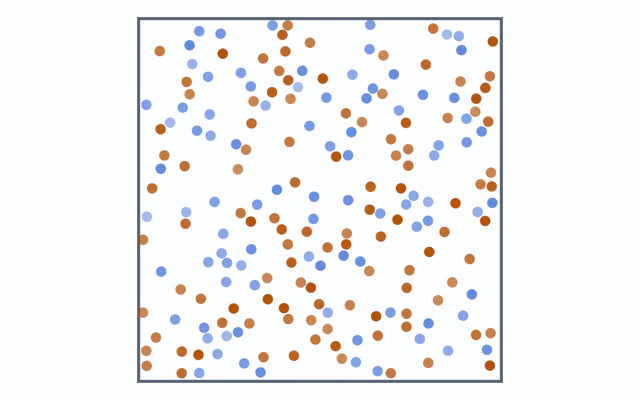
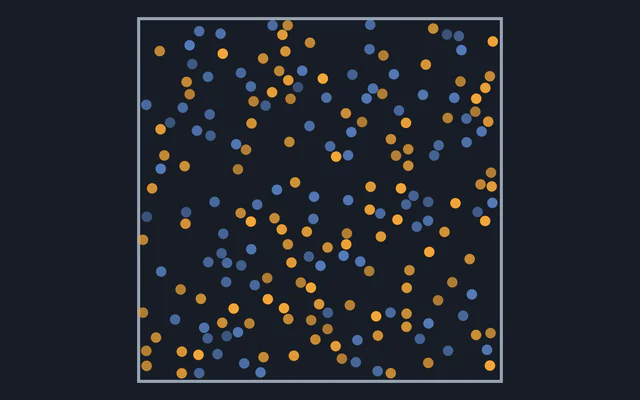
- Kinetic Theory Gas Simulator turns each gas’s relative molecular mass into the mass of one molecule, which sets how fast its molecules move at a given temperature.
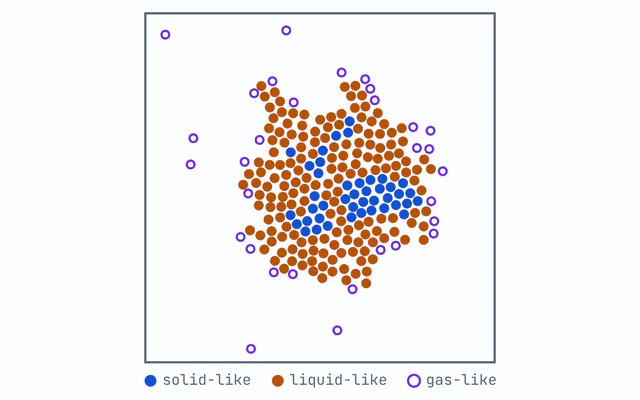
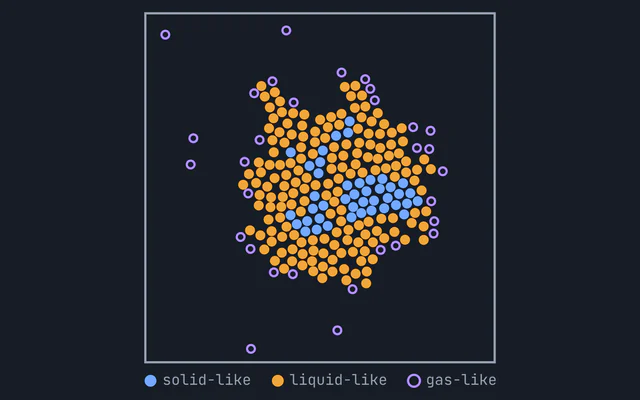
- States of Matter Simulator gives each argon atom its mass in kilograms, from argon’s relative atomic mass.
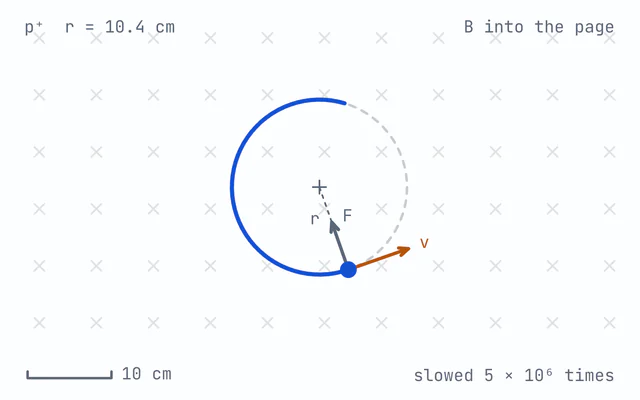
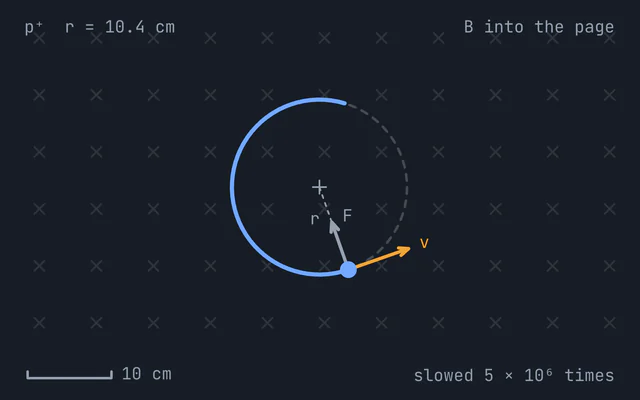
- Charged Particle in a Magnetic Field Simulator turns each isotope’s atomic mass into kilograms for the mass spectrometer, less one electron for the singly charged ion.
- Bohr Model and Hydrogen Spectrum Simulator turns the atomic masses of lithium-7, beryllium-9, boron-11 and carbon-12 into the nuclear masses of their one-electron ions.
- De Broglie Wavelength Calculator takes a custom particle’s mass in u.
Related constants
- Avogadro constant, NA = 6.02214076 × 10²³ mol⁻¹
- Electron mass, me = 9.1093837139(28) × 10⁻³¹ kg
- Proton mass, mp = 1.67262192595(52) × 10⁻²⁷ kg
- Neutron mass, mn = 1.67492750056(85) × 10⁻²⁷ kg
See also
- The physical constants table, every constant side by side
- The elements, each with the mass of one atom worked out
- Atomic mass constant on Wikipedia
Source: CODATA 2022 recommended values, published by NIST.
The values are facts and free to use; this page’s selection and presentation are © 2026 ScienceQuest.
Updated