Electron mass, me
The rest mass of the electron, the lightest known particle with an electric charge. It is measured rather than defined, and its value in kilograms comes from the Rydberg and fine-structure constants, not from weighing anything.
me = 9.1093837139(28) × 10⁻³¹ kg
CODATA 2022, measured. Standard uncertainty 0.0000000028 × 10⁻³¹ kg, which is 3.1 × 10⁻¹⁰ of the value.
Not a row of the physical constants table, which keeps to the exact constants and G.
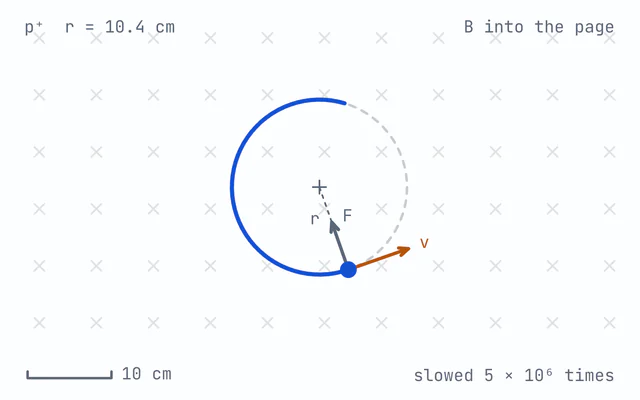
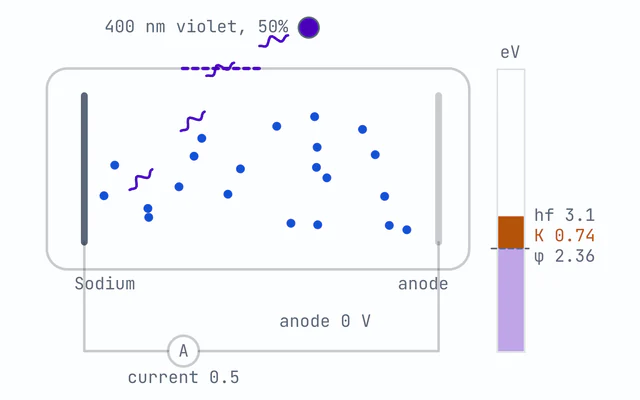
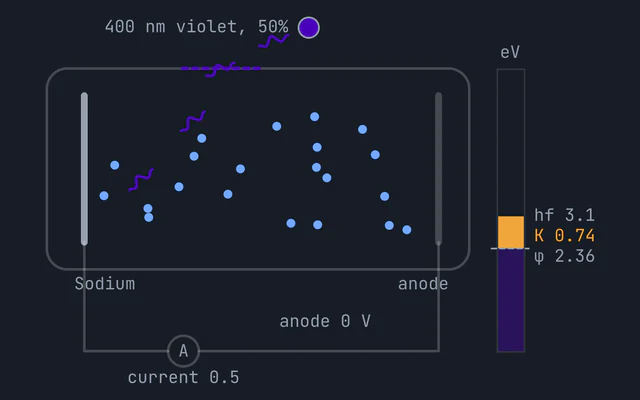
Try it in Bohr Model and Hydrogen Spectrum Simulator, Charged Particle in a Magnetic Field Simulator and Photoelectric Effect Simulator.
In other units
Measured values are in CODATA’s concise form: the digits in brackets are the standard uncertainty in the last two places, so 6.67430(15) means 6.67430 ± 0.00015.
| Quantity | Value |
|---|---|
| me | 9.1093837139(28) × 10⁻³¹ kg |
| me | 9.1093837139(28) × 10⁻²⁸ g |
| Rest energy | 0.51099895069(16) MeV |
Electron mass in g
- 9.1093837139(28) × 10⁻³¹ kg × 1000 g/kg
- = 9.1093837139(28) × 10⁻²⁸ g
Rest energy in MeV
- mₑc² = 9.1093837139(28) × 10⁻³¹ kg × (299,792,458 m/s)² ÷ (1.602176634 × 10⁻¹³ J/MeV)
- = 0.51099895069(16) MeV
The energy equivalent mₑc², which particle physics gives as the mass itself: 0.511 MeV/c².
Where the value comes from
No balance weighs an electron. Its mass in kilograms comes from the definition of the Rydberg constant, rearranged as m_e = 2hR∞/(cα²): h and c are exact, R∞ is known to about a part in a trillion from the spectra of hydrogen and deuterium, and almost all of the uncertainty comes from the fine-structure constant α, which enters squared. With CODATA 2022’s R∞ and α the relation gives 9.109383714 × 10⁻³¹ kg, the value above to ten figures.
That is also why the number moved. CODATA 2018 gave 9.1093837015(28) × 10⁻³¹ kg, and the 2022 value is higher by 1.4 parts in a billion, 4.4 times the uncertainty quoted in 2018, because α came down by 6.9 parts in 10¹⁰ and the mass moves by twice α’s change, the other way.
Which form to use
With SI units use 9.109 × 10⁻³¹ kg, or 9.109 × 10⁻²⁸ g in a chemistry problem. Particle physics works with the rest energy instead: the electron is 0.511 MeV/c², and 511 keV is the energy of each of the two gamma rays an electron and a positron give off when they annihilate at rest.
Next to a nucleus it is light. The proton is 1836.15 times heavier, so an atom’s mass sits almost entirely in its nucleus, while its size is set by the electron: the Bohr radius goes as 1/mₑ. In atomic mass units the electron is 0.00054858 u, about 1/1823 of a dalton.
Whether an electron can be treated classically depends on its kinetic energy against that rest energy. Accelerated through 100 V, its classical wavelength, h/√(2m_eK), is 0.0049 percent too long; through 200 kV, a common voltage for a transmission electron microscope, it is 9.3 percent too long, and only the relativistic momentum will do.
Common mistakes
- Using mₑ where hydrogen needs the reduced mass. The electron and the proton both circle their common centre of mass, and with
μ = m_e m_p/(m_e + m_p)in place of mₑ every level of hydrogen moves by 0.054 percent. The difference between that correction for hydrogen and for deuterium is how deuterium was discovered, in 1932. - Mixing the mass with its energy. 0.511 MeV/c² is a mass and 0.511 MeV an energy; to turn the first into kilograms, multiply by 1.602 × 10⁻¹³ J/MeV and divide by c², rather than multiply.
- Copying an older table’s digits. CODATA 2018’s 9.1093837015 × 10⁻³¹ kg is superseded rather than a misprint, and it agrees with the 2022 value to only 8 significant figures.
Tools and simulators that use it
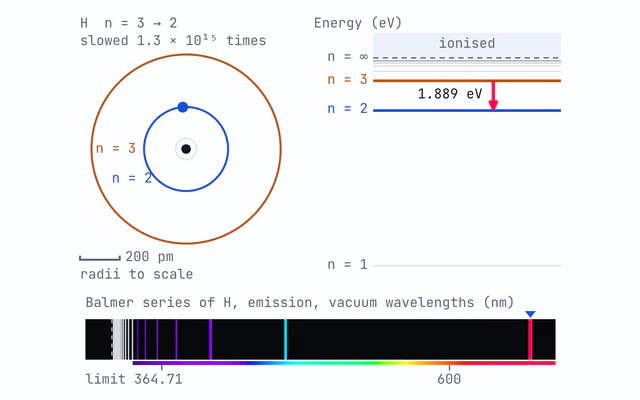
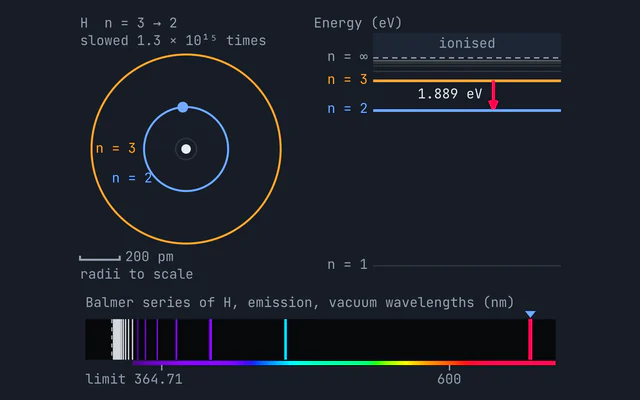
- Bohr Model and Hydrogen Spectrum Simulator sets each orbit’s speed, v = Zℏ/(mₑa₀n), and the reduced-mass correction M/(M + mₑ) that moves hydrogen’s lines away from deuterium’s.
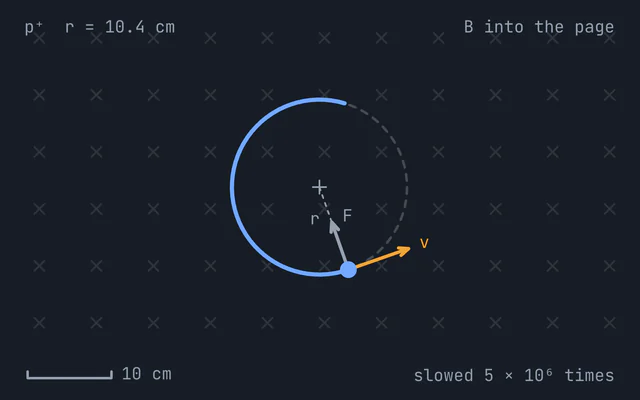
- Charged Particle in a Magnetic Field Simulator gives the electron and the positron their mass in r = mv/(qB), and takes one electron off each atom’s mass for its singly charged ion.
- Photoelectric Effect Simulator turns each photoelectron’s maximum kinetic energy into its speed, v = √(2K/mₑ).
- De Broglie Wavelength Calculator takes it as the mass of the electron it opens on, accelerated through 100 V, in λ = h/p and in the rest energy that keeps the momentum relativistic.
Related constants
- Proton mass, mp = 1.67262192595(52) × 10⁻²⁷ kg
- Atomic mass constant, mu = 1.66053906892(52) × 10⁻²⁷ kg
- Rydberg constant, R∞ = 10,973,731.568157(12) m⁻¹
- Bohr radius, a₀ = 5.29177210544(82) × 10⁻¹¹ m
See also
- The physical constants table, every constant side by side
- Mass conversion table
- Energy conversion table, with the electronvolt
- Electron mass on Wikipedia
Source: CODATA 2022 recommended values, published by NIST.
The values are facts and free to use; this page’s selection and presentation are © 2026 ScienceQuest.
Updated