Proton mass, mp
The rest mass of the proton, the nucleus of a hydrogen atom. It is measured, most precisely as a ratio to the mass of a carbon ion, and it is about 1836 times the mass of the electron.
mp = 1.67262192595(52) × 10⁻²⁷ kg
CODATA 2022, measured. Standard uncertainty 0.00000000052 × 10⁻²⁷ kg, which is 3.1 × 10⁻¹⁰ of the value.
Not a row of the physical constants table, which keeps to the exact constants and G.
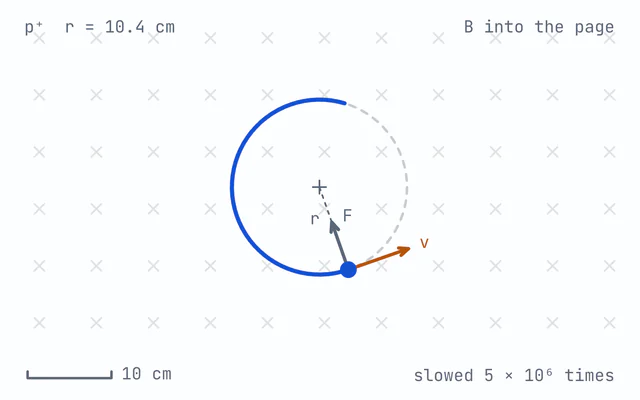
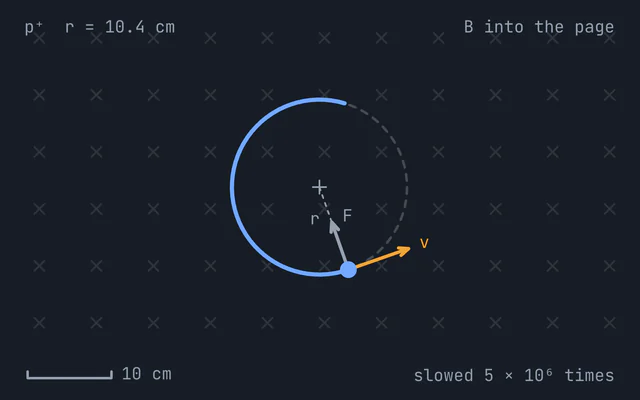
Try it in Bohr Model and Hydrogen Spectrum Simulator, Charged Particle in a Magnetic Field Simulator and De Broglie Wavelength Calculator.
In other units
Measured values are in CODATA’s concise form: the digits in brackets are the standard uncertainty in the last two places, so 6.67430(15) means 6.67430 ± 0.00015.
| Quantity | Value |
|---|---|
| mp | 1.67262192595(52) × 10⁻²⁷ kg |
| mp | 1.67262192595(52) × 10⁻²⁴ g |
| Rest energy | 938.27208943(29) MeV |
Proton mass in g
- 1.67262192595(52) × 10⁻²⁷ kg × 1000 g/kg
- = 1.67262192595(52) × 10⁻²⁴ g
Rest energy in MeV
- mₚc² = 1.67262192595(52) × 10⁻²⁷ kg × (299,792,458 m/s)² ÷ (1.602176634 × 10⁻¹³ J/MeV)
- = 938.27208943(29) MeV
The proton’s mass as nuclear and particle physics quote it, in MeV/c².
Where the value comes from
A Penning trap holds a single ion in a strong magnetic field and times how fast it circles, a frequency that goes as its charge over its mass. Comparing a proton with a carbon ion in the same trap gives the proton’s relative atomic mass, 1.0072764665789(83) in CODATA 2022, to better than a part in a hundred billion. The atomic mass constant turns that ratio into kilograms and brings its own uncertainty, which is nearly all of the proton mass’s.
So the value in kilograms moves with the atomic mass constant. CODATA 2018 gave 1.67262192369(51) × 10⁻²⁷ kg, and the 2022 value is higher by 1.4 parts in a billion, 4.4 times the 2018 uncertainty, the same shift as the electron’s, while the proton’s relative atomic mass changed by only 0.042 parts in a billion.
Which form to use
Use 1.673 × 10⁻²⁷ kg in SI work, 938.272 MeV/c² in nuclear and particle physics, and 1.007276467 u on the atomic mass scale. It is a little more than 1 u because the dalton is a twelfth of a carbon-12 atom, whose protons and neutrons are bound and weigh less together than they do apart.
A hydrogen-1 atom is the proton and one electron, which adds 0.054 percent; the hydrogen ion H⁺ is the bare proton.
Common mistakes
- Taking the proton as exactly 1 u, or a mole of protons as 1 g. It is 1.007 u, and a mole of protons is 1.007 g, 0.73 percent more.
- Using MeV as a unit of mass. 938.272 MeV is the proton’s rest energy; its mass is 938.272 MeV/c², and the c² can be dropped only in units where c = 1.
- Taking the periodic table’s 1.008 for hydrogen as the proton’s mass in u. That is the standard atomic weight: an average over the isotopes found in nature, for the atom with its electron.
Tools and simulators that use it
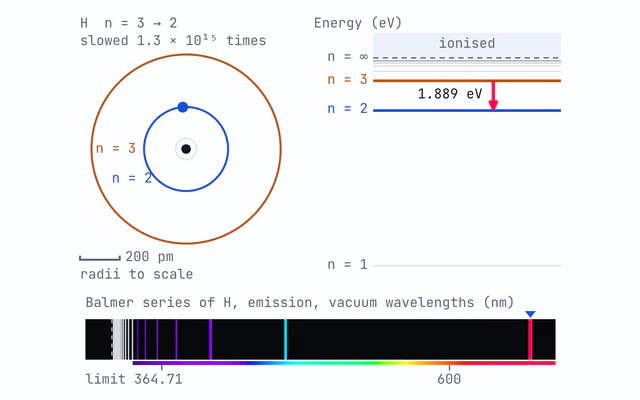
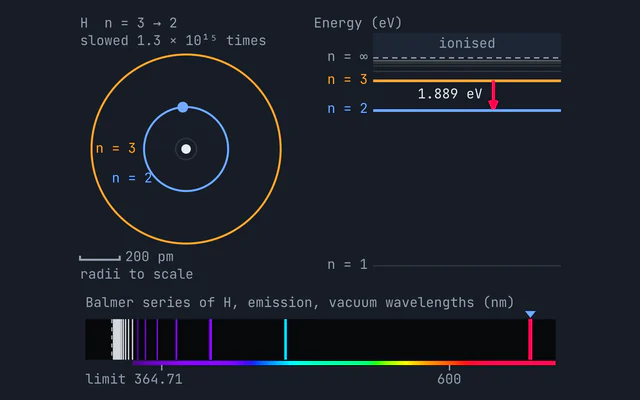
- Bohr Model and Hydrogen Spectrum Simulator gives hydrogen its nucleus, and with it the reduced-mass correction that sets hydrogen’s lines apart from deuterium’s.
- Charged Particle in a Magnetic Field Simulator gives the proton its mass in the radius r = mv/(qB) and the period 2πm/(qB).
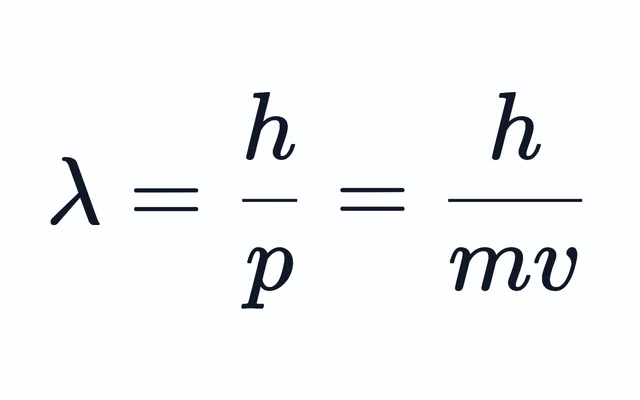
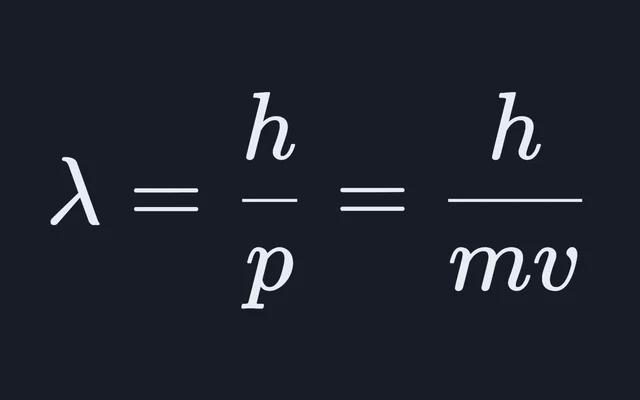
- De Broglie Wavelength Calculator takes it as the proton’s mass in λ = h/p.
Related constants
- Electron mass, me = 9.1093837139(28) × 10⁻³¹ kg
- Neutron mass, mn = 1.67492750056(85) × 10⁻²⁷ kg
- Atomic mass constant, mu = 1.66053906892(52) × 10⁻²⁷ kg
See also
- The physical constants table, every constant side by side
- Mass conversion table
- Proton mass on Wikipedia
Source: CODATA 2022 recommended values, published by NIST.
The values are facts and free to use; this page’s selection and presentation are © 2026 ScienceQuest.
Updated