Rydberg constant, R∞
The constant in Rydberg’s formula for the wavelengths of hydrogen’s spectral lines, for a nucleus of infinite mass. Multiplied by hc it becomes the Rydberg energy, 13.606 eV, the energy that frees the electron from the ground state of such an atom.
R∞ = 10,973,731.568157(12) m⁻¹
CODATA 2022, measured. Standard uncertainty 0.000012 m⁻¹, which is 1.1 × 10⁻¹² of the value.
Not a row of the physical constants table, which keeps to the exact constants and G.
Try it in Bohr Model and Hydrogen Spectrum Simulator and Atomic Orbitals Visualizer.
In other units
Measured values are in CODATA’s concise form: the digits in brackets are the standard uncertainty in the last two places, so 6.67430(15) means 6.67430 ± 0.00015.
| Quantity | Value |
|---|---|
| R∞ | 10,973,731.568157(12) m⁻¹ |
| Rydberg energy | 13.605693122990(15) eV |
| R∞ | 109,737.31568157(12) cm⁻¹ |
Rydberg energy in eV
- hcR∞ = 1.986445857… × 10⁻²⁵ J·m × 10,973,731.568157(12) m⁻¹ ÷ (1.602176634 × 10⁻¹⁹ J/eV)
- = 13.605693122990(15) eV
Rydberg constant in cm⁻¹
- 10,973,731.568157(12) m⁻¹ × 10⁻² m/cm
- = 109,737.31568157(12) cm⁻¹
Wavenumbers per centimetre, the unit spectroscopy works in.
Where the value comes from
Johannes Rydberg’s formula of 1888 gives the wavelength of every line of hydrogen as 1/λ = R(1/n₁² − 1/n₂²), with whole numbers n₁ < n₂ and a single constant R, and the series found after it, in the ultraviolet and the infrared, fit it too. Bohr’s model of 1913 explained the constant as R∞ = m_e e⁴/(8ε₀²h³c), which with the fine-structure constant reads R∞ = α²m_e c/(2h).
The measurement now runs the other way. R∞ is known to 1.1 × 10⁻¹² of its value from the spectra of hydrogen and deuterium, and CODATA uses it, with α, to fix the electron’s mass in kilograms. This site stores the Rydberg energy, 13.605693122990(15) eV, and derives R∞ from it with the exact h, c and e, so an energy and a wavelength worked out from the two always satisfy λE = hc.
Unlike the particle masses, R∞ barely moved in 2022. CODATA 2018 gave 10,973,731.568160(21) m⁻¹; the 2022 value differs by 0.14 times that uncertainty, and the uncertainty itself shrank by 43 percent.
Which form to use
The school figure, 1.097 × 10⁷ m⁻¹, is 0.034 percent low and right to four figures. For hydrogen itself use R_H = R∞ m_p/(m_p + m_e), 1.0967758 × 10⁷ m⁻¹, which allows for the recoil of the proton. With it, the Balmer line from n = 3 to n = 2, Hα, comes out at 656.47 nm in vacuum.
In energy terms, level n of a one-electron ion with nuclear charge Z lies 13.606 × Z²/n² eV below a free electron, before the same recoil correction. The shortest wavelength in hydrogen’s Lyman series, the series limit, is 1/R_H, 91.176 nm; 1/R∞, 91.127 nm, is the limit for an infinitely heavy nucleus.
Common mistakes
- Using R∞ for hydrogen when the fourth figure matters. R∞ assumes a fixed nucleus and R_H is 0.054 percent smaller, enough to move Hα from 656.11 nm to 656.47 nm.
- Forgetting Z² for an ion. Every wavenumber and every energy of a one-electron ion scales with the square of its nuclear charge, so He⁺, with Z = 2, has lines at a quarter of hydrogen’s wavelengths, apart from the recoil correction.
- Mixing up the forms. R∞ in m⁻¹ is a wavenumber; the Rydberg energy, hcR∞, and the Rydberg frequency, cR∞, are the same constant multiplied by hc or by c, and the value in cm⁻¹ is the value in m⁻¹ divided by 100.
Tools and simulators that use it
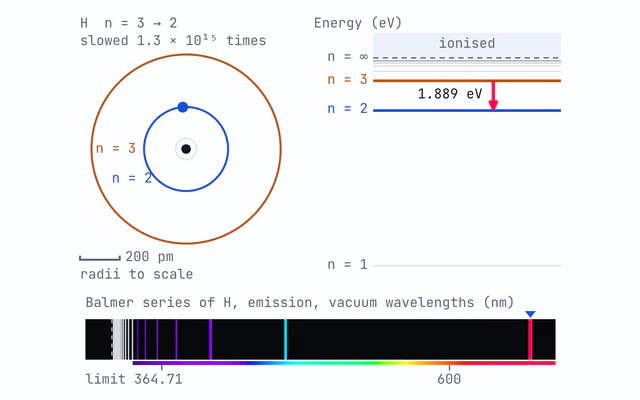
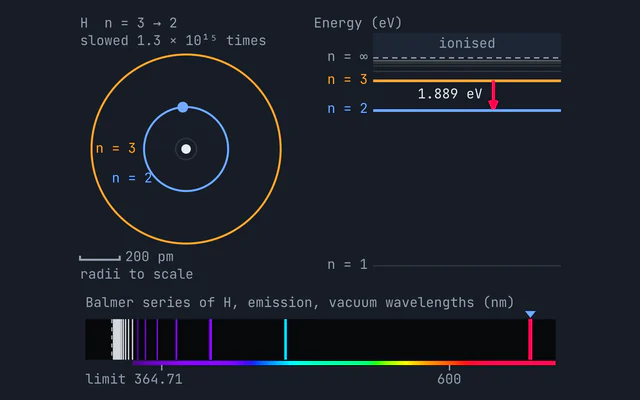
- Bohr Model and Hydrogen Spectrum Simulator computes every line from Rydberg’s formula with R = (μ/mₑ)R∞, and every level from the Rydberg energy.
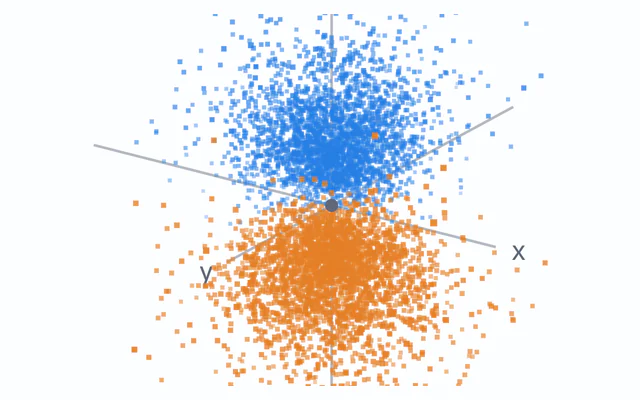
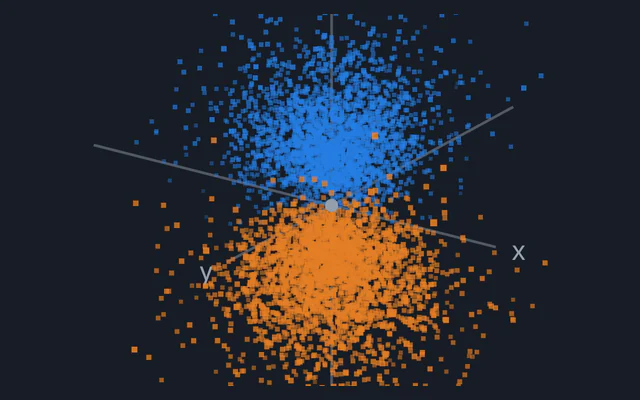
- Atomic Orbitals Visualizer gives each level its energy, −13.606 × Z²/n² eV, from the Rydberg energy.
Related constants
- Bohr radius, a₀ = 5.29177210544(82) × 10⁻¹¹ m
- Electron mass, me = 9.1093837139(28) × 10⁻³¹ kg
- Planck constant, h = 6.62607015 × 10⁻³⁴ J·s
- Speed of light in vacuum, c = 299,792,458 m/s
See also
- The physical constants table, every constant side by side
- Photon energy calculator, for the energy of any line
- Rydberg constant on Wikipedia
Source: CODATA 2022 recommended values, published by NIST.
The values are facts and free to use; this page’s selection and presentation are © 2026 ScienceQuest.
Updated