Interventricular foramen
The interventricular foramen, or foramen of Monro, is the opening through which each lateral ventricle drains into the third ventricle. There is one on each side. (Gray 1918, 4c. The Fore-brain; StatPearls, Colloid Brain Cyst)
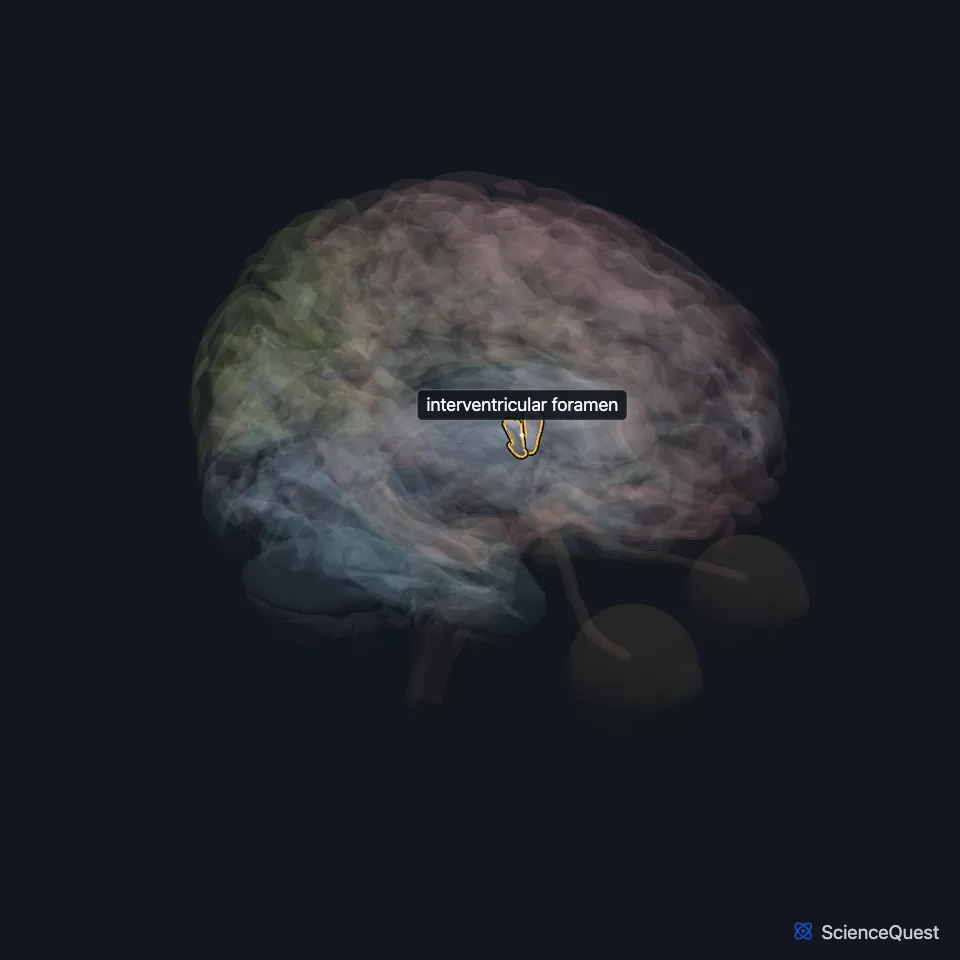
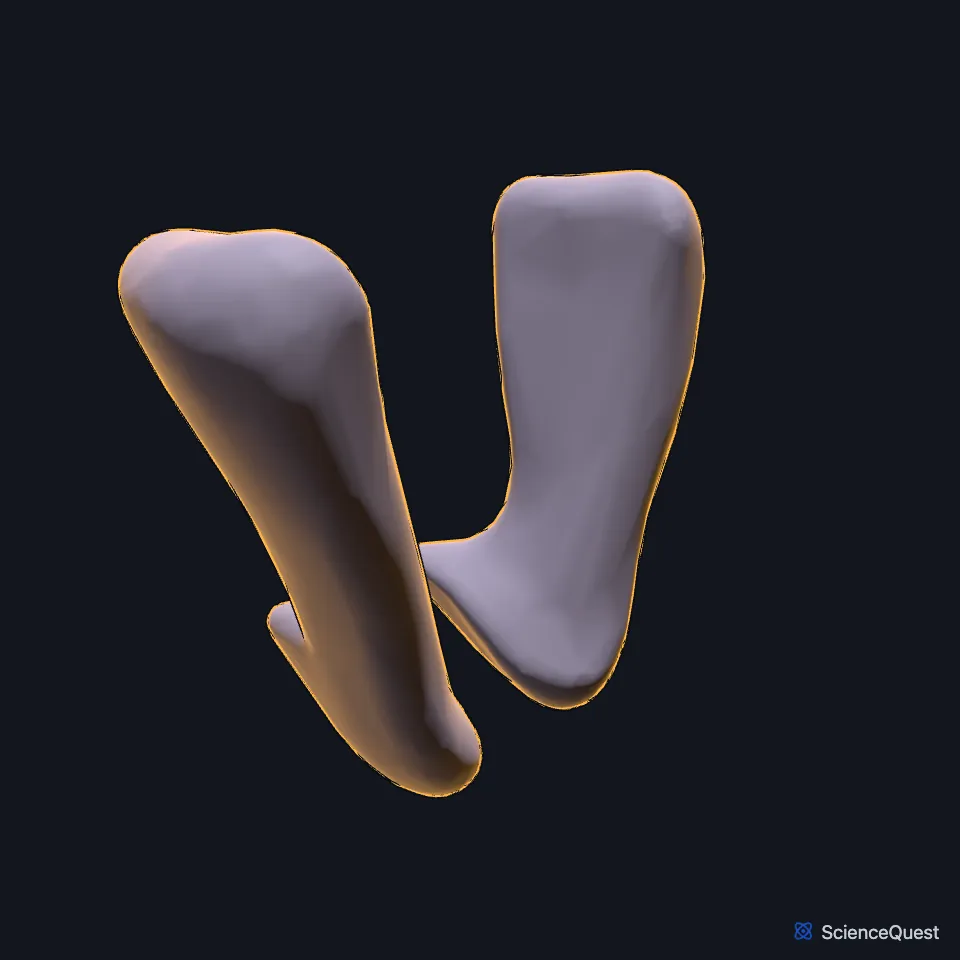
Where is the interventricular foramen?
It opens between the columns of the fornix in front and the front end of the thalamus behind, at the front of the third ventricle. (Gray 1918, 4c. The Fore-brain; StatPearls, Colloid Brain Cyst)
The central part of each lateral ventricle runs back from the foramen to the splenium of the corpus callosum, and the anterior horn runs forward from it into the frontal lobe. (StatPearls, Ventricular System; Gray 1918, 4c. The Fore-brain)
What is the shape of the interventricular foramen?
Its size and shape follow the size of the ventricles. With small ventricles each foramen is a crescent, and as they enlarge it becomes round. (StatPearls, Ventricular System)
What does the interventricular foramen do?
It is the first step on the fluid’s route: cerebrospinal fluid passes from the lateral ventricles through the foramina to the third ventricle, then through the cerebral aqueduct to the fourth. (StatPearls, Choroid Plexus and Hydrocephalus)
What passes through the interventricular foramen?
Small vessels pass through it: the medial posterior choroidal arteries, the superior choroidal vein and the septal veins. Behind its lining the choroid plexuses of the two lateral ventricles join across the midline. (StatPearls, Ventricular System; Gray 1918, 4c. The Fore-brain)
Each internal cerebral vein begins here, where the choroidal vein meets the terminal vein, now called the superior thalamostriate vein. (Gray 1918, 4c. The Fore-brain; FMA, FMA50997)
What blocks the interventricular foramen?
More than 99% of colloid cysts sit at the front of the third ventricle, at or near the foramen. A cyst can act as a ball valve, trapping fluid in the lateral ventricles and causing obstructive hydrocephalus, and rarely sudden death. (StatPearls, Colloid Brain Cyst)
The foramina of Monro are among the commonest sites of blockage in obstructive hydrocephalus, along with the cerebral aqueduct and the fourth ventricle. (StatPearls, Hydrocephalus)
Touches in this model
Measured on the BodyParts3D meshes: surfaces within 2 mm of the interventricular foramen, nearest first, 12 of 15.
- Choroid plexus of left cerebral hemisphere in contact
- Choroid plexus of right cerebral hemisphere in contact
- Left caudate nucleus in contact
- Left fornix of forebrain in contact
- Left lateral ventricle in contact
- Left stria terminalis in contact
- Right caudate nucleus in contact
- Right fornix of forebrain in contact
- Right lateral ventricle in contact
- Right stria terminalis in contact
- Third ventricle in contact
- Left stria medullaris of thalamus 0.3 mm away
Sources
Sources read between and
- Gray’s Anatomy of the Human Body, 20th US edition (1918), IX. Neurology, 4c. The Fore-brain or Prosencephalon. Henry Gray. Public domain. Read .
- StatPearls, Colloid Brain Cyst. Steven Tenny; William Thorell. Last update . CC BY-NC-ND 4.0. Read .
- StatPearls, Neuroanatomy, Ventricular System. Saraswati Satyanarayan Shenoy; Forshing Lui. Last update . CC BY-NC-ND 4.0. Read .
- StatPearls, Neuroanatomy, Choroid Plexus. Kinaan Javed; Vamsi Reddy; Forshing Lui. Last update . CC BY-NC-ND 4.0. Read .
- StatPearls, Hydrocephalus. Miroslava Koleva; Orlando De Jesus. Last update . CC BY-NC-ND 4.0. Read .
- Foundational Model of Anatomy, via the EMBL-EBI Ontology Lookup Service, Superior thalamostriate vein (FMA50997), definition and Latin names. Not printed on the page. Read . Rechecked .
The values are facts and free to use; this page’s selection and presentation are © 2026 ScienceQuest.