Palmaris longus
The palmaris longus is a small, spindle-shaped muscle of the superficial flexor group on the front of the forearm, with a long, thin tendon that ends in the palm. Some people lack it. (StatPearls, Hand Palmaris Tendon)
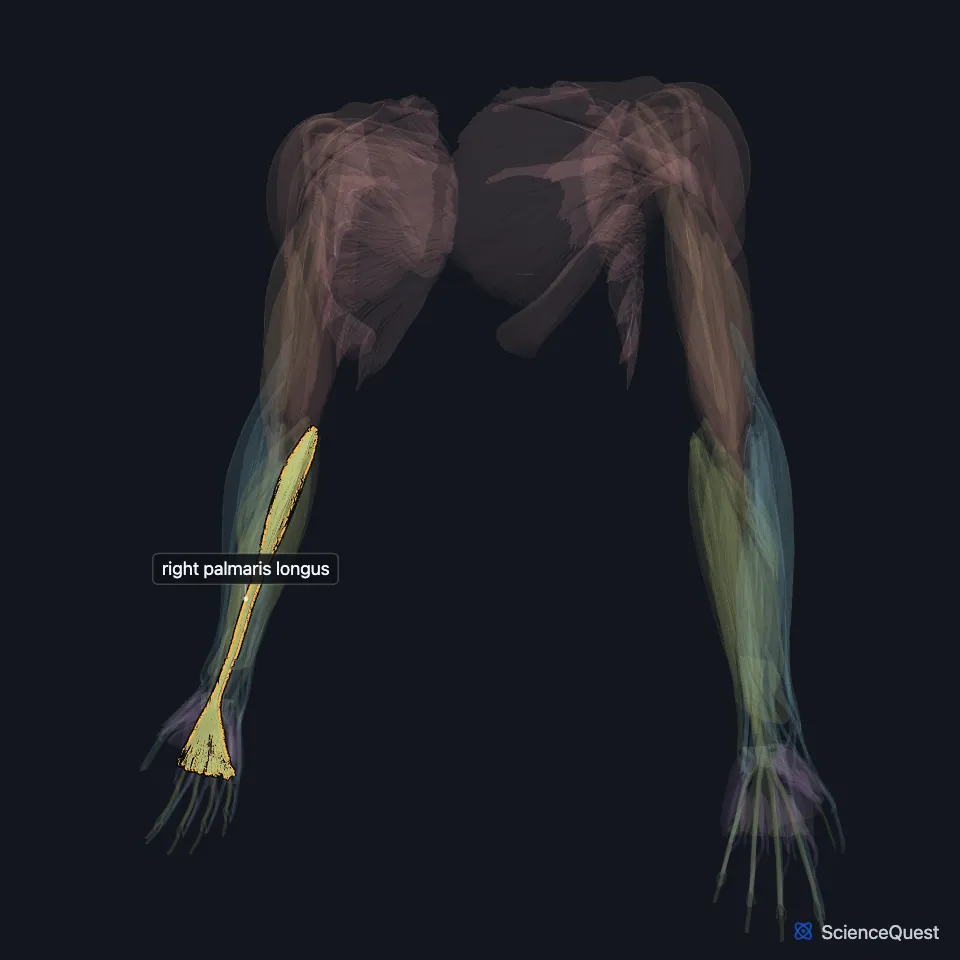
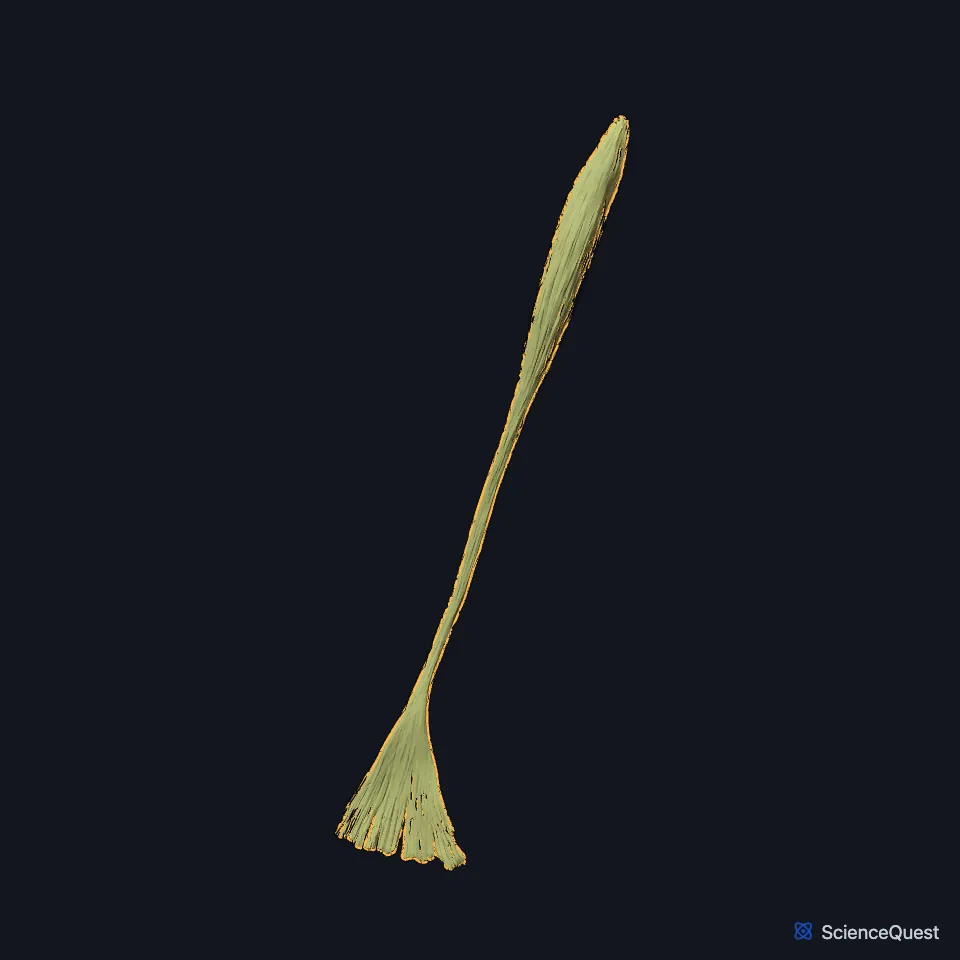
Open it in the Upper Limb Muscles Explorer See it alone in 3D
Where is the palmaris longus?
It lies on the medial side of the flexor carpi radialis. At the wrist its tendon sits near the middle, with the flexor carpi radialis tendon on one side and the flexor carpi ulnaris tendon on the other. (Gray’s Anatomy (1918), Volar Antibrachial Muscles; StatPearls, Hand Palmaris Tendon)
Where does the palmaris longus attach?
It arises from the medial epicondyle of the humerus through the common flexor tendon. Most of its tendon fibers pass over the flexor retinaculum, then fan out and weave into the palmar aponeurosis. (StatPearls, Hand Palmaris Tendon)
It often sends a slip of tendon to the abductor pollicis brevis, a short muscle of the thumb, and may help abduct the thumb through it. (StatPearls, Hand Palmaris Tendon; Gray’s Anatomy (1918), Volar Antibrachial Muscles)
What does the palmaris longus do?
It crosses the elbow and the wrist, so it adds a little flexion at both, and it appears to help tense the palmar aponeurosis. People born without it show no loss of grip or pinch strength. (StatPearls, Hand Palmaris Tendon)
Surgeons often harvest its tendon as a graft, for example to repair finger flexor and extensor tendons. The tendon is long and superficial, and taking it leaves no loss of wrist or forearm function. (StatPearls, Hand Palmaris Tendon)
Which nerve and artery supply the palmaris longus?
The median nerve supplies it. Gray’s 1918 traces that supply mainly to the sixth cervical nerve. (StatPearls, Median Nerve; Gray’s Anatomy (1918), Volar Antibrachial Muscles)
The ulnar artery supplies its blood. (StatPearls, Hand Palmaris Tendon)
Does everyone have a palmaris longus?
Some people lack it on one or both sides. You can test for it by touching the pads of your thumb and little finger together while flexing the wrist (the Schaeffer test): if the muscle is there, its tendon stands out at the front of the wrist. (StatPearls, Hand Palmaris Tendon)
When present it is one of the most variable muscles in the body. It can be doubled, have split tendons or two bellies, or insert elsewhere, such as the forearm fascia, the hypothenar muscles or the pisiform. (StatPearls, Hand Palmaris Tendon; Gray’s Anatomy (1918), Volar Antibrachial Muscles)
Where the sources differ
Reported rates of absence differ. StatPearls gives 2.5% to 26% depending on the population studied, and its forearm muscles article about 14%; Gray’s 1918 gives about 10%, and a 2013 meta-analysis of 26 studies pooled a rate of 20.25%. (StatPearls, Hand Palmaris Tendon and Forearm Muscles; Gray’s Anatomy (1918), Volar Antibrachial Muscles; Yammine 2013, Clin Anat 26(6): 709 to 718)
Sources disagree on who lacks it. StatPearls cites large studies that find absence more often in females, and on both sides more often than on one; the 2013 meta-analysis found no significant difference by sex, or between absence on one side and on both. (StatPearls, Hand Palmaris Tendon; Yammine 2013, Clin Anat 26(6): 709 to 718)
| Feature | Detail and source |
|---|---|
| Origin | Medial epicondyle of the humerus (common flexor tendon) (StatPearls, Hand Palmaris Tendon) |
| Insertion | Palmar aponeurosis and flexor retinaculum (StatPearls, Hand Palmaris Tendon) |
| Action | Weak flexion at the wrist and elbow; appears to help tense the palmar aponeurosis (StatPearls, Hand Palmaris Tendon) |
| Nerve | Median nerve (StatPearls, Median Nerve) |
Touches in this model
Measured on the BodyParts3D meshes: surfaces within 2 mm of the palmaris longus, nearest first, 12 of 15.
- Abductor digiti minimi of right hand in contact
- Flexor digiti minimi brevis of right hand in contact
- Flexor retinaculum of right wrist in contact
- Humeral head of right flexor carpi ulnaris in contact
- Humeroulnar head of right flexor digitorum superficialis in contact
- Right flexor carpi radialis in contact
- Right opponens pollicis in contact
- Set of lumbricals of right hand in contact
- Superficial head of right flexor pollicis brevis in contact
- Right humerus in contact
- Skin in contact
- Radial head of right flexor digitorum superficialis 0.1 mm away
Sources
Sources read between and
- StatPearls, Anatomy, Shoulder and Upper Limb, Hand Palmaris Tendon. David W. Cooper; Bracken Burns. Last update . CC BY-NC-ND 4.0. Read .
- Anatomy of the Human Body (Gray’s Anatomy), 20th US edition, 1918, Myology, The Muscles and Fasciae of the Forearm, 1. The Volar Antibrachial Muscles, pages 445 to 451; Internet Archive scan of the 1918 Lea and Febiger printing, terminology of 1918. Henry Gray; edited by Warren H. Lewis. Public domain. Read .
- StatPearls, Anatomy, Shoulder and Upper Limb, Median Nerve. Kelly A. Murphy; Nicholas Ryan; Adegbenro O. Fakoya. Last update . CC BY-NC-ND 4.0. Read .
- StatPearls, Anatomy, Shoulder and Upper Limb, Forearm Muscles. Brittney Mitchell; Lacey Whited. Last update . CC BY-NC-ND 4.0. Read .
- Clinical Anatomy (peer-reviewed systematic review and meta-analysis), Clinical prevalence of palmaris longus agenesis: a systematic review and meta-analysis (abstract, read through NCBI E-utilities, PMID 23825029). Yammine K. Abstract read on PubMed; no reuse licence stated. Read .
The values are facts and free to use; this page’s selection and presentation are © 2026 ScienceQuest.