Opponens pollicis
The opponens pollicis is the deepest and largest of the three thenar muscles, and it opposes the thumb. (StatPearls, Hand Thenar Eminence and Hand Muscles)
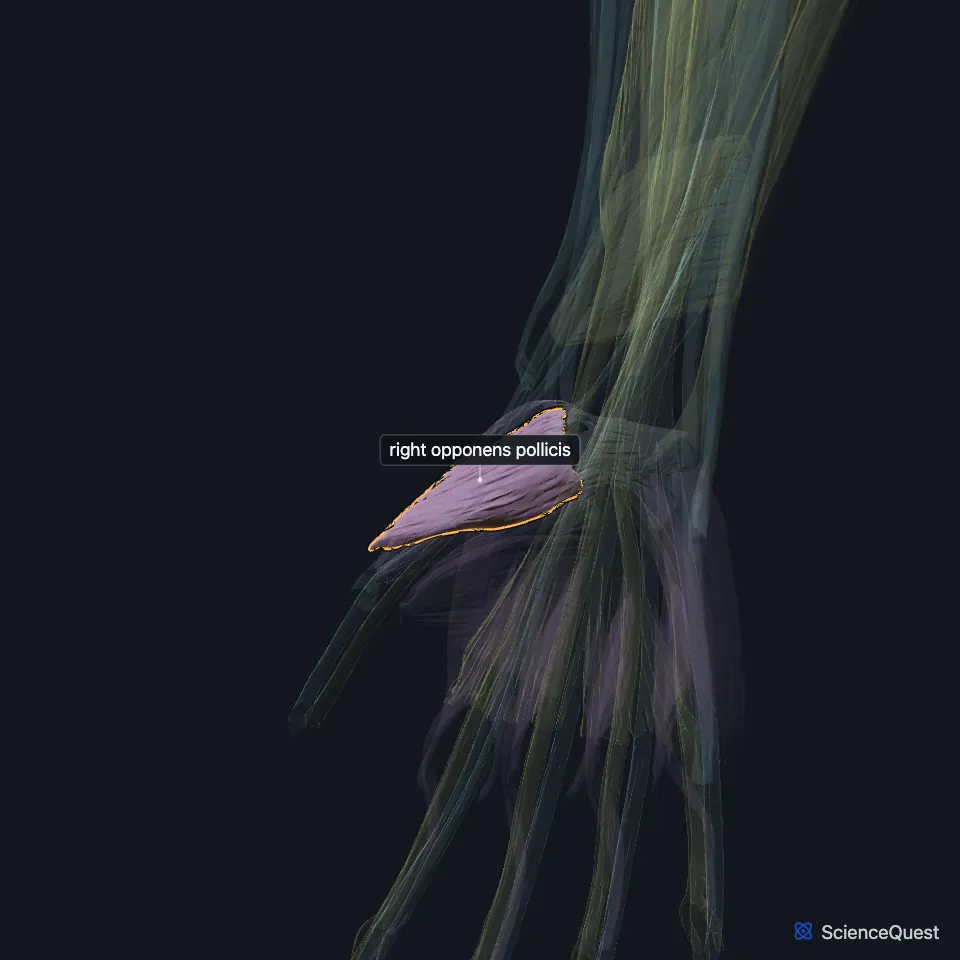
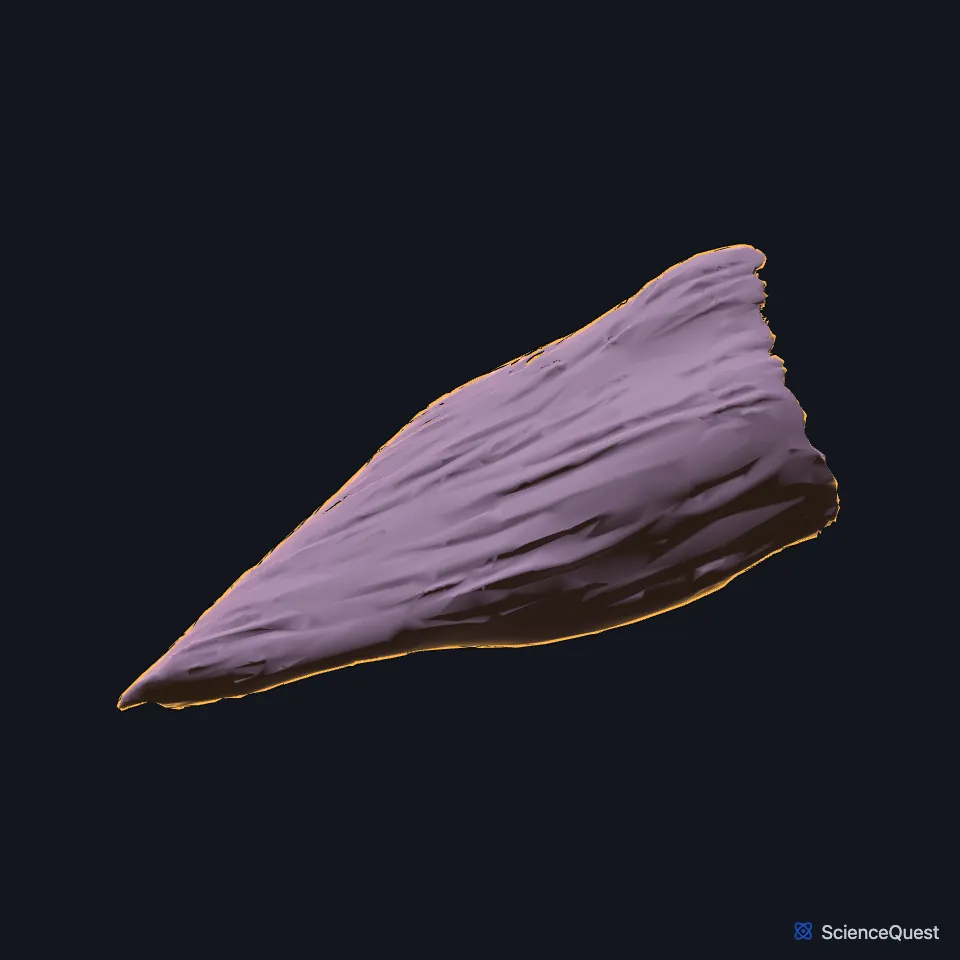
Open it in the Upper Limb Muscles Explorer See it alone in 3D
Where is the opponens pollicis?
It lies deep to the other two thenar muscles, under the abductor pollicis brevis and the flexor pollicis brevis. (StatPearls, Hand Thenar Eminence; Gray’s Anatomy (1918), Lateral Volar Muscles)
What does the opponens pollicis attach to?
It arises from the tubercle of the trapezium and the flexor retinaculum, and inserts along the whole length of the first metacarpal, on its radial side. (StatPearls, Hand Opponens Pollicis Muscle; Gray’s Anatomy (1918), Lateral Volar Muscles)
Of the three thenar muscles, only the opponens pollicis ends on the first metacarpal. The abductor and the flexor pollicis brevis both end on the thumb’s proximal phalanx. (StatPearls, Hand Thenar Eminence)
What does the opponens pollicis do?
Opposition brings the tip of the thumb to the tips of the other fingers. The opponens pollicis does it by drawing the thumb in across the palm, a movement made of flexion, medial rotation and palmar abduction. (StatPearls, Hand Thenar Eminence and Hand Opponens Pollicis Muscle)
Opposition lets the hand cup objects and makes the pinch grip possible. To touch the little finger, the thumb needs both opponens muscles: this one and the opponens digiti minimi. (StatPearls, Hand Opponens Pollicis Muscle)
Which nerve supplies the opponens pollicis?
The recurrent branch of the median nerve supplies it. In some people the ulnar nerve supplies it instead. (StatPearls, Hand Thenar Eminence and Hand Opponens Pollicis Muscle)
Damage to the recurrent motor branch of the median nerve denervates the thenar muscles, the opponens pollicis above all, and the thumb can no longer oppose. Clinicians call the result ape hand deformity. (StatPearls, Hand Thenar Eminence)
| Feature | Detail and source |
|---|---|
| Origin | Tubercle of the trapezium; flexor retinaculum (StatPearls, Hand Opponens Pollicis Muscle) |
| Insertion | Whole length of the first metacarpal, radial side (StatPearls, Hand Opponens Pollicis Muscle; Gray’s Anatomy (1918), Lateral Volar Muscles) |
| Action | Opposes the thumb (StatPearls, Hand Thenar Eminence) |
| Nerve | Recurrent branch of the median nerve (StatPearls, Hand Thenar Eminence) |
Touches in this model
Measured on the BodyParts3D meshes: surfaces within 2 mm of the opponens pollicis, nearest first.
- Flexor retinaculum of right wrist in contact
- Right abductor pollicis brevis in contact
- Right palmaris longus in contact
- Superficial head of right flexor pollicis brevis in contact
- Right first metacarpal bone in contact
- Right trapezium in contact
- Skin in contact
- Deep head of right flexor pollicis brevis 0.3 mm away
- Right flexor carpi radialis 0.4 mm away
- Right abductor pollicis longus 1.1 mm away
Sources
Sources read
- StatPearls, Anatomy, Shoulder and Upper Limb, Hand Thenar Eminence. Dylan Luxenburg; Michael G. Rizzo. Last update . CC BY-NC-ND 4.0. Read .
- StatPearls, Anatomy, Shoulder and Upper Limb, Hand Muscles. Ebubechi Okwumabua; Margaret A. Sinkler; Bruno Bordoni. Last update . CC BY-NC-ND 4.0. Read .
- Anatomy of the Human Body (Gray’s Anatomy), 20th US edition, 1918, Myology, The Muscles and Fasciae of the Hand, 1. The Lateral Volar Muscles, pages 461 to 462; Internet Archive scan of the 1918 Lea and Febiger printing, terminology of 1918. Henry Gray; edited by Warren H. Lewis. Public domain. Read .
- StatPearls, Anatomy, Shoulder and Upper Limb, Hand Opponens Pollicis Muscle. John D. Nguyen; Hieu Duong. Last update . CC BY-NC-ND 4.0. Read .
The values are facts and free to use; this page’s selection and presentation are © 2026 ScienceQuest.