Sternohyoid
The sternohyoid is a thin, narrow strap muscle at the front of the neck, running from behind the sternum and clavicle up to the hyoid bone. It is one of the four infrahyoid muscles. (Gray 1918, 5c. Supra- and Infrahyoid Muscles; StatPearls, Sternohyoid Muscle)
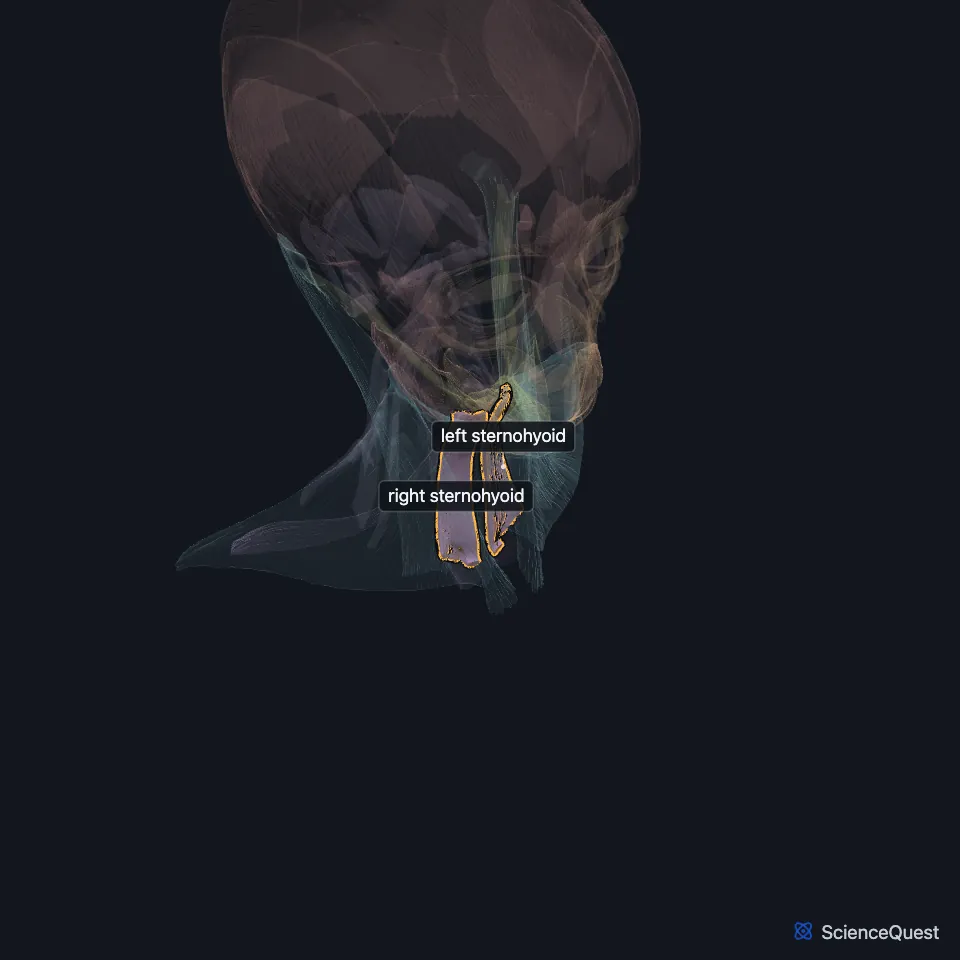
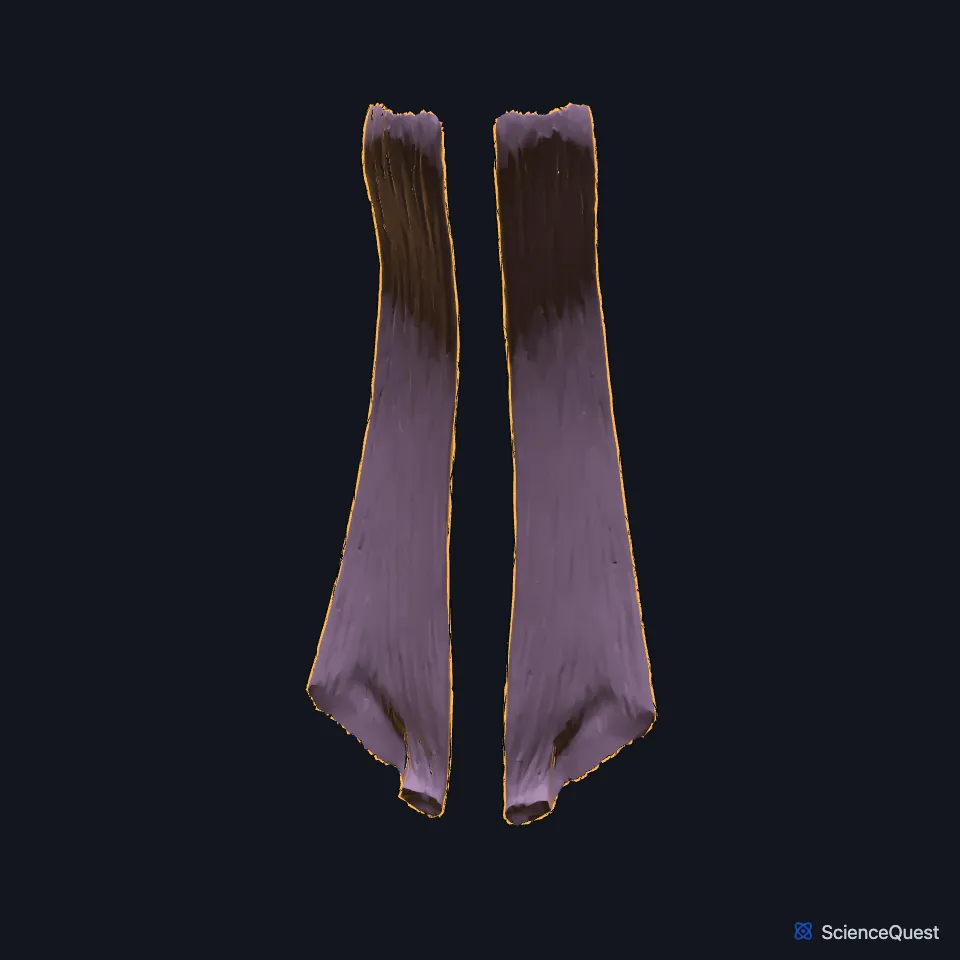
Open it in the Head and Neck Muscles Explorer See it alone in 3D
Where is the sternohyoid?
It arises from the back of the medial end of the clavicle, the posterior sternoclavicular ligament and the upper back of the manubrium of the sternum. It runs up and toward the midline to the lower border of the body of the hyoid bone. (Gray 1918, 5c. Supra- and Infrahyoid Muscles)
Low in the neck the two sternohyoids are well apart. They meet halfway up and run side by side from there to the hyoid. (Gray 1918, 5c. Supra- and Infrahyoid Muscles)
It lies just off the midline, over the sternothyroid and thyrohyoid, with the omohyoid along its outer side. The front edge of the sternocleidomastoid overlaps it. (StatPearls, Neck Triangle and Thyroid Muscles)
What does the sternohyoid do?
It pulls the hyoid bone back down after swallowing has drawn it up with the pharynx. It also lowers the hyoid as the jaw opens to speak, chew and swallow. (Gray 1918, 5c. Supra- and Infrahyoid Muscles; StatPearls, Sternohyoid Muscle)
With the other strap muscles it helps protect the trachea, the esophagus, blood vessels and the thyroid gland. (StatPearls, Sternohyoid Muscle)
What supplies the sternohyoid?
Branches of the ansa cervicalis, a nerve loop from the first three cervical nerves, supply it. Its blood comes from the superior thyroid artery. (StatPearls, Sternohyoid Muscle and Neck Triangle)
Why do surgeons move the sternohyoid?
The thyroid and parathyroid glands lie beneath the infrahyoid muscles. Surgeons retract the sternohyoid or dissect it away in thyroidectomy, parathyroidectomy, tracheostomy and laryngectomy, and they have used it as a muscle flap in reconstruction. (StatPearls, Sternohyoid Muscle)
How does the sternohyoid vary?
It may be doubled, carry an extra slip (Gray’s cleidohyoid) or be missing, and a tendinous band sometimes crosses it just above its origin. StatPearls also reports a single unpaired sternohyoid, and one that arose from the omohyoid’s tendon instead of the sternum. (Gray 1918, 5c. Supra- and Infrahyoid Muscles; StatPearls, Sternohyoid Muscle)
| Feature | Detail and source |
|---|---|
| Origin | Back of the medial end of the clavicle, the posterior sternoclavicular ligament and the upper back of the manubrium (Gray 1918, 5c. Supra- and Infrahyoid Muscles) |
| Insertion | Lower border of the body of the hyoid bone (Gray 1918, 5c. Supra- and Infrahyoid Muscles) |
| Action | Lowers the hyoid bone (StatPearls, Sternohyoid Muscle) |
| Nerve | Ansa cervicalis (C1 to C3) (StatPearls, Sternohyoid Muscle) |
Touches in this model
Measured on the BodyParts3D meshes: surfaces within 2 mm of the sternohyoid, nearest first, 12 of 21.
- Left omohyoid in contact
- Left sternothyroid in contact
- Left thyrohyoid in contact
- Right omohyoid in contact
- Right sternothyroid in contact
- Right thyrohyoid in contact
- Hyoid bone in contact
- Left brachiocephalic vein in contact
- Left clavicle in contact
- Left internal jugular vein in contact
- Left subclavian vein in contact
- Manubrium in contact
Sources
Sources read
- Gray’s Anatomy of the Human Body, 20th US edition (1918), IV. Myology, 5c. The Supra- and Infrahyoid Muscles (1918 terms: Thyreohyoideus for thyrohyoid, Sternothyreoideus for sternothyroid, submaxillary triangle for submandibular triangle, descendens hypoglossi for the superior root of the ansa cervicalis, ansa hypoglossi for ansa cervicalis). Henry Gray. Public domain. Read .
- StatPearls, Anatomy, Head and Neck, Sternohyoid Muscle. John D. Nguyen; Hieu Duong. Last update . CC BY-NC-ND 4.0. Read .
- StatPearls, Anatomy, Head and Neck, Neck Triangle. James Stathakios; Felix Jozsa. Last update . CC BY-NC-ND 4.0. Read .
- StatPearls, Anatomy, Head and Neck, Thyroid Muscles. Ani Mnatsakanian; Yasir Al Khalili. Last update . CC BY-NC-ND 4.0. Read .
The values are facts and free to use; this page’s selection and presentation are © 2026 ScienceQuest.