Sternum
The sternum is the partly T-shaped vertical bone at the center of the front chest wall. It has three parts, the manubrium, the body and the xiphoid process. (StatPearls, Sternum)
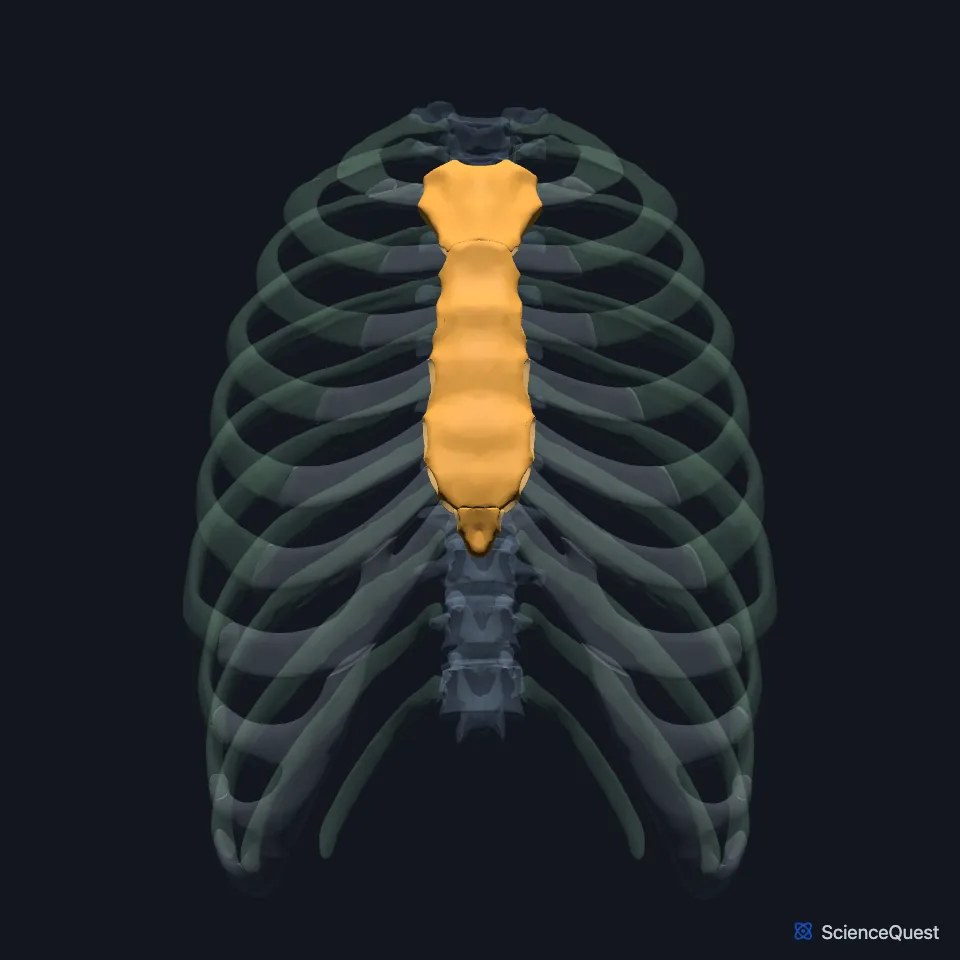
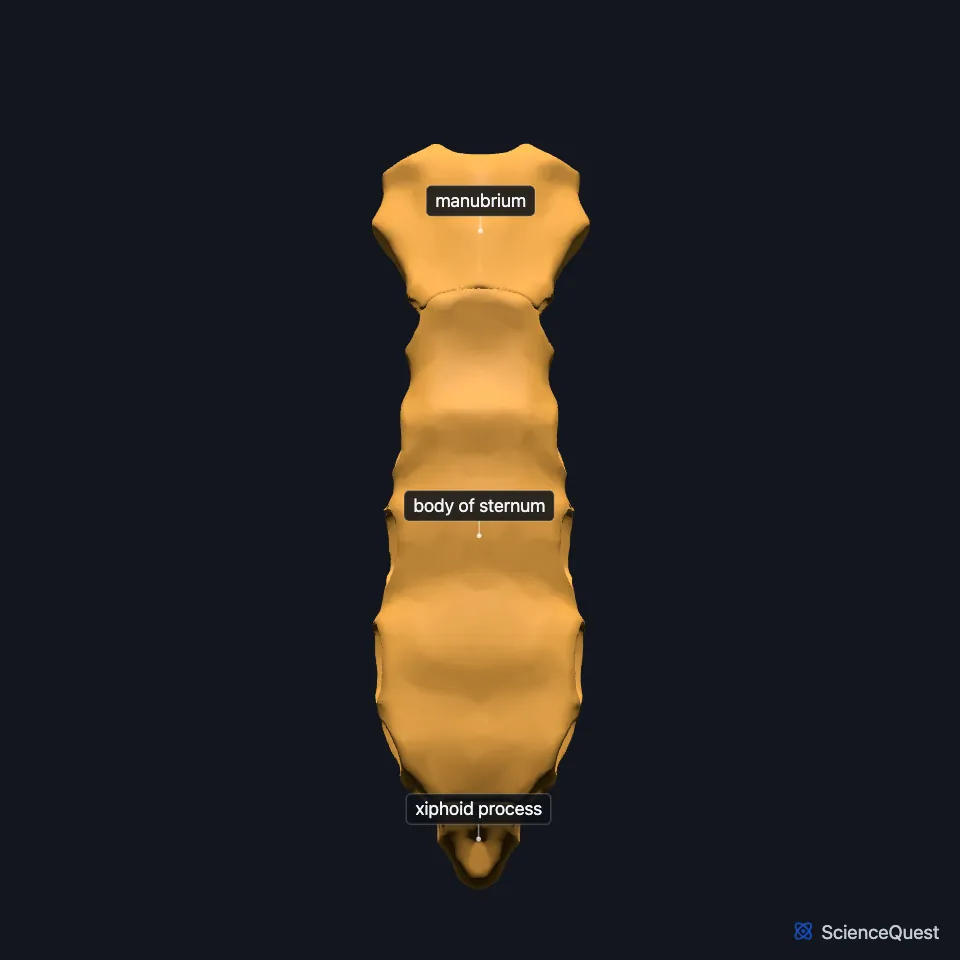
Open it in the Rib Cage and Thoracic Spine Explorer See it alone in 3D
Where is the sternum?
It lies in the midline of the front of the chest. The costal cartilages join it to the ribs and complete the front of the rib cage. (StatPearls, Sternum)
The sternal angle, where the manubrium meets the body, lies level with the disc between the fourth and fifth thoracic vertebrae. The tip of the xiphoid process points down at the level of T10. (StatPearls, Sternum and Xiphoid Process)
What are the parts of the sternum?
The manubrium is the broad, four-sided top part. The suprasternal, or jugular, notch marks its upper border, with a clavicular notch to each side. (StatPearls, Sternum)
The body is the longest part. The costal cartilages of ribs 3 to 7 meet its sides below the sternal angle. (StatPearls, Sternum)
The xiphoid process is the small triangular lowest part, about 2 to 5 cm long. Its name comes from the Greek for a straight sword. (StatPearls, Sternum and Xiphoid Process)
What does the sternum do?
Its main role is to protect the mediastinum, the central compartment of the chest, and what it holds. (StatPearls, Sternum)
The second costal cartilages attach at the sternal angle, so the angle is a landmark for counting the ribs. (StatPearls, Sternum)
Blood-forming marrow persists in the sternum throughout life, which is why it is a common site for collecting bone marrow. (StatPearls, Sternum)
What joins and attaches to the sternum?
The medial end of each clavicle meets a clavicular notch to form a sternoclavicular joint. The first costal cartilages also join the manubrium. (StatPearls, Sternum)
The sternocleidomastoid, sternohyoid and sternothyroid attach to the manubrium. The pectoralis major attaches to the body, and the transversus thoracis to the body and xiphoid process. (StatPearls, Sternum)
The xiphoid process anchors the diaphragm and the abdominal wall muscles: the external oblique, internal oblique, transversus abdominis and rectus abdominis. (StatPearls, Sternum)
Its blood comes mainly from branches of the right and left internal thoracic arteries. The internal thoracic veins drain into the brachiocephalic veins. (StatPearls, Sternum)
How does the sternum vary?
The xiphoid process stays mostly cartilage until about age 40 and is fully calcified by 60, though these changes vary widely. Females usually have a shorter, thinner sternal body than males. (StatPearls, Sternum)
Variations are commonest at the lower end, and a bifid xiphoid is among the most frequent. A sternal foramen, from incomplete fusion of the cartilage model, occurs in 2.5% to 13.8% of people. (StatPearls, Sternum)
| Feature | Detail and source |
|---|---|
| Parts | Manubrium, body, xiphoid process (StatPearls, Sternum) |
| Articulates with | Clavicles; costal cartilages of ribs 1 (manubrium), 2 (sternal angle) and 3 to 7 (body) (StatPearls, Sternum) |
| Levels | Sternal angle at the T4 to T5 disc; xiphoid tip at T10 (StatPearls, Sternum and Xiphoid Process) |
Touches in this model
Measured on the BodyParts3D meshes: surfaces within 2 mm of the sternum, nearest first, 12 of 49.
- Left fifth costal cartilage in contact
- Left first costal cartilage in contact
- Left fourth costal cartilage in contact
- Left second costal cartilage in contact
- Left seventh costal cartilage in contact
- Left sixth costal cartilage in contact
- Left third costal cartilage in contact
- Right fifth costal cartilage in contact
- Right first costal cartilage in contact
- Right fourth costal cartilage in contact
- Right second costal cartilage in contact
- Right seventh costal cartilage in contact
Sources
- StatPearls, Anatomy, Thorax, Sternum. Abdulraheem A. Altalib; Kathleen H. Miao; Ritesh G. Menezes. Last update July 24, 2023. CC BY-NC-ND 4.0. Read 2026-10-25.
- StatPearls, Anatomy, Thorax, Xiphoid Process. Bradley W. Anderson; Matthew R. Holme; Leena Alkhammash; Bracken Burns. Last update March 26, 2023. CC BY-NC-ND 4.0. Read 2026-10-25.
The values are facts and free to use; this page’s selection and presentation are © 2026 ScienceQuest.