Prostate
The prostate is a dense fibromuscular gland directly below the bladder, wrapped around the first part of the urethra. Its alkaline fluid protects sperm in the acidic vagina. (StatPearls, Abdomen and Pelvis, Prostate)
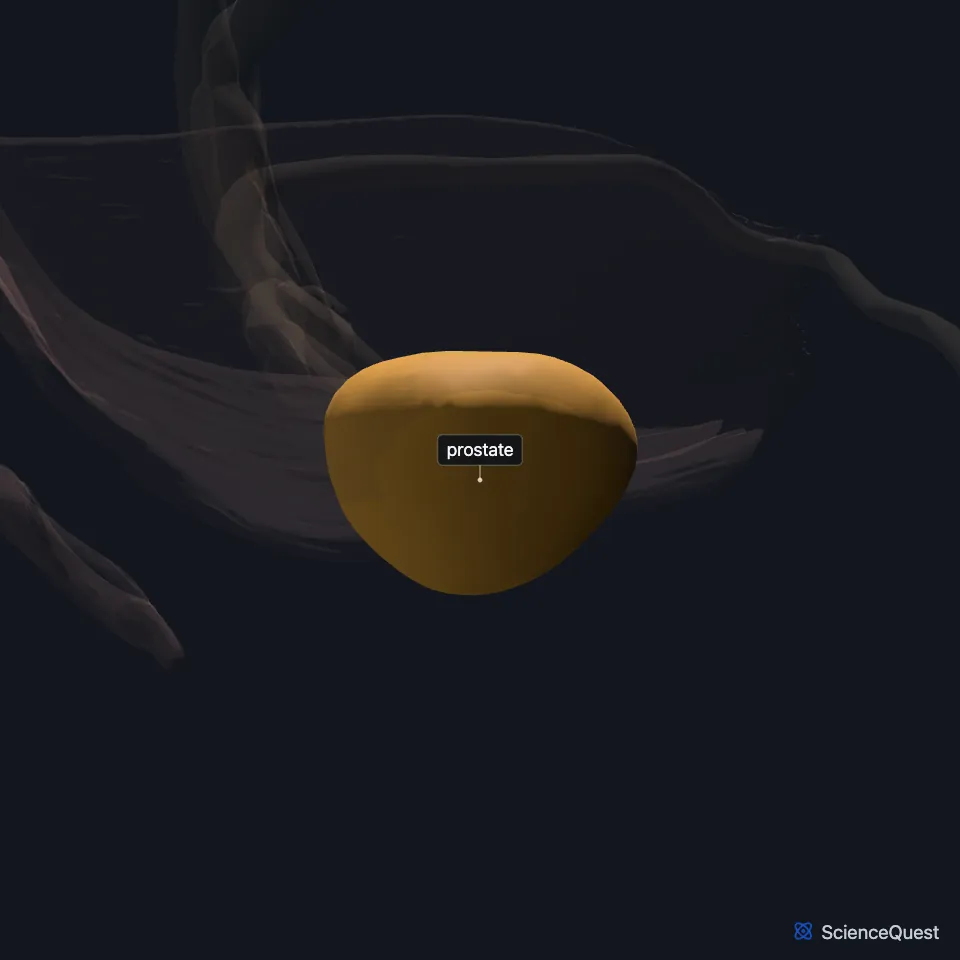
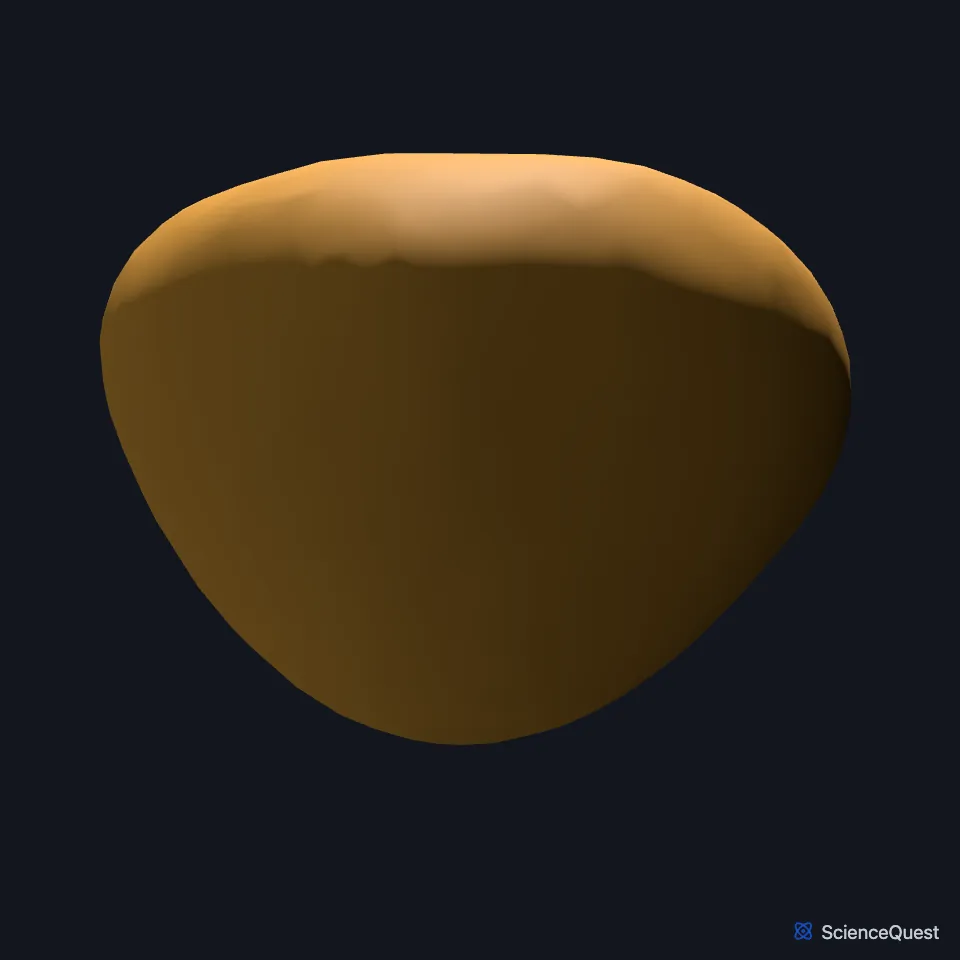
Open it in the Male Reproductive Organs Explorer See it alone in 3D
Where is the prostate?
It is shaped like an upside-down cone. Its base, at the top, surrounds the neck of the bladder, and its apex, at the bottom, rests on the external urethral sphincter. (StatPearls, Abdomen and Pelvis, Prostate)
It sits just below the bladder and in front of the rectum. OpenStax compares its size to a walnut, and Gray’s 1918 text to a chestnut. (OpenStax A&P 2e, 27.1; StatPearls, Abdomen and Pelvis, Prostate; Gray 1918, 3c. 6. The Prostate)
What are the zones and lobes of the prostate?
By its tissue it has three zones. The central zone forms the base around the ejaculatory ducts, the peripheral zone is about 70% of the gland, and the small transition zone surrounds the urethra between the bladder and the seminal colliculus (verumontanum). (StatPearls, Abdomen and Pelvis, Prostate)
An anterior fibromuscular stroma, with no glands, lies at the front, and a fibrous capsule encloses the whole gland. (StatPearls, Abdomen and Pelvis, Prostate)
Many anatomy texts describe five lobes: anterior, posterior, two lateral and a median lobe. In the clinic it is usually described as two lateral lobes and a median lobe. (StatPearls, Abdomen and Pelvis, Prostate)
Two ejaculatory ducts enter it from the seminal vesicles, run downward and inward, and open into the urethra inside the gland at the seminal colliculus. (StatPearls, Abdomen and Pelvis, Prostate)
What does the prostate do?
It adds an alkaline fluid to semen that offsets the acidity of the vagina, so sperm live longer, along with proteins and enzymes that nourish them. The fructose that fuels sperm comes from the seminal vesicles. (OpenStax A&P 2e, 27.1; StatPearls, Abdomen and Pelvis, Prostate and Physiology, Male Reproductive System)
It keeps growing as men age, by about 2% to 2.5% in volume a year, and half of men over 50 show benign prostatic hyperplasia. (OpenStax A&P 2e, 27.1; StatPearls, Benign Prostatic Hyperplasia)
What lies next to the prostate?
In front, retropubic fat and the prostatic venous plexus separate it from the pubic symphysis. Behind, the rectovesical septum (Denonvilliers fascia) separates it from the rectum, and at its sides lies the levator ani of the pelvic floor. (StatPearls, Abdomen and Pelvis, Prostate)
Below it, the external urethral sphincter wraps around the urethra and helps control urinary and ejaculatory flow. (StatPearls, Abdomen and Pelvis, Prostate)
Its main artery is the inferior vesical artery, with help from the middle rectal and internal pudendal arteries. Its veins form the prostatic plexus, which drains to the internal iliac veins. (StatPearls, Abdomen and Pelvis, Prostate)
Its nerves come from the inferior hypogastric plexus: sympathetic fibers through the hypogastric nerve and parasympathetic fibers through the pelvic nerve. (StatPearls, Abdomen and Pelvis, Prostate)
Where the sources differ
OpenStax says prostatic fluid first thickens semen and then thins it. StatPearls says the gel forms from semenogelin made by the seminal vesicles, and prostate-specific antigen then liquefies it. (OpenStax A&P 2e, 27.1; StatPearls, Abdomen and Pelvis, Seminal Vesicle)
| Feature | Detail and source |
|---|---|
| Zones | Central, peripheral (about 70%), transition (StatPearls, Abdomen and Pelvis, Prostate) |
| Surrounds | Prostatic urethra and the two ejaculatory ducts (StatPearls, Abdomen and Pelvis, Prostate) |
| Main artery | Inferior vesical artery (StatPearls, Abdomen and Pelvis, Prostate) |
| Lymph | Internal iliac and sacral nodes (StatPearls, Abdomen and Pelvis, Prostate) |
Touches in this model
Measured on the BodyParts3D meshes: surfaces within 2 mm of the prostate, nearest first.
- Left pubococcygeus in contact
- Left seminal vesicle in contact
- Right pubococcygeus in contact
- Right seminal vesicle in contact
- Left puborectalis in contact
- Right puborectalis in contact
- Skin in contact
- Urinary bladder in contact
- Rectum 0.9 mm away
- Left deferent duct 1.4 mm away
- Right deferent duct 1.5 mm away
- Corpus cavernosum of penis 1.6 mm away
Sources
- StatPearls, Anatomy, Abdomen and Pelvis, Prostate. Omesh Singh; Srinivasa Rao Bolla. Last update July 17, 2023. CC BY-NC-ND 4.0. Read 2026-10-25.
- OpenStax Anatomy and Physiology 2e, section 27.1, Anatomy and Physiology of the Testicular Reproductive System. CC BY-NC-SA 4.0. Read 2026-10-25.
- Gray’s Anatomy of the Human Body, 20th US edition (1918), XI. Splanchnology, 3c. 6. The Prostate. Henry Gray. Public domain. Read 2026-10-25.
- StatPearls, Physiology, Male Reproductive System. Purnima Gurung; Ekrem Yetiskul; Ishwarlal Jialal. Last update May 1, 2023. CC BY-NC-ND 4.0. Read 2026-10-25.
- StatPearls, Benign Prostatic Hyperplasia. Michael Ng; Stephen W. Leslie; Krishna M. Baradhi. Last update October 20, 2024. CC BY-NC-ND 4.0. Read 2026-10-25.
- StatPearls, Anatomy, Abdomen and Pelvis, Seminal Vesicle. Alastair C. McKay; Nkiruka Odeluga; Jay Jiang; Sandeep Sharma. Last update July 24, 2023. CC BY-NC-ND 4.0. Read 2026-10-25.
The values are facts and free to use; this page’s selection and presentation are © 2026 ScienceQuest.