Deferent duct
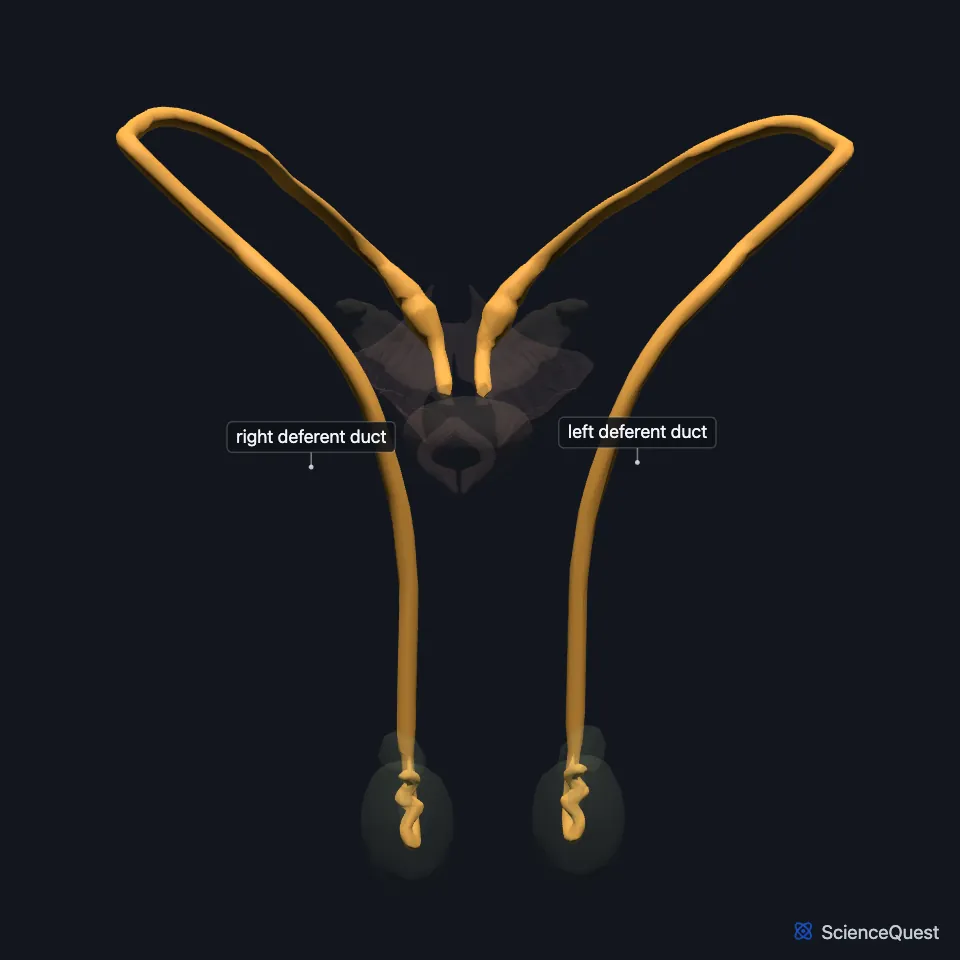
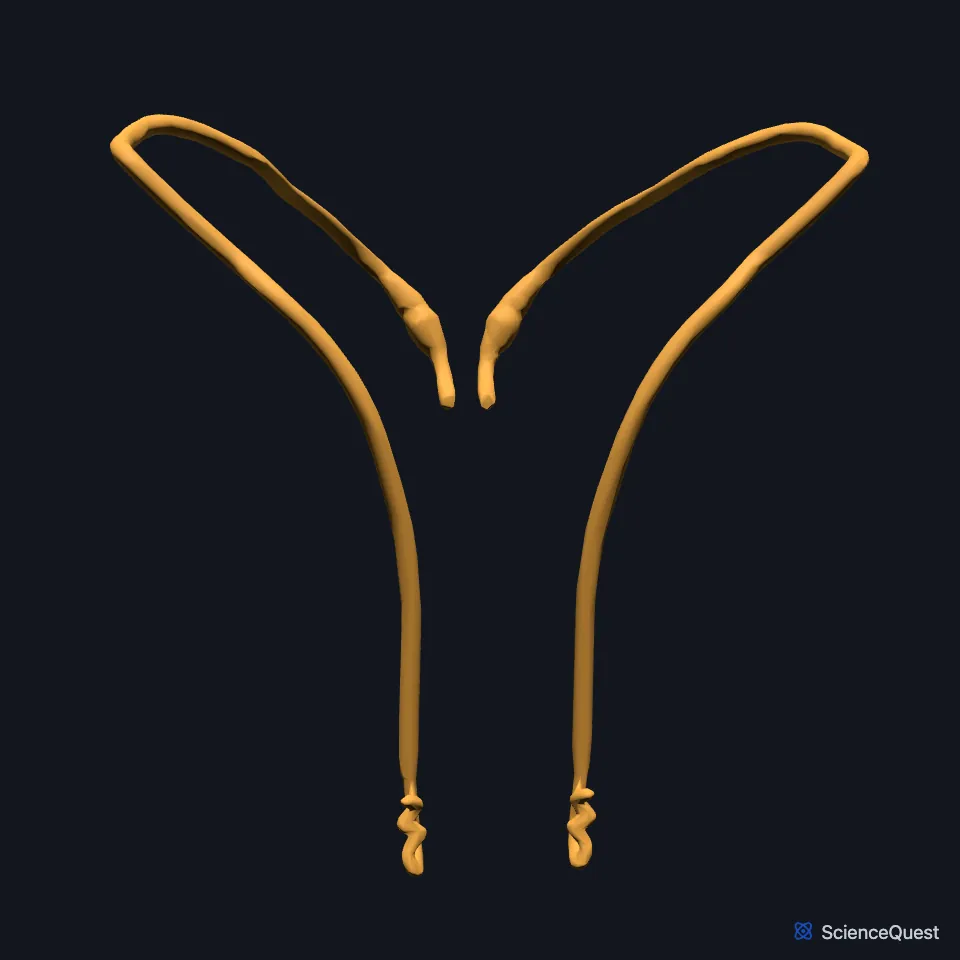
The deferent duct, also called the ductus deferens or vas deferens, is a thick muscular tube. It carries sperm from the tail of the epididymis to the ejaculatory duct. (OpenStax A&P 2e, 27.1; StatPearls, Physiology, Male Reproductive System)
Open it in the Male Reproductive Organs Explorer See it alone in 3D
Where does the deferent duct run?
In the scrotum it runs inside the spermatic cord, bundled with connective tissue, blood vessels and nerves. From there it rises through the inguinal canal in the abdominal wall into the abdominal cavity. (OpenStax A&P 2e, 27.1; Gray 1918, 3c. 2. The Ductus Deferens and 3c. The Male Genital Organs)
It then runs back into the pelvic cavity and ends behind the urinary bladder, where it widens into the ampulla. (OpenStax A&P 2e, 27.1; Gray 1918, 3c. 2. The Ductus Deferens)
The inguinal canal it passes through is 4 to 6 cm long and lies in the lower front of the abdominal wall, just above the inguinal ligament. In males it carries the spermatic cord. (StatPearls, Abdomen and Pelvis: Inguinal Region (Inguinal Canal))
What does the deferent duct do?
At ejaculation, smooth muscle in the epididymis pushes sperm into the duct. Near the prostate the duct joins the duct of the seminal vesicle, whose fluid mixes with the sperm. (OpenStax A&P 2e, 27.1; StatPearls, Physiology, Male Reproductive System)
The ampulla and the duct of the seminal vesicle join to form the short ejaculatory duct, which carries the fluid into the prostate. The two ejaculatory ducts open into the prostatic urethra at the seminal colliculus (verumontanum). (OpenStax A&P 2e, 27.1; StatPearls, Abdomen and Pelvis, Seminal Vesicle)
A surgeon can reach it through the layers of the scrotum, which makes it the tube a vasectomy divides to stop the flow of sperm. (OpenStax A&P 2e, 27.1; StatPearls, Vasectomy)
What lies next to the deferent duct?
Near the bladder each ureter passes behind the deferent duct. Each seminal vesicle lies to the outer side of the ampulla. (StatPearls, Abdomen and Pelvis Ureter and Abdomen and Pelvis, Seminal Vesicle)
In the spermatic cord it travels with the testicular artery, its own artery, the cremasteric artery, lymphatics and the pampiniform plexus of veins, which lies in front of it. (StatPearls, Abdomen and Pelvis: Inguinal Region (Inguinal Canal) and Abdomen and Pelvis: Testes)
Its sympathetic nerve supply comes from the hypogastric nerve, which also supplies the seminal vesicle. (StatPearls, Abdomen and Pelvis, Seminal Vesicle)
Where does the deferent duct come from?
It develops from the mesonephric, or Wolffian, duct, as do the epididymis, the seminal vesicles and the ejaculatory ducts. Testosterone drives that development. (StatPearls, Physiology, Male Reproductive System)
Can the deferent duct be missing?
Absence of both seminal vesicles is rare. When it occurs it is commonly accompanied by absence of both deferent ducts, and it is often related to mutations in the CFTR gene on chromosome 7p. (StatPearls, Abdomen and Pelvis, Seminal Vesicle)
| Feature | Detail and source |
|---|---|
| Other names | Ductus deferens, vas deferens (OpenStax A&P 2e, 27.1; StatPearls, Physiology, Male Reproductive System) |
| Starts at | Tail of the epididymis (OpenStax A&P 2e, 27.1; Gray 1918, 3c. 2. The Ductus Deferens) |
| Passes through | Spermatic cord and inguinal canal (OpenStax A&P 2e, 27.1; Gray 1918, 3c. 2. The Ductus Deferens) |
| Ends as | Ampulla, joining the seminal vesicle duct to form the ejaculatory duct (OpenStax A&P 2e, 27.1; Gray 1918, 3c. 2. The Ductus Deferens) |
Touches in this model
Measured on the BodyParts3D meshes: surfaces within 2 mm of the deferent duct, nearest first, 12 of 28.
- Left epididymis in contact
- Left seminal vesicle in contact
- Left testis in contact
- Right epididymis in contact
- Right seminal vesicle in contact
- Right testis in contact
- Left adductor longus in contact
- Left external iliac artery in contact
- Left external oblique in contact
- Left iliacus in contact
- Left inguinal ligament in contact
- Left pectineus in contact
Sources
- OpenStax Anatomy and Physiology 2e, section 27.1, Anatomy and Physiology of the Testicular Reproductive System. CC BY-NC-SA 4.0. Read 2026-10-25.
- StatPearls, Physiology, Male Reproductive System. Purnima Gurung; Ekrem Yetiskul; Ishwarlal Jialal. Last update May 1, 2023. CC BY-NC-ND 4.0. Read 2026-10-25.
- Gray’s Anatomy of the Human Body, 20th US edition (1918), XI. Splanchnology, 3c. 2. The Ductus Deferens. Henry Gray. Public domain. Read 2026-10-25.
- Gray’s Anatomy of the Human Body, 20th US edition (1918), XI. Splanchnology, 3c. The Male Genital Organs, 1. The Testes and their Coverings (1918 terms: tubuli seminiferi, tubuli recti and ductuli efferentes for seminiferous tubules, straight tubules and efferent ductules). Henry Gray. Public domain. Read 2026-10-25.
- StatPearls, Anatomy, Abdomen and Pelvis: Inguinal Region (Inguinal Canal). Faiz Tuma; Richard A. Lopez; Matthew A. Varacallo. Last update July 24, 2023. CC BY-NC-ND 4.0. Read 2026-10-25.
- StatPearls, Anatomy, Abdomen and Pelvis, Seminal Vesicle. Alastair C. McKay; Nkiruka Odeluga; Jay Jiang; Sandeep Sharma. Last update July 24, 2023. CC BY-NC-ND 4.0. Read 2026-10-25.
- StatPearls, Vasectomy. Gavin Stormont; Christopher M. Deibert. Last update May 18, 2025. CC BY-NC-ND 4.0. Read 2026-10-25.
- StatPearls, Anatomy, Abdomen and Pelvis Ureter. Hernan A. Lescay; Jay Jiang; Stephen W. Leslie; Faiz Tuma. Last update May 5, 2024. CC BY-NC-ND 4.0. Read 2026-10-25.
- StatPearls, Anatomy, Abdomen and Pelvis: Testes. Manpreet S. Tiwana; Stephen W. Leslie. Last update April 15, 2023. CC BY-NC-ND 4.0. Read 2026-10-25.
The values are facts and free to use; this page’s selection and presentation are © 2026 ScienceQuest.