Rib
The ribs are the curved bones of the chest wall, usually 12 on each side. Together they form the bony framework of the thoracic cavity. (StatPearls, Thorax, Ribs; Gray’s Anatomy (1918), Ribs, p. 123)
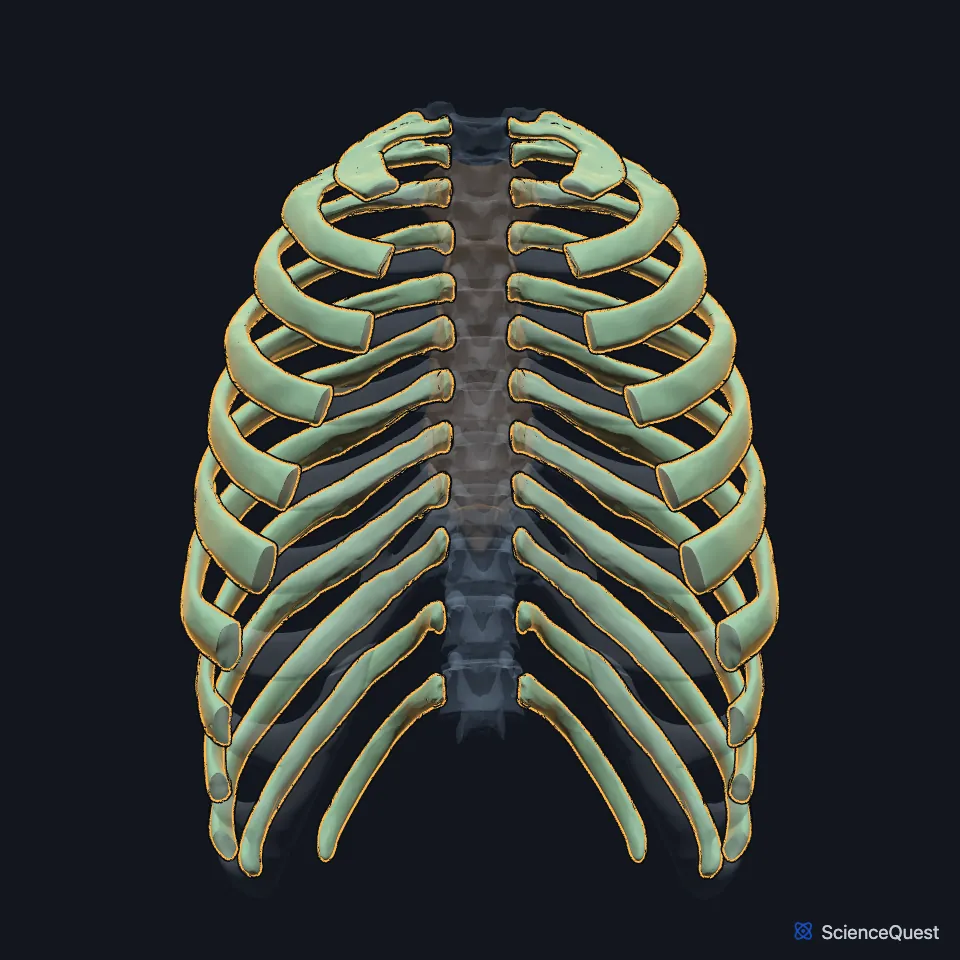
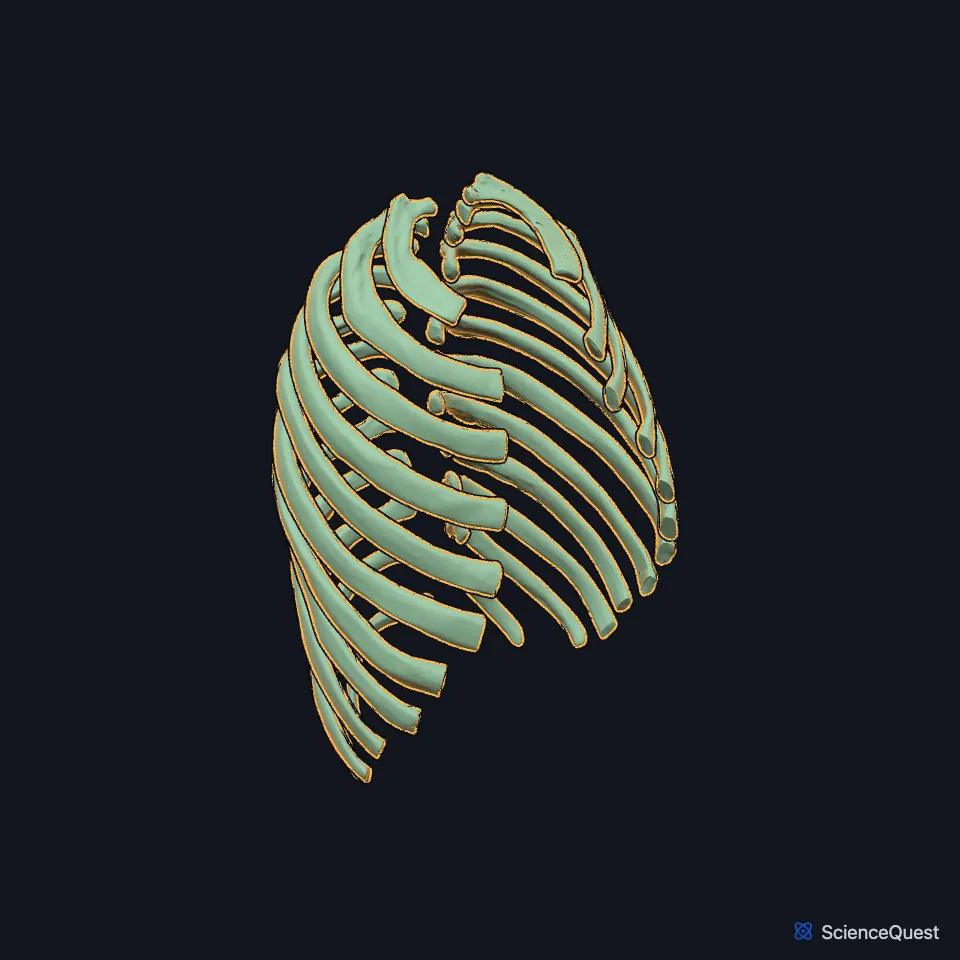
Open it in the Rib Cage and Thoracic Spine Explorer See it alone in 3D
Where do the ribs attach?
At the back most ribs meet two thoracic vertebrae, with a facet on the head for the body of each. The first, eleventh and twelfth ribs have a single facet and meet only their own vertebra. At the front the costal cartilages of the first seven join them to the sternum. (Gray’s Anatomy (1918), Ribs, p. 123; StatPearls, Thorax, Ribs and Thoracic Vertebrae)
What are true, false and floating ribs?
The first seven are true ribs, joined to the sternum by their own costal cartilages. The other five, the eighth to twelfth, are false ribs: the cartilages of the eighth, ninth and tenth join the cartilage of the rib above, and the eleventh and twelfth are floating ribs, free at their front ends. (Gray’s Anatomy (1918), Ribs, p. 123; FMA, Set of false ribs; StatPearls, Thorax, Ribs)
The first rib may also meet the clavicle at the costoclavicular joint, and the joint between the first rib and the sternum is a synarthrosis, unlike the other sternocostal joints. (StatPearls, Thorax, Ribs)
What are the parts of a rib?
A typical rib has a head with two articular facets, a neck, a tubercle, a shaft and a costal groove. The first, second, tenth, eleventh and twelfth ribs are atypical: the first is short and wide with a single facet, and the eleventh and twelfth have one facet and no neck. (StatPearls, Thorax, Ribs)
The ribs lengthen from the first to the seventh and then shorten to the twelfth. The second rib has a tuberosity on its upper surface for serratus anterior. (Gray’s Anatomy (1918), Ribs, p. 123; StatPearls, Thorax, Ribs)
What do the ribs do?
Ribs move to change the volume of the thorax in breathing, driven by the diaphragm, the external intercostals and part of the internal intercostals. They also protect the organs of the chest and anchor muscles, and from birth on they stay a site where blood cells are made. (StatPearls, Thorax, Ribs)
How do the ribs vary, and when do they break?
A cervical rib, an extra rib from a neck vertebra, occurs in about 0.5% to 1% of people, most often on the seventh cervical vertebra. Gray’s Anatomy (1918) adds that the count can also rise with a lumbar rib or fall to eleven. (StatPearls, Cervical Rib; Gray’s Anatomy (1918), Ribs, p. 123)
Children break ribs less often than adults because their ribs are more elastic. Flail chest is fractures of three or more neighbouring ribs, each in at least two places, which leaves a segment of chest wall moving on its own. (StatPearls, Rib Fracture and Flail Chest)
Where the sources differ
StatPearls sorts the ribs into three groups, true, false and floating, and counts only the eighth, ninth and tenth as false. Gray’s Anatomy (1918) counts all five lower ribs as false, the last two of them floating, and the Foundational Model of Anatomy also names the eighth to twelfth as the false ribs. (StatPearls, Thorax, Ribs; Gray’s Anatomy (1918), Ribs, p. 123; FMA, Set of false ribs)
Gray’s Anatomy (1918) and StatPearls’ rib article give the tenth rib a single facet on its head, and Gray’s says only some people have half facets on the tenth vertebra instead. StatPearls’ article on the thoracic vertebrae treats the single facet as the variation, with T9 then losing its lower half facet. (Gray’s Anatomy (1918), Ribs, p. 123 and Thoracic vertebrae, p. 102; StatPearls, Thorax, Ribs and Thoracic Vertebrae)
Gray’s Anatomy (1918) has only the last two ribs floating, with the cartilages of the eighth to tenth each joined to the one above. StatPearls cites cadaver studies in which the tenth rib was floating in 46% to 59% of specimens. (Gray’s Anatomy (1918), Ribs, p. 123; StatPearls, Thorax, Ribs)
| Feature | Detail and source |
|---|---|
| Number | Usually 12 pairs (StatPearls, Thorax, Ribs; Gray’s Anatomy (1918), Ribs, p. 123) |
| Articulates with | Thoracic vertebrae behind; sternum through costal cartilage (ribs 1 to 7) (Gray’s Anatomy (1918), Ribs, p. 123; StatPearls, Thorax, Ribs) |
| Groups | True 1 to 7; false 8 to 12, of which 11 and 12 float (Gray’s Anatomy (1918), Ribs, p. 123; FMA, Set of false ribs; StatPearls, Thorax, Ribs) |
Touches in this model
Measured on the BodyParts3D meshes: surfaces within 2 mm of the rib, nearest first, 12 of 112.
- Eighth thoracic vertebra in contact
- Eleventh thoracic vertebra in contact
- Fifth thoracic vertebra in contact
- First thoracic vertebra in contact
- Fourth thoracic vertebra in contact
- Left costal cartilage in contact
- Left fifth costal cartilage in contact
- Left first costal cartilage in contact
- Left fourth costal cartilage in contact
- Left second costal cartilage in contact
- Left seventh costal cartilage in contact
- Left sixth costal cartilage in contact
Sources
Sources read between and
- StatPearls, Anatomy, Thorax, Ribs. Omar A. Safarini; Bruno Bordoni. Last update . CC BY-NC-ND 4.0. Read .
- Gray’s Anatomy of the Human Body, 20th US edition (1918), edited by Warren H. Lewis, Osteology, The Ribs (from p. 123); 1918 names: vertebro-sternal for true ribs, vertebro-chondral for ribs 8 to 10, vertebral for floating ribs. Henry Gray; Warren H. Lewis (editor). Public domain. Read .
- StatPearls, Anatomy, Back, Thoracic Vertebrae. Joshua A. Waxenbaum; Vamsi Reddy; Konstantinos Margetis. Last update . CC BY-NC-ND 4.0. Read .
- Foundational Model of Anatomy 5.1.0, via EBI Ontology Lookup Service, Set of false ribs [VIII-XII] (FMA71333). FMA release terms, University of Washington. Read .
- StatPearls, Anatomy, Thorax, Cervical Rib. Brian E. Fliegel; Ritesh G. Menezes. Last update . CC BY-NC-ND 4.0. Read .
- StatPearls, Rib Fracture. Kevin Kuo; Amie M. Kim. Last update . CC BY-NC-ND 4.0. Read .
- StatPearls, Flail Chest. Thomas B. Perera; Mohamed H. Alahmadi; Kevin C. King. Last update . CC BY-NC-ND 4.0. Read .
- Gray’s Anatomy of the Human Body, 20th US edition (1918), edited by Warren H. Lewis, Osteology, The Thoracic Vertebrae (pp. 102 to 104); 1918 name: intervertebral fibrocartilages for intervertebral disks. Henry Gray; Warren H. Lewis (editor). Public domain. Read .
The values are facts and free to use; this page’s selection and presentation are © 2026 ScienceQuest.