Scalenus posterior
The scalenus posterior is the smallest and most deeply placed of the three scalene muscles. It runs from the lowest cervical vertebrae to the second rib. (Gray 1918, 5e. Lateral Vertebral Muscles; StatPearls, Scalenus Muscle)
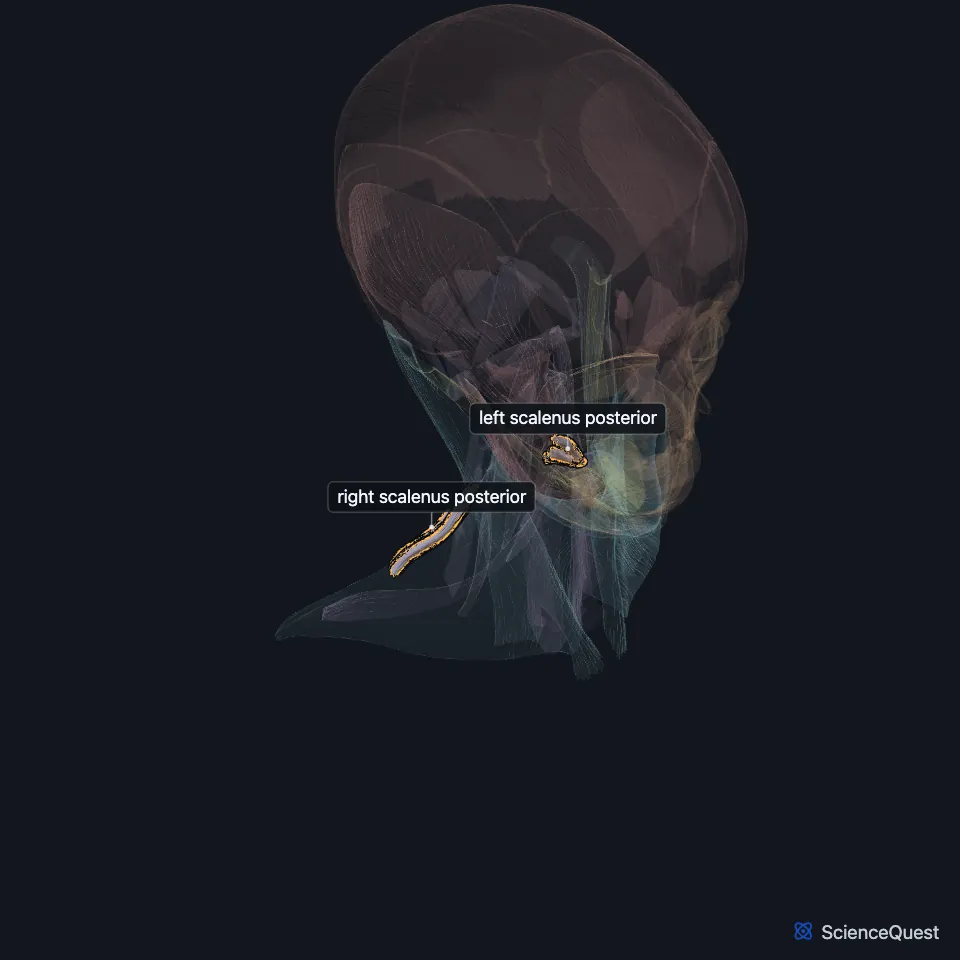
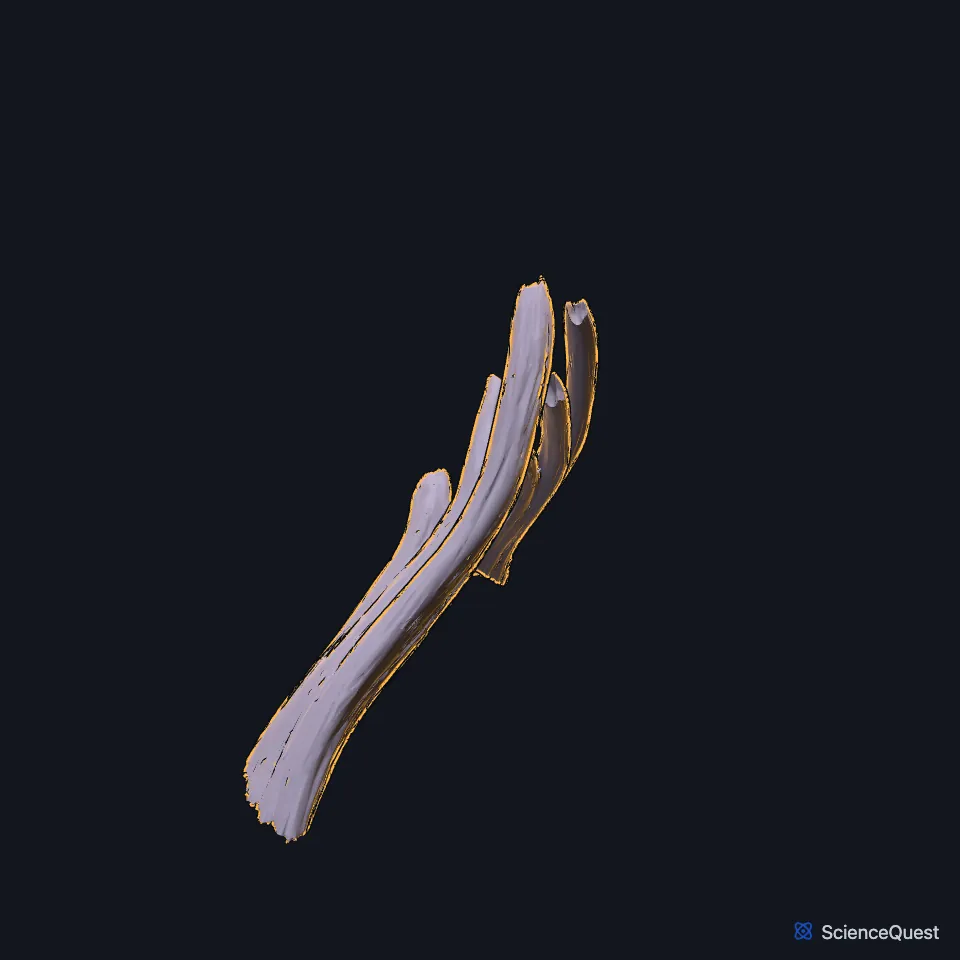
Open it in the Head and Neck Muscles Explorer See it alone in 3D
Where is the scalenus posterior?
It arises by two or three tendons from the posterior tubercles of the transverse processes of the lowest cervical vertebrae. A thin tendon attaches it to the second rib, behind the attachment of the serratus anterior. (Gray 1918, 5e. Lateral Vertebral Muscles; StatPearls, Scalenus Muscle)
It is sometimes blended with the scalenus medius, and some of its fibers may merge with the first intercostal muscle. (Gray 1918, 5e. Lateral Vertebral Muscles; StatPearls, Scalenus Muscle)
With the scalenus anterior and medius it lies within the posterior triangle of the neck. (StatPearls, Posterior Neck Triangle)
What does the scalenus posterior do?
Acting from above, the scalenes raise the first and second ribs, so they help with breathing in. Acting from below, they bend the neck to one side. (Gray 1918, 5e. Lateral Vertebral Muscles)
Apart from breathing, StatPearls notes the scalenes stay active when you lie on your back and when you raise your arm. (StatPearls, Scalenus Muscle)
Which nerves pass the scalenus posterior?
A thicker scalenus posterior can shift the path of the long thoracic and dorsal scapular nerves. That can cause pain or weakness in the serratus anterior, the levator scapulae and the rhomboids. (StatPearls, Scalenus Muscle)
The ascending, or superficial, cervical artery supplies it. (StatPearls, Scalenus Muscle)
How does the scalenus posterior vary?
It may be missing, or reach down to the third rib. Some studies describe it in two layers, a front part and a back part. (Gray 1918, 5e. Lateral Vertebral Muscles; StatPearls, Scalenus Muscle)
Where the sources differ
Gray’s 1918 text has it arising from the lower two or three cervical vertebrae and inserting on the outer surface of the second rib. StatPearls gives the last three or four cervical vertebrae and the anterior surface of the second rib. (Gray 1918, 5e. Lateral Vertebral Muscles; StatPearls, Scalenus Muscle)
| Feature | Detail and source |
|---|---|
| Origin | Posterior tubercles of the lowest cervical transverse processes (see the note below) (Gray 1918, 5e. Lateral Vertebral Muscles; StatPearls, Scalenus Muscle) |
| Insertion | Second rib (Gray 1918, 5e. Lateral Vertebral Muscles; StatPearls, Scalenus Muscle) |
| Action | Lifts the second rib in breathing in; bends the neck to the side (Gray 1918, 5e. Lateral Vertebral Muscles) |
| Nerve | Anterior rami of cervical nerves: C3 to C8 in StatPearls, C2 to C7 in Gray 1918 (StatPearls, Scalenus Muscle; Gray 1918, 5e. Lateral Vertebral Muscles) |
Touches in this model
Measured on the BodyParts3D meshes: surfaces within 2 mm of the scalenus posterior, nearest first, 12 of 30.
- Left scalenus medius in contact
- Right scalenus medius in contact
- Descending part of left trapezius in contact
- Descending part of right trapezius in contact
- Fifth cervical vertebra in contact
- Left iliocostalis cervicis in contact
- Left iliocostalis thoracis in contact
- Left longissimus capitis in contact
- Left longissimus cervicis in contact
- Left second rib in contact
- Left serratus posterior superior in contact
- Right iliocostalis cervicis in contact
Sources
Sources read
- Gray’s Anatomy of the Human Body, 20th US edition (1918), IV. Myology, 5e. The Lateral Vertebral Muscles (1918 terms: Scalenus anticus for scalenus anterior, Scalenus posticus for scalenus posterior). Henry Gray. Public domain. Read .
- StatPearls, Anatomy, Head and Neck, Scalenus Muscle. Bruno Bordoni; Felix Jozsa; Matthew A. Varacallo. Last update . CC BY-NC-ND 4.0. Read .
- StatPearls, Anatomy, Head and Neck, Posterior Neck Triangle. Jarett Casale; Zachary Geiger. Last update . CC BY-NC-ND 4.0. Read .
The values are facts and free to use; this page’s selection and presentation are © 2026 ScienceQuest.