Actinium
- Atomic number
- 89
- Mass number
- 227
- Configuration
- [Rn] 6d1 7s2
- Category
- Actinide
- Group
- 3 or none, by convention
Actinium (Ac) is an actinide with atomic number 89. It has no stable isotope and no characteristic isotopic composition on Earth, so it has no standard atomic weight; its longest-lived isotope has mass number 227. Its electron configuration is [Rn] 6d1 7s2.
Interactive periodic tableOrbital shapesMolar mass calculator
Actinium key data
| Symbol | Ac |
|---|---|
| Atomic number | 89 |
| Mass number (longest-lived isotope) | 227 |
| Protons | 89 |
|---|---|
| Neutrons (longest-lived isotope, actinium-227) | 138 |
| Electrons (neutral atom) | 89 |
| Category | Actinide |
|---|---|
| Period | 7 |
| Group | 3 or none, by convention |
| Block | d-block or f-block, by convention |
| Noble gas notation | [Rn] 6d1 7s2 |
|---|---|
| Full electron configuration | 1s2 2s2 2p6 3s2 3p6 3d10 4s2 4p6 4d10 4f14 5s2 5p6 5d10 6s2 6p6 6d1 7s2 |
| Electrons per shell | 2, 8, 18, 32, 18, 9, 2 |
Mass number: IUPAC CIAAW radioactive elements, from NUBASE2020.
The values are facts and free to use; this page’s selection and presentation are © 2026 ScienceQuest.
Updated
Measured properties of actinium
From PubChem, the US National Institutes of Health. Public domain. PubChem’s periodic table gives no value for the rows not shown. The first ionisation energy is the value for actinium from the NIST Atomic Spectra Database, in place of PubChem’s 5.17 eV.
| Melting point | 1324 K (1050.9 °C), 45th of 103 by melting point |
|---|---|
| Boiling point | 3471 K (3197.9 °C), 30th of 93 by boiling point |
| Density | 10.07 g/cm³, 26th of 96 by density |
| State at room temperature | Solid |
| Electronegativity | 1.1 (Pauling), joint 84th of 95 by electronegativity |
| Van der Waals radius | 260 pm, 7th of 99 by atomic radius |
| First ionisation energy | 5.3802 eV (519.11 kJ/mol), 95th of 102 by first ionisation energy |
| Common oxidation states | +3 |
| Discovered | 1899 |
Each rank counts down from the highest value, among the elements PubChem’s table gives one for, and links to that property ranked across the whole table. All of them are collected under periodic trends.
Actinium electron configuration
The full electron configuration of actinium is 1s2 2s2 2p6 3s2 3p6 3d10 4s2 4p6 4d10 4f14 5s2 5p6 5d10 6s2 6p6 6d1 7s2. With the noble-gas core collapsed it is [Rn] 6d1 7s2, and the outermost subshell is 7s2.
Actinium does not follow the simple filling order. Its measured configuration differs from the one the aufbau rule predicts, because at this point in the table the 5f and 6d subshells lie so close in energy that one electron goes into 6d rather than 5f. This is a measured fact about the atom rather than an exception to be derived.
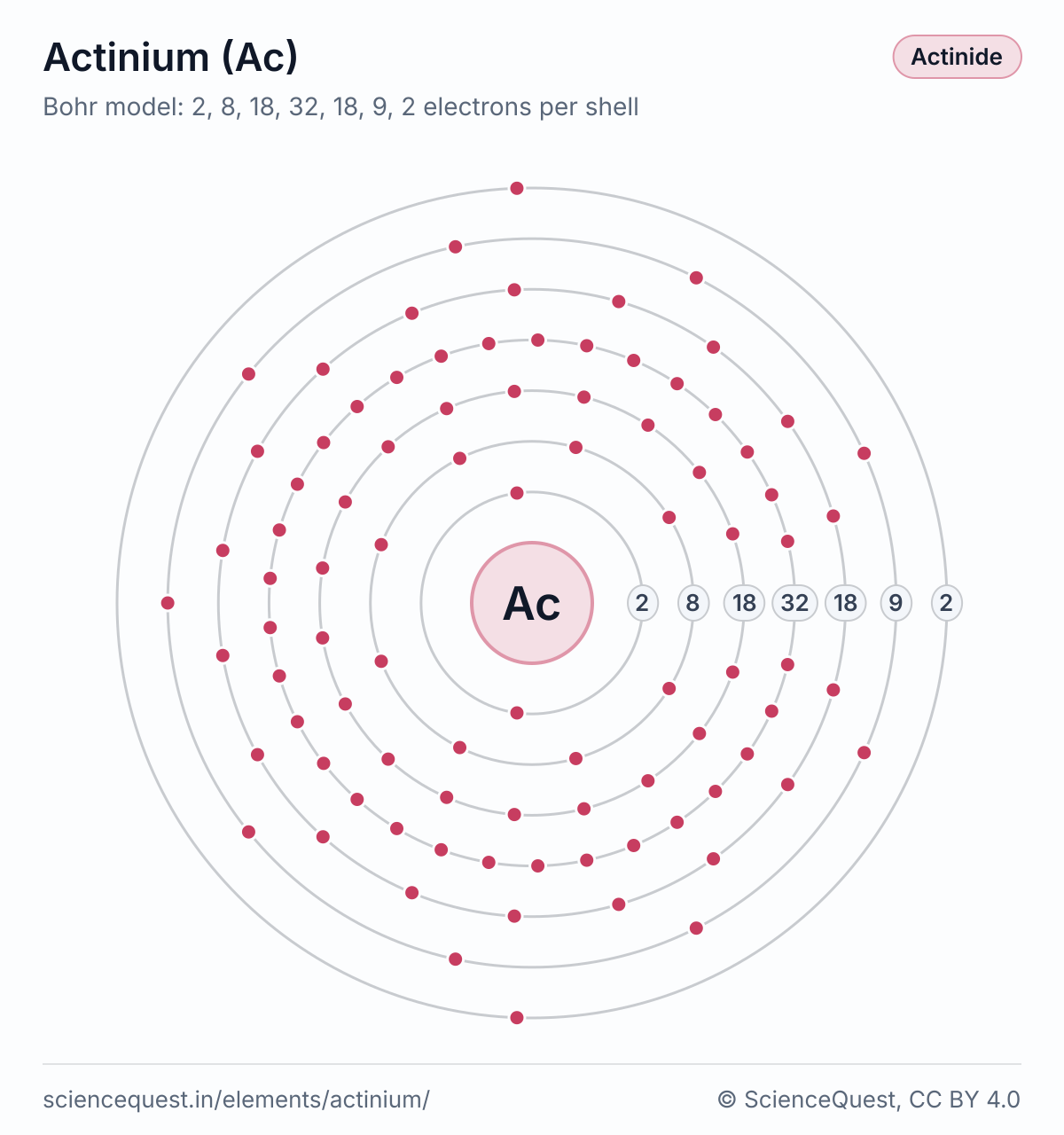
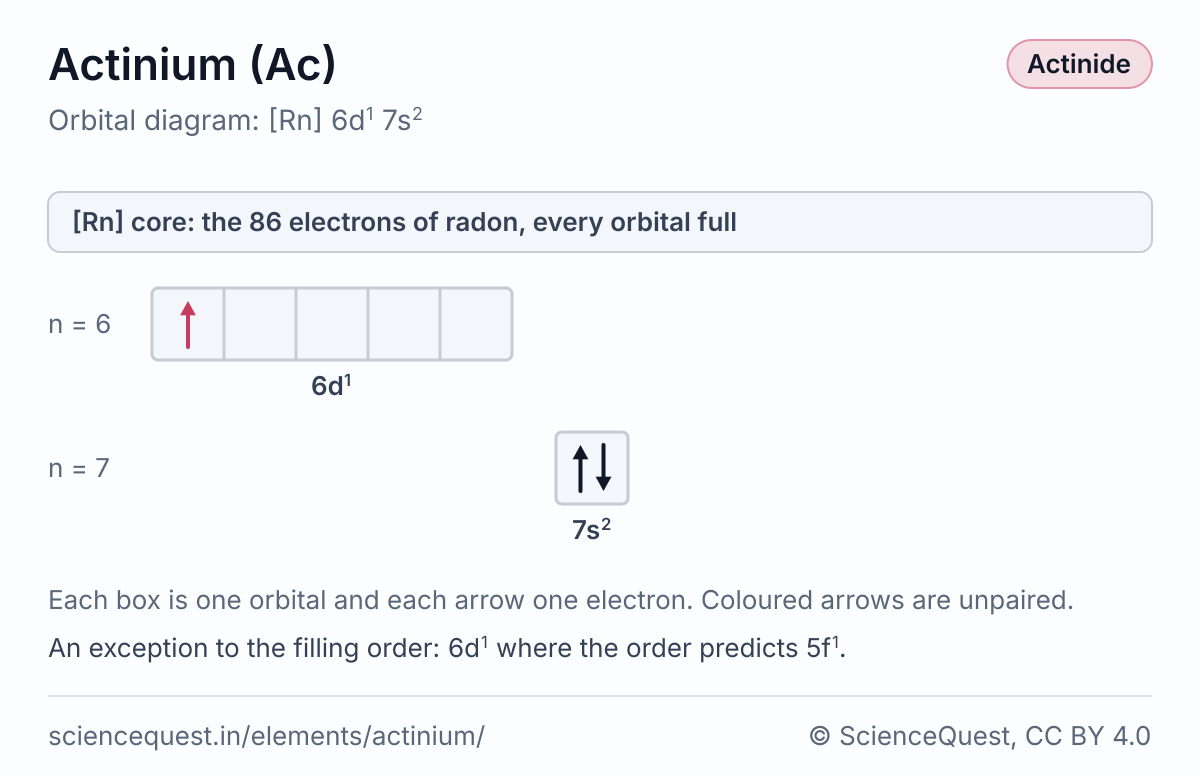
Why group and block follow from this is set out in how the periodic table maps electron configuration, and the electron configuration of every element is listed on one page. To write the configuration of an ion of actinium, use the electron configuration calculator.
Electron configurations of actinium ions
The table gives the actinium atom and the ion for the common oxidation state listed above, in its ground state as a free ion in the gas phase.
| Atom or ion | Electrons | Configuration | Unpaired electrons |
|---|---|---|---|
| Ac (neutral atom) | 89 | [Rn] 6d1 7s2 | 1 |
| Ac³⁺ | 86 | [Xe] 4f14 5d10 6s2 6p6 | 0 |
The positive ion matches its ground state in the NIST Atomic Spectra Database. Unpaired electrons are counted by Hund’s rule.
Ac³⁺ has the same electron configuration as a radon atom.
Actinium: isotopes, discovery and uses
- Most stable known isotopes
- Actinium-227, half-life 21.772(3) years (CIAAW)
- Discovered
- André-Louis Debierne, 1899 (Jefferson Lab via PubChem)
- Friedrich Otto Giesel, 1902, independently (Jefferson Lab via PubChem)
- Name
- From the Greek aktis, aktinos, meaning beam or ray (Los Alamos National Laboratory via PubChem)
- Isotopes in use
- Medicine: 225Ac (with a half-life of 10 days) can be used in cancer treatments (IUPAC Periodic Table of the Elements and Isotopes via PubChem)
- Estimated crustal abundance
- 5.5 × 10⁻¹⁰ mg/kg (Jefferson Lab via PubChem)
Read at the sources on 26 October 2026. “via PubChem” marks text PubChem republishes from the publisher named.
Mass of one actinium atom
A molar mass is grams per mole, so dividing by the Avogadro constant gives the mass of a single atom, and the reciprocal gives how many atoms sit in a gram.
Mass of one atom
- one atom = 227 / (6.02214076 × 10²³)
- = 3.7694 × 10⁻²² g
Atoms in one gram
- atoms per gram = 6.02214076 × 10²³ / 227
- = 2.6529 × 10²¹ atoms
Actinium has no standard atomic weight, because it has neither a stable isotope nor a characteristic isotopic composition on Earth. The figure used above is the mass number of actinium-227, so treat these as nominal.
Actinium on the periodic table
Actinium is in period 7. Tables differ on its group: some place it in group 3, in the d-block, and others in the f-block, outside the numbered groups.
The rest of period 7
- 87 Fr Francium
- 88 Ra Radium
- 89 Ac Actinium
- 90 Th Thorium
- 91 Pa Protactinium
- 92 U Uranium
- 93 Np Neptunium
- 94 Pu Plutonium
- 95 Am Americium
- 96 Cm Curium
- 97 Bk Berkelium
- 98 Cf Californium
- 99 Es Einsteinium
- 100 Fm Fermium
- 101 Md Mendelevium
- 102 No Nobelium
- 103 Lr Lawrencium
- 104 Rf Rutherfordium
- 105 Db Dubnium
- 106 Sg Seaborgium
- 107 Bh Bohrium
- 108 Hs Hassium
- 109 Mt Meitnerium
- 110 Ds Darmstadtium
- 111 Rg Roentgenium
- 112 Cn Copernicium
- 113 Nh Nihonium
- 114 Fl Flerovium
- 115 Mc Moscovium
- 116 Lv Livermorium
- 117 Ts Tennessine
- 118 Og Oganesson
Work with actinium
- Radioactive decay simulator
- The shapes of s, p, d and f orbitals, in the atomic orbitals visualizer
- Interactive periodic table
- Polyatomic ion table
- Molar mass calculator, prefilled with Ac
- Protons, neutrons and electrons in actinium-227
- Half-life calculator
- Actinium on Wikipedia