Neptunium
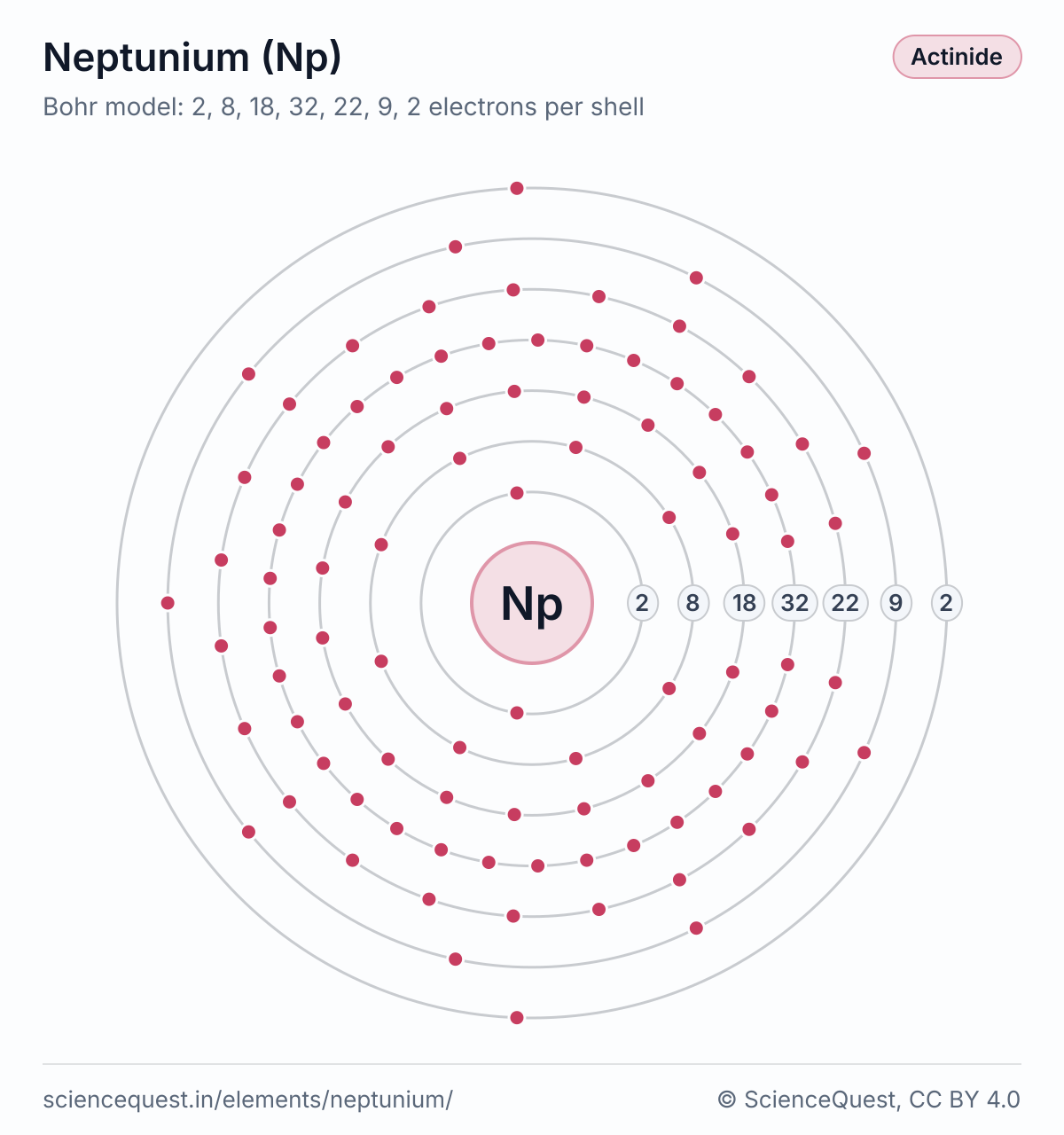
Neptunium (Np) is an actinide with atomic number 93. It has no stable isotope and no characteristic isotopic composition on Earth, so it has no standard atomic weight; its longest-lived isotope has mass number 237. Its electron configuration is [Rn] 5f4 6d1 7s2.
Neptunium key data
| Symbol | Np |
|---|---|
| Atomic number | 93 |
| Mass number (longest-lived isotope) | 237 |
| Protons | 93 |
| Neutrons (longest-lived isotope, neptunium-237) | 144 |
| Electrons (neutral atom) | 93 |
| Category | Actinide |
| Period | 7 |
| Group | f-block, no group |
| Block | f-block |
| Noble gas notation | [Rn] 5f4 6d1 7s2 |
| Full electron configuration | 1s2 2s2 2p6 3s2 3p6 3d10 4s2 4p6 4d10 4f14 5s2 5p6 5d10 5f4 6s2 6p6 6d1 7s2 |
| Electrons per shell | 2, 8, 18, 32, 22, 9, 2 |
Mass number: IUPAC CIAAW radioactive elements, from NUBASE2020.
The values are facts and free to use; this page’s selection and presentation are © 2026 ScienceQuest.
Measured properties of neptunium
From PubChem, the US National Institutes of Health. Public domain. PubChem’s periodic table gives no value for the rows not shown.
| Melting point | 917 K (643.85 °C), 67th of 103 by melting point |
|---|---|
| Boiling point | 4175 K (3901.9 °C), 15th of 93 by boiling point |
| Density | 20.25 g/cm³, 5th of 96 by density |
| State at room temperature | Solid |
| Electronegativity | 1.36 (Pauling), joint 57th of 95 by electronegativity |
| Van der Waals radius | 221 pm, joint 32nd of 99 by atomic radius |
| First ionisation energy | 6.266 eV (604.6 kJ/mol), 65th of 102 by first ionisation energy |
| Common oxidation states | +6, +5, +4, +3 |
| Discovered | 1940 |
Each rank counts down from the highest value, among the elements PubChem’s table gives one for, and links to that property ranked across the whole table. All of them are collected under periodic trends.
Neptunium electron configuration
The full electron configuration of neptunium is 1s2 2s2 2p6 3s2 3p6 3d10 4s2 4p6 4d10 4f14 5s2 5p6 5d10 5f4 6s2 6p6 6d1 7s2. With the noble-gas core collapsed it is [Rn] 5f4 6d1 7s2, and the outermost subshell is 7s2.
Neptunium does not follow the simple filling order. Its measured configuration differs from the one the aufbau rule predicts, because at this point in the table the 5f and 6d subshells lie so close in energy that one electron goes into 6d rather than 5f. This is a measured fact about the atom rather than an exception to be derived.
![Orbital box diagram of neptunium (Np), [Rn] 5f4 6d1 7s2, with the radon core drawn as one bar: one box per orbital, filled by Hund’s rule, showing five unpaired electrons, in 5f and 6d.](/images/elements/neptunium-orbital-diagram.png)
Why group and block follow from this is set out in how the periodic table maps electron configuration, and the electron configuration of every element is listed on one page.
Mass of one neptunium atom
A molar mass is grams per mole, so dividing by the Avogadro constant gives the mass of a single atom, or for an element with more than one natural isotope the average mass of its atoms, and the reciprocal gives how many atoms sit in a gram.
Mass of one atom
- one atom = 237 / (6.02214076 × 10²³)
- = 3.9355 × 10⁻²² g
Atoms in one gram
- atoms per gram = 6.02214076 × 10²³ / 237
- = 2.5410 × 10²¹ atoms
Neptunium has no standard atomic weight, because it has neither a stable isotope nor a characteristic isotopic composition on Earth. The figure used above is the mass number of neptunium-237, so treat these as nominal.
Neptunium on the periodic table
Neptunium is in period 7, outside the numbered groups, in the f-block.
The rest of period 7
- 87 Fr Francium
- 88 Ra Radium
- 89 Ac Actinium
- 90 Th Thorium
- 91 Pa Protactinium
- 92 U Uranium
- 94 Pu Plutonium
- 95 Am Americium
- 96 Cm Curium
- 97 Bk Berkelium
- 98 Cf Californium
- 99 Es Einsteinium
- 100 Fm Fermium
- 101 Md Mendelevium
- 102 No Nobelium
- 103 Lr Lawrencium
- 104 Rf Rutherfordium
- 105 Db Dubnium
- 106 Sg Seaborgium
- 107 Bh Bohrium
- 108 Hs Hassium
- 109 Mt Meitnerium
- 110 Ds Darmstadtium
- 111 Rg Roentgenium
- 112 Cn Copernicium
- 113 Nh Nihonium
- 114 Fl Flerovium
- 115 Mc Moscovium
- 116 Lv Livermorium
- 117 Ts Tennessine
- 118 Og Oganesson