Resistor Colour Code Calculator
Read 4, 5 and 6 band resistor colour codes as ohms, tolerance and temperature coefficient per IEC 60062:2016, or turn a value into its colour bands.
Calculator
±5%
Yellow, violet, red, gold
- Tolerance
- ±5 %
- Lowest
- 4.465 kΩ
- Highest
- 4.935 kΩ
Read from the other end, this is not a code, because gold is never a figure, so band 1 is where the code starts.
Nearest preferred values, IEC 60063
4.7 kΩ is in E6, E12, E24 and E192. The highlighted row, E24, is the series usually paired with ±5%.
| Series | Below | Above |
|---|---|---|
| E6 | 4.7 kΩ, exact | |
| E12 | 4.7 kΩ, exact | |
| E24 | 4.7 kΩ, exact | |
| E48 | 4.64 kΩ −1.28% (nearest) | 4.87 kΩ +3.62% |
| E96 | 4.64 kΩ −1.28% | 4.75 kΩ +1.06% (nearest) |
| E192 | 4.7 kΩ, exact | |
Reading the bands
- Bands 1 and 2 are figures: yellow 4, violet 7, so 47.
- Band 3 is the multiplier: red, x 10².
- R = 47 x 10² = 4700 Ω
- That is 4.7 kΩ.
- Band 4 is the tolerance: gold, ±5%.
- Lowest: 4700 x (1 - 0.05) = 4465 Ω.
- Highest: 4700 x (1 + 0.05) = 4935 Ω.
Figures come first, then the multiplier, then the tolerance, which comes last unless a sixth band gives the temperature coefficient.
Citing this tool
Last updated . Add the date you accessed it as well, which a citation of a page that can change asks for. If a specific result matters, cite the permalink from the tool’s share row instead of this page: it reproduces the exact parameters.
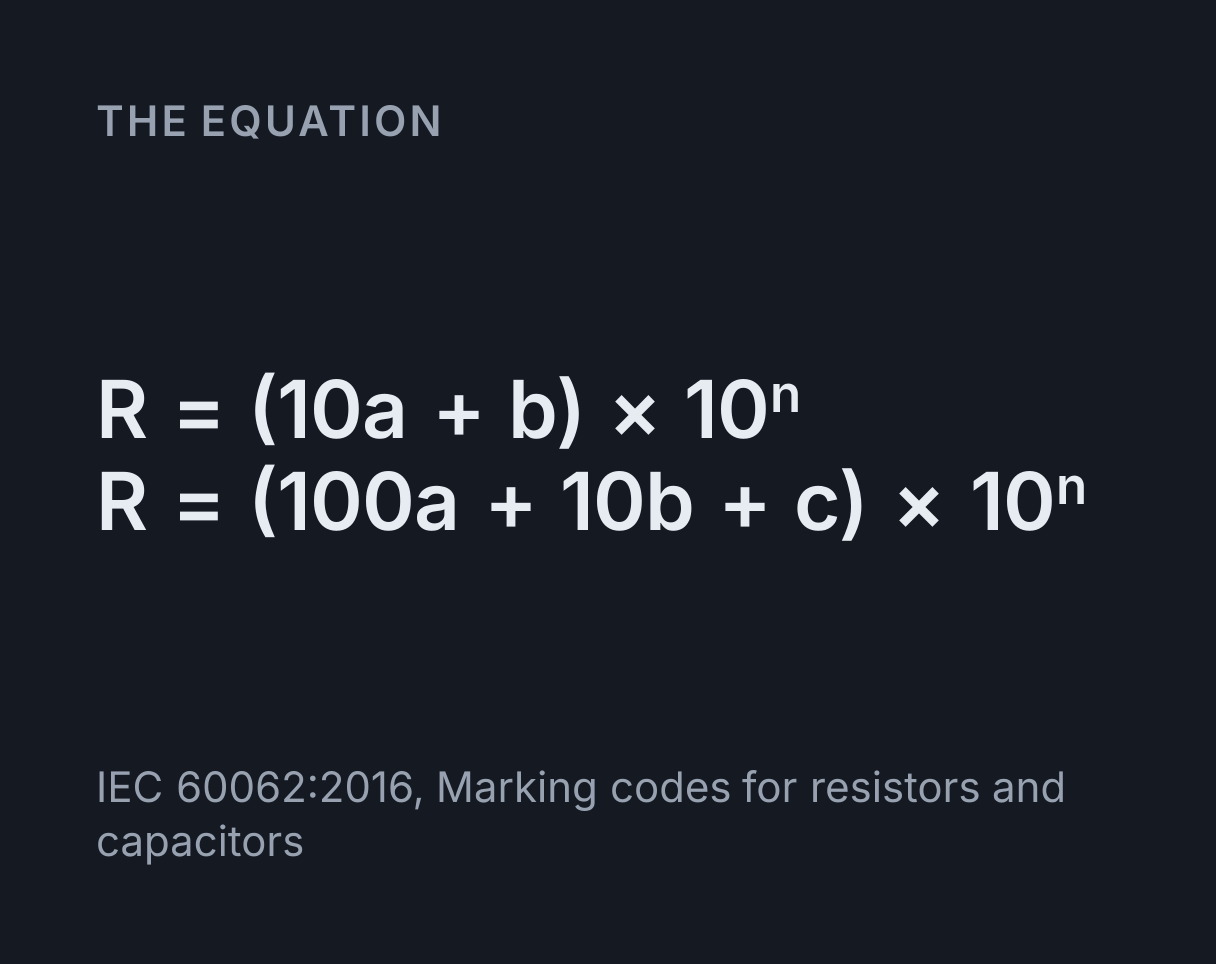
The equation
IEC 60062:2016, Marking codes for resistors and capacitors
How to read a resistor colour code
A resistor colour code writes the resistance as significant figures and a power of ten: the first two
bands are digits (three on a five- or six-band resistor), the next band is the power of ten to multiply
by, and the band after that is the tolerance. In symbols that is R = (10a + b) × 10ⁿ for
three or four bands and R = (100a + 10b + c) × 10ⁿ for five or six. Yellow, violet, red,
gold reads 47 × 10² = 4700 Ω, which is 4.7 kΩ within ±5 percent.
The digits run black 0, brown 1, red 2, orange 3, yellow 4, green 5, blue 6, violet 7, grey 8 and white 9. As a multiplier the same colours give the power of ten, from black for ×1 to white for ×10⁹, and three more take it below one: gold ×0.1, silver ×0.01 and pink ×0.001. Pick the bands above to get the value, or start from a resistance to get the bands it should carry, with the nearest preferred values either side.
The resistor colour code chart
The chart gives every colour and what it means in each position, as Table 1 of IEC 60062:2016 assigns them. A blank cell is a meaning the colour does not have: gold is never a figure and white is never a tolerance. The last row is a resistor with no tolerance band at all, which is ±20 percent.
| Colour | Figure | Multiplier | Tolerance | Coefficient, ppm/K |
|---|---|---|---|---|
| Pink | ×0.001 | |||
| Silver | ×0.01 | ±10% | ||
| Gold | ×0.1 | ±5% | ||
| Black | 0 | ×1 | ±250 | |
| Brown | 1 | ×10 | ±1% | ±100 |
| Red | 2 | ×100 | ±2% | ±50 |
| Orange | 3 | ×1k | ±0.05% | ±15 |
| Yellow | 4 | ×10k | ±0.02% | ±25 |
| Green | 5 | ×100k | ±0.5% | ±20 |
| Blue | 6 | ×1M | ±0.25% | ±10 |
| Violet | 7 | ×10M | ±0.1% | ±5 |
| Grey | 8 | ×100M | ±0.01% | ±1 |
| White | 9 | ×1G | ||
| No band | ±20% |
Worked example: red, yellow, white, orange, brown, red
A six-band code carries three figures, a multiplier, a tolerance and a temperature coefficient. The
first three bands are figures, red 2, yellow 4 and white 9, so the digits are 249. The fourth band, orange, is the multiplier ×10³, so
R = 249 × 10³ = 249,000 Ω, which is 249 kΩ.
The fifth band, brown, is the tolerance, ±1 percent, so the resistor can be anything from 246.51 kΩ to
251.49 kΩ and still be in specification. The sixth band, red, is the temperature coefficient, ±50 ppm/K:
the resistance may move by up to 249,000 × 50 × 10⁻⁶ = 12.45 Ω for every kelvin the
temperature changes. Warming it from 25 °C to 85 °C, a rise of 60 K, can move it by up to 747 Ω, which
is 0.3 percent.
249 kΩ is in E48, E96 and E192, and E96 is the series usually paired with ±1 percent, so it is a standard value at that tolerance. Set these six bands above and the calculator shows the value, the limits and the change per kelvin, with the working.
Which end to start from
Start from the band nearest an end of the resistor, which is where IEC 60062 asks a maker to put the first band, and read towards the tolerance band, which comes last, or second to last when a sixth band gives the temperature coefficient, and on many resistors is wider than the others or set apart by a larger gap. Gold and silver are never figures, so a gold or silver band at one end is always the last band. A colour that cannot be a figure in the first position, or a black first band, means you are probably holding the resistor the wrong way round.
Some codes read sensibly both ways. Brown, black, red, brown is 10 × 10² = 1 kΩ ±1
percent, and turned round, brown, red, black, brown is 12 × 1 = 12 Ω ±1 percent. Only the
band widths, the spacing or a meter can settle that one. The calculator reads every code from the other
end as well, says whether that reading is possible, and says so when only one of the two readings is a
value in any E series.
Three, four, five and six bands
A three-band resistor has two figures and a multiplier and no tolerance band, which the standard reads as ±20 percent: blue, grey, red is 6.8 kΩ ±20 percent. Four bands add the tolerance. Five bands carry a third figure, so they can mark 4.75 kΩ, which four bands cannot: four bands can only mark it rounded, to 4.8 kΩ (yellow, grey, red), while five write it exactly as yellow, violet, green, brown, followed by the tolerance band, brown for ±1 percent. Six bands add a temperature coefficient after the tolerance.
The temperature coefficient is not always a solid sixth band. It can also be marked as an interrupted band or a dot, and the colours mean the same either way.
From a value to its bands, and why 4.7 kΩ but not 4.8 kΩ
Resistors are made in the preferred values of IEC 60063, the E series, which divide each decade in near-equal ratios: E12 has twelve values in a decade, E24 twenty-four, and so on up to E192. E24, the series usually paired with ±5 percent, has 4.7 and 5.1 and nothing between them, so 4.8 kΩ is not a preferred value.
Type 4.8 kΩ into the calculator and it gives the bands for 4.8 kΩ, yellow, grey, red, and the neighbours in every series. In E24 they are 4.7 kΩ, 2.08 percent below, and 5.1 kΩ, 6.25 percent above. The nearer is 4.7 kΩ, and at ±5 percent a 4.7 kΩ part can be anything from 4.465 kΩ to 4.935 kΩ, so it can measure 4.8 kΩ and still be in specification. Where the error has a safe direction, as with the resistor that limits an LED’s current, round up instead.
The finer series do not simply contain the coarser ones. E48, E96 and E192 use three figures and follow
the rule 10^(i/n) rounded, apart from a single value, 9.20 in E192, while E24 keeps eight
values that depart from it: the rule would give 2.6, 2.9, 3.2, 3.5, 3.8, 4.2, 4.6 and 8.3 where the
standard has 2.7, 3.0, 3.3, 3.6, 3.9, 4.3, 4.7 and 8.2. So 4.7 kΩ is in E24 and E192 but not in E48 or
E96, whose nearest values are 4.64 kΩ and 4.75 kΩ respectively.
With a value in hand, the Ohm’s law calculator gives the current it passes, the resistor network calculator combines several in series and parallel, the LED resistor calculator works out the value an LED needs, rounded up to the next E12 part, and the RC time constant calculator pairs it with a capacitor.
Where charts disagree
This calculator follows Table 1 of IEC 60062:2016. That edition added pink for the multiplier ×0.001, and its table gives yellow and grey the tolerances ±0.02 and ±0.01 percent, which many older charts leave blank. The American EIA RS-279 standard of 1963 gave grey as ±0.05 percent, and a chart that still prints that value disagrees with this one on grey. The table above has the nine temperature coefficient colours the 2016 table assigns. On a precision part, the maker’s datasheet is the final word.
What this does not cover
The colour code gives the value, the tolerance and the temperature coefficient, and nothing else. It says nothing about the power rating, which comes from the part’s size and datasheet, or the voltage it can take. This does not read the letter and numeral codes such as 4K7 that IEC 60062 also defines, the numbers printed on surface-mount resistors, or the markings on capacitors and inductors. Some parts carry an extra band that is not part of the IEC code, and a code that makes sense in neither direction may be one of those. A zero-ohm link is usually a single black band.
The tolerance is how far a part may be from its marked value as made. Ageing, soldering heat and temperature can move it further, and the temperature coefficient covers only temperature, as the largest change per kelvin the band allows, applied as a straight line.
Common mistakes
- Reading from the wrong end. Gold or silver at the start means the resistor is the wrong way round, and a black first band usually does.
- Treating the multiplier as a figure. On a four-band code the third band is a power of ten, so yellow, violet, red is 4700 Ω, not 472 Ω.
- Reading a gold or silver multiplier as a tolerance. In the third band of four they multiply by 0.1 and 0.01, so yellow, violet, gold, gold is 4.7 Ω, not 47 Ω.
- Reading five bands as four. Brown, black, black, brown, brown is
100 × 10 = 1 kΩ±1 percent. Read as four bands it would be 10 Ω. - Confusing similar colours. Red, orange and brown are easy to mix up under poor light, and so are grey, white and silver. A value that is in no E series is a reason to look again, or to measure the part.
- Expecting the exact value. A 4.7 kΩ ±5 percent resistor can measure anything from 4.465 kΩ to 4.935 kΩ and still be in specification.
Converting units first? Use the resistance conversion table.
Common questions
How do you read a four-band resistor colour code?
Read the first two bands as digits, the third as the power of ten to multiply by and the fourth as the tolerance. Yellow, violet, red, gold is 47 × 10² = 4700 Ω, which is 4.7 kΩ within ±5 percent, so the part may measure anywhere from 4.465 kΩ to 4.935 kΩ. The digits run from black for 0 to white for 9, and in the third band gold and silver mean ×0.1 and ×0.01.
Which end of a resistor do you read from?
From the end the bands start nearest, which IEC 60062 makes the first band, towards the tolerance band, which comes last, or second to last on a six-band resistor, and on many resistors is wider or set apart by a larger gap. Gold and silver are never a figure, so a resistor with gold or silver at one end is read from the other end. Some codes make sense both ways round: brown, black, red, brown is 1 kΩ ±1 percent, and turned round it reads 12 Ω ±1 percent, so only the band widths, the spacing or a meter can settle it.
What is the difference between four, five and six band resistors?
Five bands carry a third significant figure and six add a temperature coefficient. Four bands can mark 4.7 kΩ but not 4.75 kΩ, which needs five: yellow, violet, green and brown, then the tolerance band. The sixth band says how far the resistance may drift with temperature, in ppm/K; red is ±50 ppm/K, which on a 249 kΩ resistor is up to 12.45 Ω for each kelvin.
What do gold and silver mean on a resistor?
Gold means ±5 percent and silver ±10 percent in the tolerance band, and ×0.1 and ×0.01 in the multiplier band. So yellow, violet, gold, gold is 47 × 0.1 = 4.7 Ω ±5 percent. Neither is ever a figure, which is why a gold or silver band at one end tells you it is the last band.
Why does grey mean ±0.01 percent here when my chart says ±0.05 percent?
Because this calculator follows IEC 60062:2016, which gives grey as ±0.01 percent. The American EIA RS-279 standard of 1963 gave grey as ±0.05 percent, and charts that still print it disagree on that one colour. The 2016 edition also added pink as the multiplier ×0.001, and its table gives yellow the tolerance ±0.02 percent, which many older charts leave blank. On a precision part, the maker’s datasheet is the final word.
What is the colour code of a 10 kΩ resistor?
Brown, black, orange, gold on a four-band 10 kΩ ±5 percent resistor, and brown, black, black, red, brown on a five-band 10 kΩ ±1 percent one. Other common values follow the same pattern on four bands: 1 kΩ is brown, black, red; 220 Ω is red, red, brown; and 100 kΩ is brown, black, yellow, each followed by the tolerance band.