Internal capsule
The internal capsule is a thick band of white matter in each cerebral hemisphere that carries fibers to and from the cerebral cortex. It runs between the lentiform nucleus on the outside and the caudate nucleus and thalamus on the inside. (StatPearls, Internal Capsule; Gray 1918, 4c. The Fore-brain)
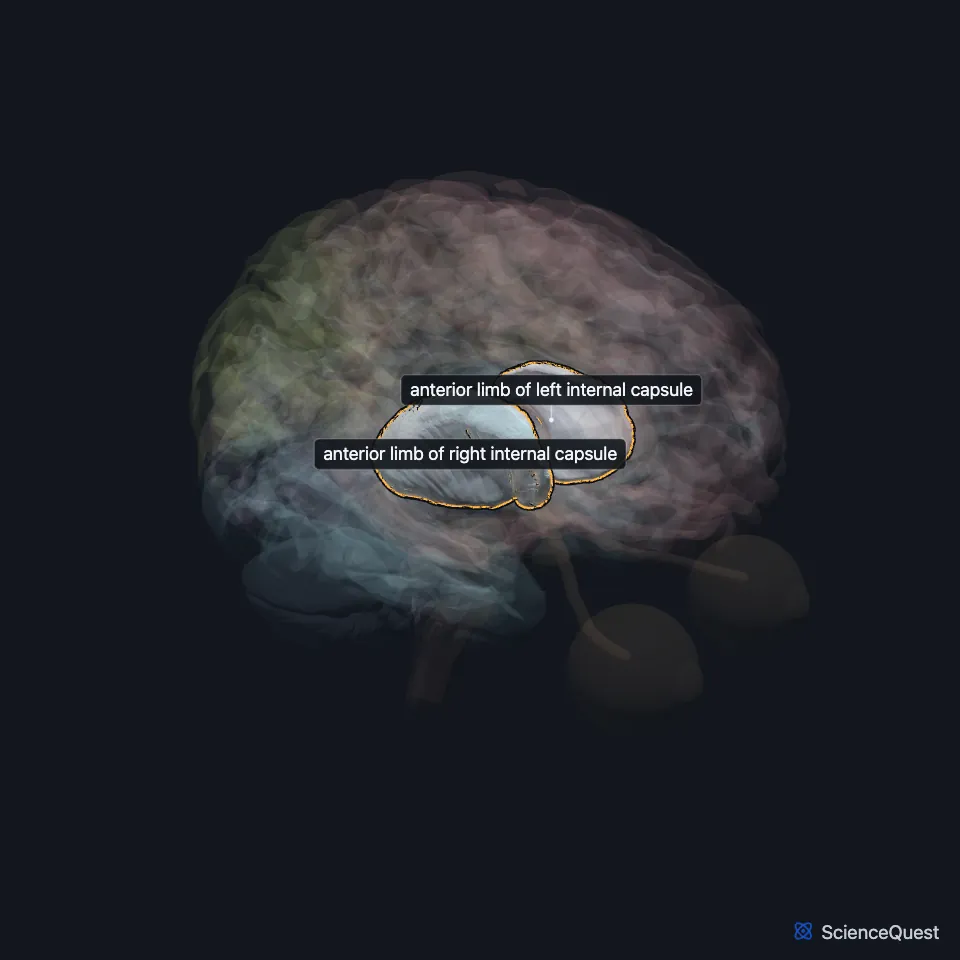
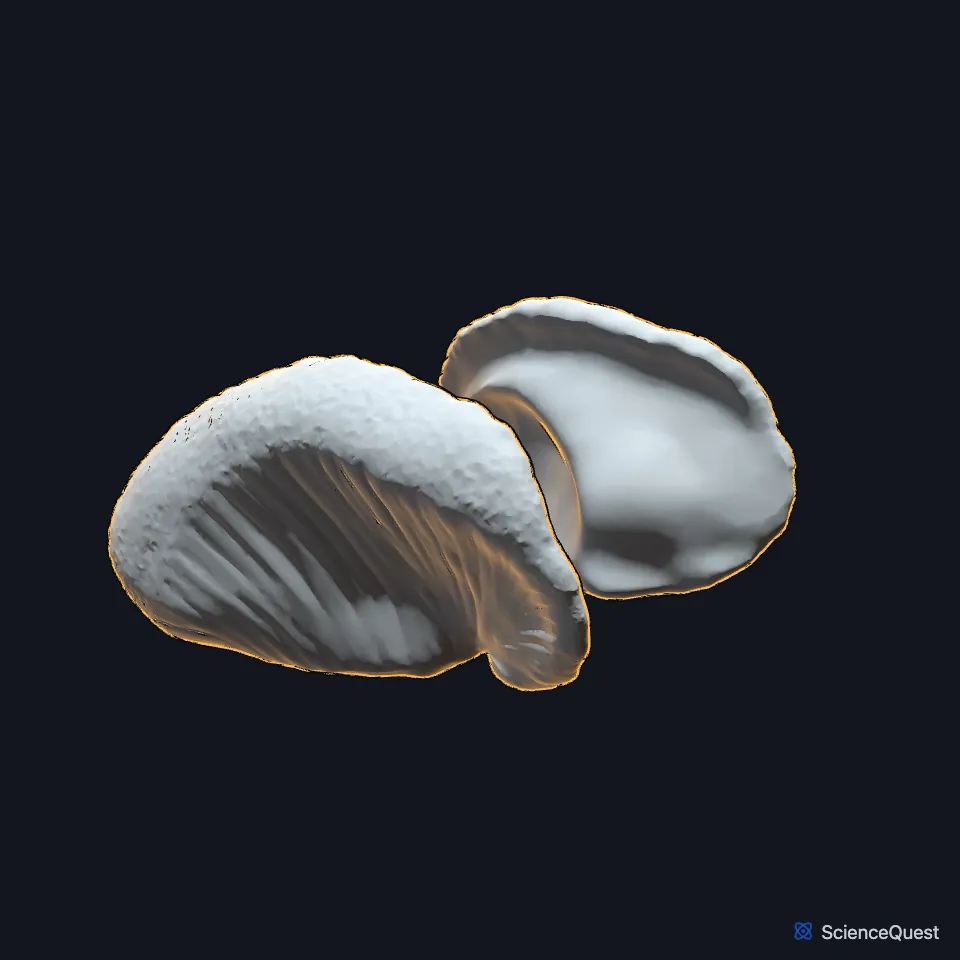
Where is the internal capsule?
Cut across, it is V-shaped with its point toward the midline. The anterior limb lies between the head of the caudate nucleus and the lentiform nucleus, and the posterior limb between the thalamus and the lentiform nucleus. (StatPearls, Internal Capsule)
Above the lentiform nucleus its fibers fan out as the corona radiata, and below they gather into the base of the cerebral peduncle in the midbrain. (StatPearls, Internal Capsule; Gray 1918, 4c. The Fore-brain)
What are the parts of the internal capsule?
It has five parts: the anterior limb, the genu where the two limbs meet, the posterior limb, and the retrolenticular and sublenticular parts behind and below the lentiform nucleus. Gray’s 1918 calls the limbs the frontal and occipital parts, older names. (StatPearls, Internal Capsule; Gray 1918, 4c. The Fore-brain)
Which tracts run through the internal capsule?
The anterior limb carries the anterior thalamic radiation to the prefrontal cortex and cingulate gyrus, and frontopontine fibers to the pons. Its tracts are tied to emotion, decision making and motivation. (StatPearls, Internal Capsule)
The genu carries corticobulbar fibers, which reach the cranial nerve nuclei and control the muscles of the face and neck. The posterior limb carries the corticospinal tract in its front half and sensory fibers from the thalamus to the postcentral gyrus in its back third. (StatPearls, Internal Capsule)
The retrolenticular part carries the optic radiation from the lateral geniculate body, and the sublenticular part the auditory radiation from the medial geniculate body. (StatPearls, Internal Capsule)
What supplies the internal capsule?
Small perforating branches of the anterior cerebral, middle cerebral, anterior choroidal and internal carotid arteries supply it. The upper levels of all three central parts take their blood from perforators of the middle cerebral artery. (StatPearls, Internal Capsule)
Why do small strokes in the internal capsule matter?
Its narrow perforating arteries are prone to blocking, and a blocked one gives a lacunar stroke, most often from lipohyalinosis tied to long-standing high blood pressure. A pure motor stroke weakens the opposite face, arm and leg equally, and clumsy hand dysarthria comes from the anterior limb or genu. (StatPearls, Internal Capsule)
Touches in this model
Measured on the BodyParts3D meshes: surfaces within 2 mm of the internal capsule, nearest first, 12 of 15.
- Anterior commissure in contact
- Left caudate nucleus in contact
- Left globus pallidus in contact
- Left putamen in contact
- Left thalamus in contact
- Peduncle of midbrain in contact
- Right caudate nucleus in contact
- Right globus pallidus in contact
- Right putamen in contact
- Right thalamus in contact
- White matter structure of cerebral hemisphere in contact
- Hypothalamus 0.5 mm away
Sources
Sources read
- StatPearls, Neuroanatomy, Internal Capsule. Marc Christopher Emos; Mahammed Z. Khan Suheb; Sanjeev Agarwal. Last update . CC BY-NC-ND 4.0. Read .
- Gray’s Anatomy of the Human Body, 20th US edition (1918), IX. Neurology, 4c. The Fore-brain or Prosencephalon. Henry Gray. Public domain. Read .
The values are facts and free to use; this page’s selection and presentation are © 2026 ScienceQuest.