Electrolysis Simulator
Electrolyze melts and solutions such as brine and copper sulfate: see what forms at each electrode and work the mass and gas volume from Faraday’s law.
Simulator
Drag the scrubber to move through the run. With the scene focused, the arrow keys move it a minute (ten seconds on a short run), and Home and End jump to either end. Space plays and pauses.
Electrolysis of 0.5 mol/L copper(ii) sulfate at 1 A, 0.0 of 10.0 min. Copper forms at the cathode and oxygen at the anode; 0 C has passed.
Products
- Cathode (−) Cu²⁺ at +0.33 V is above water at −0.41 V (pH 7), so copper plates. AQA’s rule agrees: copper is less reactive than hydrogen.
- Copper Cu²⁺ + 2e⁻ → Cu
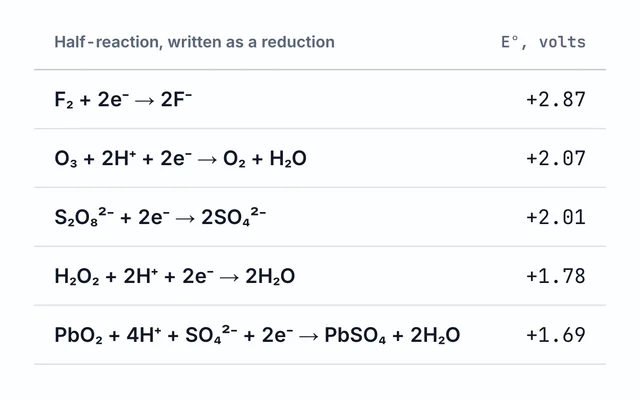
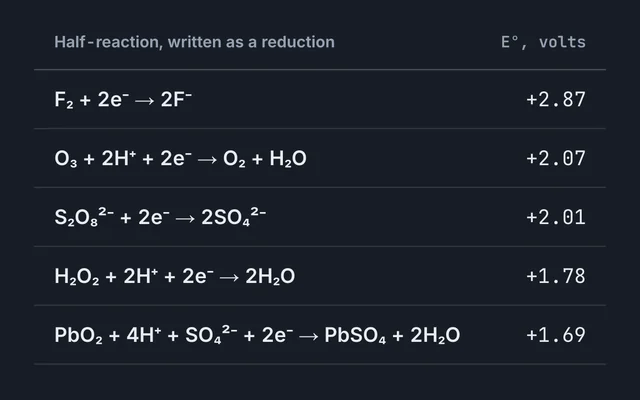
- Anode (+) Sulfate would need +2.01 V (S₂O₈²⁻/SO₄²⁻), above water at +0.82 V (pH 7), so water is oxidized to oxygen and leaves H⁺. AQA writes it 4OH⁻ → O₂ + 2H₂O + 4e⁻.
- Oxygen 2H₂O → O₂ + 4H⁺ + 4e⁻
After 0 s
- Charge passed, Q Q = It = 1 A × 0 s.
- 0 C
- Electrons n(e⁻) = Q ÷ F, with F = 96,485 C/mol, the charge on a mole of electrons.
- 0 mol
- Copper deposited n(Cu) = n(e⁻) ÷ 2 = 0 mol; m = n × 63.546 g/mol.
- 0 g 0 oz
- Oxygen collected n(O₂) = n(e⁻) ÷ 4 = 0 mol, and V = nRT/P at 25 °C and 1 atm. The note uses AQA’s 24 dm³/mol at room temperature and pressure, 20 °C (8462 4.3.5).
- 0 mL 0 mL at RTP
A teaching model: the current holds steady, every electron makes the product named, and gases are counted dry at 25 °C and 1 atm.
- Cu at the cathode
- O₂ at the anode
More 3 more readings, solution volume, currents to 50 A
After 0 s
- Minimum voltage −E°cell. E°cathode − E°anode = +0.34 V − (+1.23 V). OpenStax 17.7 calls such figures ballpark estimates, since the cell is not at standard conditions. A real cell also needs more for overpotential and the solution’s resistance.
- 0.89 V
- H⁺ at the anode One H⁺ for each electron, from 2H₂O → O₂ + 4H⁺ + 4e⁻.
- 0 mmol acidic there
- Cu²⁺ left Down from 0.5 mol/L as the cathode discharges it.
- 0.5 mol/L
Sets how many ions there are to use up.
Opens the current slider past a school supply’s 5 A.
Cite this tool
Citing this tool
Last updated . Add the date you accessed it as well, which a citation of a page that can change asks for. If a specific result matters, cite the permalink from the tool’s share row instead of this page: it reproduces the exact parameters.
The equation
OpenStax Chemistry 2e (2019), section 17.7, and AQA GCSE Chemistry 8462, 4.4.3
The equation as an image to reuse
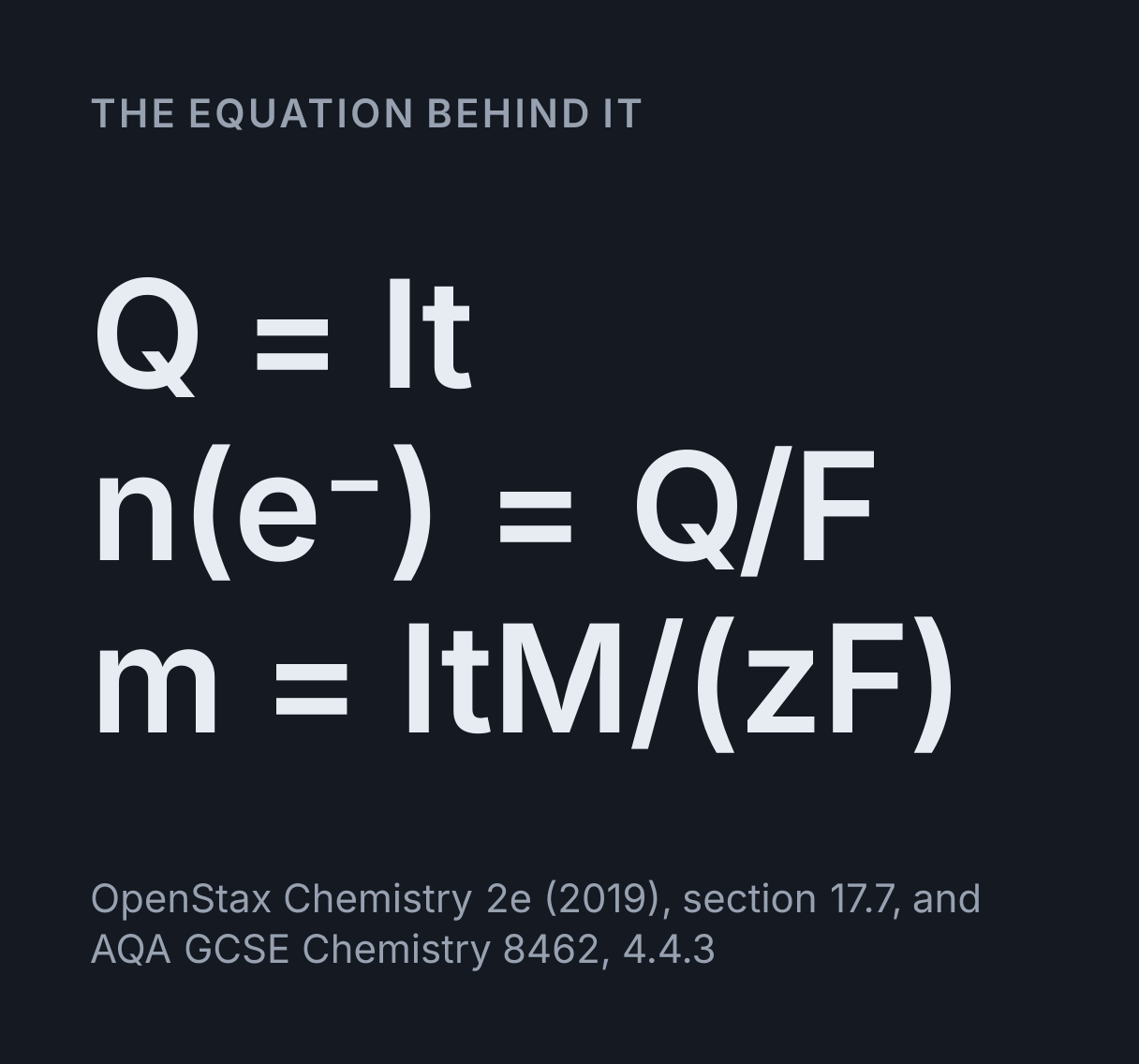
What the electrolysis simulator shows
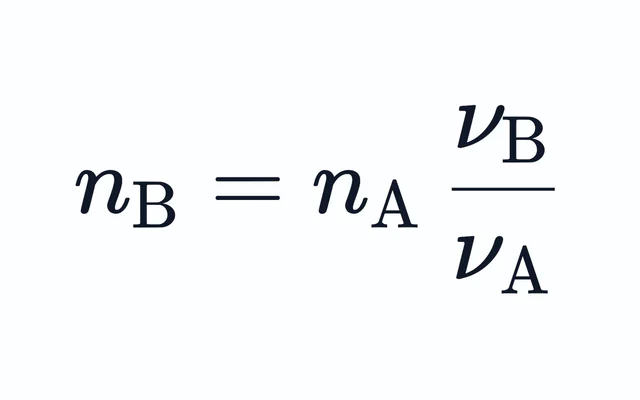
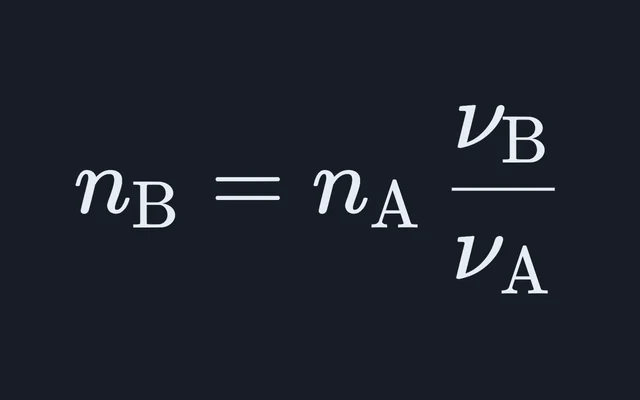
A steady current runs through a molten salt or a solution in water between two electrodes. You see which product forms at each one, the ions drifting toward the electrode of opposite charge, gas filling a tube over each gas electrode and metal plating the cathode. The amounts come from Q = It, n(e⁻) = Q ÷ F and m = ItM ÷ zF, with F the Faraday constant, 96,485 C/mol.
The list holds 3 molten salts and 7 solutions: lead(II) bromide, zinc chloride and sodium chloride as melts, then copper(II) sulfate, copper(II) chloride, brine, sodium sulfate, dilute sulfuric acid, potassium iodide and silver nitrate. Copper(II) sulfate also runs with copper electrodes, the cell used to plate and refine copper. Solutions go up to 2 mol/L, except copper(II) sulfate and sodium sulfate, which stop at 1 mol/L to stay unsaturated. Copper(II) sulfate saturates at 201 g/L at 20 °C, about 1.26 mol, and sodium sulfate dissolves to 28.1 g per 100 mL at 25 °C but 4.76 g at 0 °C.
What to try
- Copper(II) sulfate, then copper(II) chloride. The cathode plates copper in both. The anode switches from oxygen to chlorine, because the second solution holds a halide.
- Brine, then molten sodium chloride. Same salt, different cathode product: hydrogen from the solution, sodium from the melt. More, under the plot, gives the reason with the numbers.
- Sodium sulfate. Hydrogen and oxygen fill their tubes at 2 to 1, and the indicator turns blue at the cathode and red at the anode as water leaves OH⁻ and H⁺ behind.
- Double the current, or the time. Every amount formed doubles, since each depends only on the charge passed. The plot’s lines stay straight.
- Dilute copper(II) sulfate at a high current. At 0.05 mol/L in 100 mL and 5 A the copper ions run out after 3.22 min, and the run stops there.
Run plays the electrolysis at 60x to start, so a 10 minute run takes 10 seconds; the speed menu runs from 1x, the bench pace, to 600x. The scrubber, and the arrow keys with the scene focused, move through the run. The share link keeps every setting after the # in its address. With reduced motion on, the scene opens on the end of the run without bubbles or drifting ions.
Predicting the products
AQA’s specification for GCSE Chemistry (8462, 4.4.3.2) puts a melt in one sentence: with inert electrodes, “the metal (lead) is produced at the cathode and the non-metal (bromine) is produced at the anode.” A melt holds no water, so the salt’s own ions are the only ones there to discharge. Bromine boils at 58.8 °C and lead(II) bromide melts at 370.6 °C, so the bromine leaves the melt as a brown vapor. The simulator gives its mass, since at 25 °C bromine is a liquid.
In a solution water competes at both electrodes. AQA 4.4.3.4 gives two rules. At the cathode, “hydrogen is produced if the metal is more reactive than hydrogen.” At the anode, “oxygen is produced unless the solution contains halide ions when the halogen is produced.” The simulator checks both rules against the table of standard reduction potentials, with each couple corrected for the solution by the Nernst equation. The cathode reduces whichever couple has the higher potential, and the anode oxidizes the one with the lower.
- Copper(II) sulfate at the cathode. Cu²⁺ at 0.5 mol/L sits at +0.33 V, above water’s −0.41 V at pH 7, so copper plates. Copper is less reactive than hydrogen, and AQA’s rule agrees.
- Brine at the cathode. Na⁺ at 0.5 mol/L sits at −2.73 V, far below water, so water is reduced: 2H₂O + 2e⁻ → H₂ + 2OH⁻. AQA writes the same change as 2H⁺ + 2e⁻ → H₂.
- Sulfate and nitrate at the anode. Oxidizing sulfate would need 2.01 V, against water’s +0.82 V at pH 7, or +1.23 V in dilute sulfuric acid, which the simulator compares at the table’s 1 M H⁺. Chemguide notes that water is easier to discharge than nitrate. Water gives oxygen: 2H₂O → O₂ + 4H⁺ + 4e⁻, which AQA writes as 4OH⁻ → O₂ + 2H₂O + 4e⁻.
- Iodide at the anode. I⁻ at 0.5 mol/L sits at +0.56 V, below water’s +0.82 V, so iodine forms. Thermodynamics and AQA’s halide rule give the same answer.
Chlorine or oxygen: the chloride exception
Chloride is the one case where the table and the rule disagree. At 0.5 mol/L Cl⁻ sits at +1.38 V, well above water’s +0.82 V at pH 7, so thermodynamics favors oxygen. OpenStax Chemistry 2e (17.7) says so, then adds that “in practice it is observed that both water and chloride ion are oxidized under typical conditions, producing a mixture of oxygen and chlorine gas.” Chemguide gives the trend: a concentrated solution gives mainly chlorine, a very dilute one mainly oxygen, and anything between gives a mixture.
No source gives the split as a number, so the simulator follows AQA’s rule and sends every electron to chlorine, and the note under the readouts flags each chloride run. Read its chlorine volume as an upper limit, and expect less the more dilute the brine.
How much forms: Faraday’s law
Each product forms in proportion to the charge. A steady current I for a time t passes Q = It coulombs, which is Q ÷ F moles of electrons, and a product that takes z electrons per atom or molecule forms n(e⁻) ÷ z moles of it. The AP Chemistry framework (9.11.A.1) lists the same links: the electrons transferred, the mass deposited or removed, the current, the time and the charge on the ion.
The simulator opens on copper(II) sulfate at 0.5 mol/L in 100 mL, run at 1 A for 10 minutes:
Q = 1.00 A × 600 s = 600 C, which is600 ÷ 96,485 = 0.006219 molof electrons.-
Copper takes 2 electrons per atom:
0.006219 ÷ 2 = 0.003109 mol, and0.003109 × 63.55 = 0.1976 gof copper on the cathode. -
Oxygen takes 4 electrons per molecule:
0.001555 mol, which is 38.03 mL at 25 °C and 1 atm, or 37.31 mL using AQA’s 24 dm³/mol. - The solution’s Cu²⁺ falls from 0.5 to 0.469 mol/L, and its blue fades with it.
OpenStax works the same law the other way in its Example 17.9: 10.23 A for exactly 1 hour passes
36,830 C, 0.3817 mol of electrons, and deposits 41.19 g of silver from silver nitrate. Set silver nitrate,
the industrial range in More, 10.23 A and 60 min, with 2 mol/L in 250 mL so the silver lasts, and the
simulator gives 41.17 g, because it uses silver’s standard atomic weight, 107.87, where the book uses 107.9.
Example 17.10 runs it backward: 4.56 mol of chromium from Cr³⁺ needs
4.56 × 3 × 96,485 = 1.32 × 10⁶ C, about 11 hours at 33.46 A.
Gas volumes, at 25 °C and at RTP
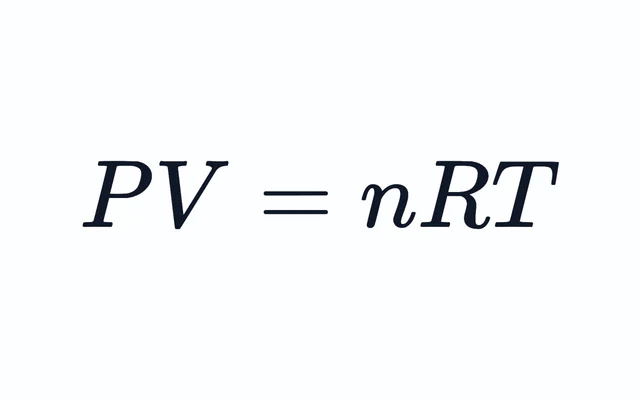
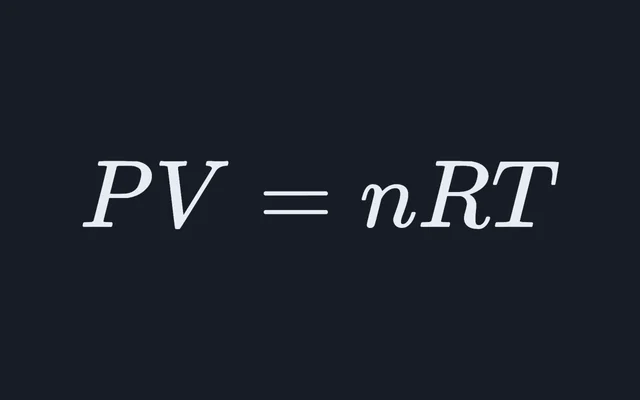
The tubes give each gas from the ideal gas law, V = nRT ÷ P, at 25 °C and 1 atm, where a mole fills 24.47 L. AQA (8462, 4.3.5) has GCSE students use 24 dm³ per mole at room temperature and pressure, 20 °C and 1 atm, and each gas readout gives that figure beside it.
Splitting water gives 2 volumes of hydrogen for each of oxygen, because hydrogen takes 2 electrons per molecule and oxygen 4. After 10 minutes at 1 A, sodium sulfate or dilute sulfuric acid gives 76.07 mL of hydrogen and 38.03 mL of oxygen. Brine gives equal volumes of hydrogen and chlorine, 76.07 mL each, since each takes 2 electrons.
The minimum voltage
An electrolytic cell drives a reaction that would not run by itself, so its standard cell potential, E°cathode − E°anode, comes out negative, and the supply has to provide at least −E°cell. OpenStax gives −1.229 V for the electrolysis of water and −2.186 V for brine; the site’s table, to two decimals, gives 1.23 V and 2.19 V. Copper(II) sulfate needs 0.89 V and potassium iodide 1.37 V. OpenStax warns that such figures are ballpark estimates, since a working cell is not at standard conditions. A real supply also needs more to overcome overpotential and the resistance of the solution, which the simulator leaves out. No minimum is given for a melt, because the table’s potentials hold for water at 25 °C.
Copper electrodes: plating and refining
Swap the inert electrodes for copper in copper(II) sulfate and the anode stops making oxygen. Copper at +0.33 V is easier to oxidize than water, so the anode dissolves, Cu → Cu²⁺ + 2e⁻, while the cathode plates Cu²⁺ + 2e⁻ → Cu. Chemguide calls the result “a net transfer of copper from the anode to the cathode”: the anode loses exactly the mass the cathode gains, the solution keeps its concentration, and E°cell is 0 V. OpenStax’s silver-plated spoon is the same cell with silver.
What the simulator leaves out
- Overpotential and resistance. The products follow the table and AQA’s rules, and the voltage is the thermodynamic minimum. The site carries no overpotentials, which is why zinc sulfate, where Chemguide says zinc plates despite the rule, is not on the list.
- The chloride mixture. Chloride solutions send every electron to chlorine, as above.
- What happens once an ion runs out. The run stops when an inert electrode has used up the copper, silver, chloride or iodide ions, and the note says when.
- Side reactions. Chlorine and hydroxide are kept apart, gases are counted dry and none stays dissolved.
- The water used up. The simulator weighs it but holds the volume steady. Splitting water at 50 A for an hour takes 16.8 g, a third of a 50 mL beaker, and a note under the readouts says so once a run uses a tenth of its solution.
- The melt’s temperature. The flames are a picture. AQA notes that melting the compounds and producing the current use large amounts of energy; the model only counts the charge.
Testing the gases
In the required practical you identify each gas with AQA’s tests (8462, 4.8.2): hydrogen burns with a pop at a burning splint, oxygen relights a glowing splint, and chlorine bleaches damp litmus paper white. AQA’s practical 3 in GCSE Chemistry, number 9 in Combined Science: Trilogy, asks you to “investigate what happens when aqueous solutions are electrolysed using inert electrodes” and to start from a hypothesis. For the spontaneous reaction run the other way, try the galvanic cell simulator.
Sources
- Flowers, Theopold, Langley and Robinson, OpenStax Chemistry 2e, section 17.7 Electrolysis (2019): the electrolysis of molten sodium chloride, of water and of brine, electroplating, Q = It and Q = nF, and Examples 17.9 and 17.10.
- AQA GCSE Chemistry 8462, 4.4.3 Electrolysis: the rules for melts and solutions, the half equations and required practical 3; with 4.3.5 for the molar volume and 4.8.2 for the gas tests.
- Jim Clark, Chemguide, The electrolysis of solutions (2017): the effect of concentration on chloride, sulfate and nitrate anodes, and copper anodes.
- College Board, AP Chemistry Course and Exam Description (2024), topics 9.8 and 9.11.
- Wikipedia’s articles on each salt, for the solubilities that set the concentration range (copper(II) sulfate’s from the CRC Handbook of Chemistry and Physics, 99th edition) and the melting points of lead(II) bromide and zinc chloride, and on the Downs cell, where sodium floats on the melt. Element melting points, boiling points and densities are PubChem’s.
The potentials are the site’s own table, quoted to two decimals at 25 °C, and the molar masses are CIAAW’s abridged standard atomic weights. The drawings are this site’s own.
Model and assumptions
The method, what it assumes and how accurate it is
- Method
- Exact expression, no time stepping
- Repeatability
- Deterministic. The same link gives the same numbers on any machine.
What it assumes
- The supply holds the current steady, so the charge passed is the current times the time, and Faraday’s laws give every amount from it in closed form: moles of electrons Q/F, and moles of each product n(e⁻) over the electrons it takes.
- A melt gives its metal at the cathode and its nonmetal at the anode. In water each electrode compares its ion with water, using the table’s potentials corrected by the Nernst equation at pH 7, and the products agree with AQA’s two rules for every solution offered.
- Chloride solutions send every electron to chlorine, as AQA’s rule does, although water is easier to oxidize; OpenStax says both form in practice, so the chlorine is an upper limit.
- Gases are counted dry at 25 °C and 1 atm from V = nRT/P, with AQA’s 24 dm³ per mole at room temperature and pressure beside them, and none dissolves or reacts with the other electrode’s product.
- With inert electrodes the run stops when the ion an electrode discharges runs out; with copper electrodes the anode replaces every copper ion the cathode takes. The water used up is weighed while the volume stays fixed, and the melt, the copper anode and the solution running short are left out.
- Water’s couples are compared at pH 7 in a salt solution and at the table’s 1 M H⁺ in dilute sulfuric acid. The minimum voltage is −E°cell from the table’s standard potentials, with no overpotential or resistance, and none is given for a melt.
Where it stops holding. Overpotential, which decides the products of solutions such as zinc sulfate and the share of oxygen and chlorine from a chloride, and which raises the real voltage; any temperature but 25 °C; and any change in the solution beyond the ions the electrodes use. The Galvanic Cell Simulator is the right tool there.
Numerical accuracy
No method error to report: the result is a closed-form expression evaluated directly, with no time stepping to accumulate error. What remains is double-precision rounding, of order one part in 10^16 per operation.
Constants used: Molar gas constant (R) and Faraday constant (F).
Common questions
What forms at each electrode during electrolysis?
In a melt, the metal forms at the cathode and the nonmetal at the anode: molten lead(II) bromide gives lead and bromine (AQA 8462 4.4.3.2). In a solution AQA’s two rules decide. Hydrogen forms at the cathode if the metal is more reactive than hydrogen, and oxygen forms at the anode unless the solution holds halide ions, when the halogen forms. So copper(II) sulfate gives copper and oxygen, brine gives hydrogen and chlorine, and potassium iodide gives hydrogen and iodine.
Why does electrolysis of brine give hydrogen instead of sodium?
Water is easier to reduce than Na⁺. Na⁺ + e⁻ → Na has a standard potential of −2.71 V and water at pH 7 sits at −0.41 V, so the cathode reduces water, 2H₂O + 2e⁻ → H₂ + 2OH⁻, and the sodium ions stay in solution beside the hydroxide. OpenStax 17.7 puts it in terms of concentration: neutral brine holds about 10⁻⁷ M of H⁺, far below the standard 1 M, so the reaction observed is the reduction of water. Sodium metal comes from molten sodium chloride, which holds no water.
How do you calculate the mass deposited in electrolysis?
Find the charge, Q = It, divide by the Faraday constant, 96,485 C/mol, for the moles of electrons, divide by the electrons each atom takes, and multiply by the molar mass. In OpenStax’s Example 17.9, 10.23 A for 1 hour passes 36,830 C, which is 0.3817 mol of electrons. Ag⁺ takes one electron, so 0.3817 × 107.9 = 41.19 g of silver plates out. Cu²⁺ takes two, so the same charge deposits half as many moles of copper.
Why do chloride solutions give chlorine when oxygen is easier to make?
Thermodynamics favors oxygen: at pH 7 water is oxidized at +0.82 V and chloride at 0.5 mol/L at +1.38 V. OpenStax 17.7 notes that in practice both are oxidized under typical conditions, giving a mixture of the two gases, and Chemguide says a concentrated solution gives mainly chlorine and a very dilute one mainly oxygen. AQA’s rule gives the halogen, and the simulator follows it, so treat its chlorine figure as an upper limit.
How much gas does electrolysis make?
One mole of hydrogen or chlorine for every 2 moles of electrons, and one of oxygen for every 4. At 1 A for 10 minutes, 600 C, splitting water gives 76.07 mL of hydrogen and 38.03 mL of oxygen at 25 °C and 1 atm, where a mole of gas fills 24.47 L. AQA has GCSE students use 24 dm³ per mole at room temperature and pressure, which gives 74.62 mL and 37.31 mL.