Rotational Inertia and Rolling Race Simulator
Race a hoop, disk, sphere, shell or cart down identical ramps: see why β = I/mR² sets the order, how the energy splits, and when friction runs out.
Simulator
Drag the dot at the top of ramp A to tilt both ramps, or use the arrow keys with the scene focused. Space plays and pauses.
Two 15° ramps at t = 0 s. A, Disk or solid cylinder, rolls, 0 of 2 m at 0 m/s. B, Hoop, rolls, 0 of 2 m at 0 m/s.
ADisk or solid cylinder
- Time to the finish t = √(2L/a) from rest over 2 m.
- 1.538 s first
- Acceleration g sin θ/(1 + β) with β = 1/2. Mass and radius cancel (OpenStax equation 11.4).
- 1.692 m/s² 5.55 ft/s²
- Speed at the finish √(2gh/(1 + β)) with h = L sin θ = 0.5176 m.
- 2.602 m/s 8.54 ft/s
- β = I/mR² I = m R² / 2 (OpenStax Figure 10.20).
- 1/2
- Spin share of KE K rot/K total = β/(1 + β): 1/2 for a hoop, 1/3 for a disk, 2/7 for a sphere.
- 33.3 %
- Motion μs = 0.5 covers tan θ · β/(1 + β) = 0.0893, so static friction holds the contact still and does no work (AP Physics 1, 6.5.B.2).
- Rolls needs μs ≥ 0.0893
BHoop
- Time to the finish t = √(2L/a) from rest over 2 m.
- 1.775 s 0.238 s behind
- Acceleration g sin θ/(1 + β) with β = 1. Mass and radius cancel (OpenStax equation 11.4).
- 1.269 m/s² 4.16 ft/s²
- Speed at the finish √(2gh/(1 + β)) with h = L sin θ = 0.5176 m.
- 2.253 m/s 7.39 ft/s
- β = I/mR² I = m R² (OpenStax Figure 10.20).
- 1
- Spin share of KE K rot/K total = β/(1 + β): 1/2 for a hoop, 1/3 for a disk, 2/7 for a sphere.
- 50 %
- Motion μs = 0.5 covers tan θ · β/(1 + β) = 0.134, so static friction holds the contact still and does no work (AP Physics 1, 6.5.B.2).
- Rolls needs μs ≥ 0.134
More readings I, α, ω, energies and friction
ADisk or solid cylinder
- Moment of inertia, I β m R² = 1/2 × 1 kg × (0.1 m)².
- 0.005 kg·m²
- Angular acceleration, α α = a/R while rolling without slipping (OpenStax equation 11.2).
- 16.92 rad/s²
- Spin at the finish, ω v/R, so a smaller body spins faster.
- 26.02 rad/s
- U at the start, mgh m g L sin θ, with h = 0.5176 m.
- 5.076 J
- K trans at the finish ½ m v².
- 3.384 J
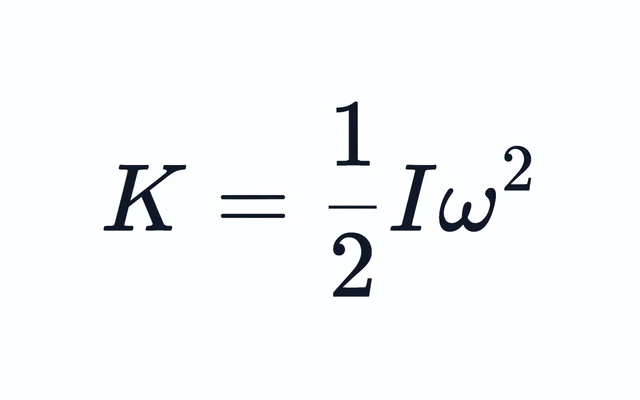
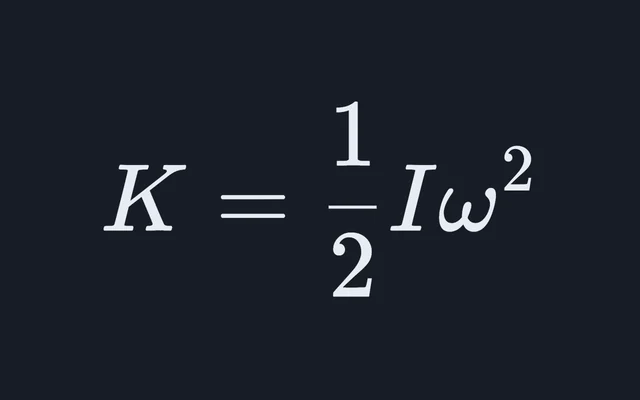
- K rot at the finish ½ I ω².
- 1.692 J
- Heat from friction None: rolling without slipping, the contact point is at rest, so static friction does no work.
- 0 J
- Static friction needed m g sin θ · β/(1 + β), up the slope. It provides the torque that spins the body up.
- 0.846 N
- Friction acting Static, exactly the friction needed.
- 0.846 N
BHoop
- Moment of inertia, I β m R² = 1 × 1 kg × (0.1 m)².
- 0.01 kg·m²
- Angular acceleration, α α = a/R while rolling without slipping (OpenStax equation 11.2).
- 12.69 rad/s²
- Spin at the finish, ω v/R, so a smaller body spins faster.
- 22.53 rad/s
- U at the start, mgh m g L sin θ, with h = 0.5176 m.
- 5.076 J
- K trans at the finish ½ m v².
- 2.538 J
- K rot at the finish ½ I ω².
- 2.538 J
- Heat from friction None: rolling without slipping, the contact point is at rest, so static friction does no work.
- 0 J
- Static friction needed m g sin θ · β/(1 + β), up the slope. It provides the torque that spins the body up.
- 1.269 N
- Friction acting Static, exactly the friction needed.
- 1.269 N
Why a = g sin θ/(1 + β) Forces, then energy
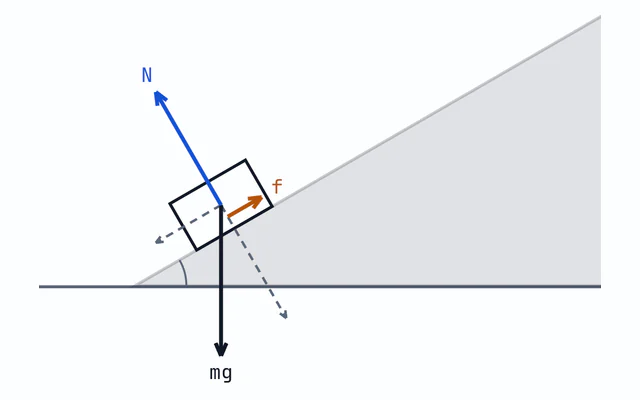
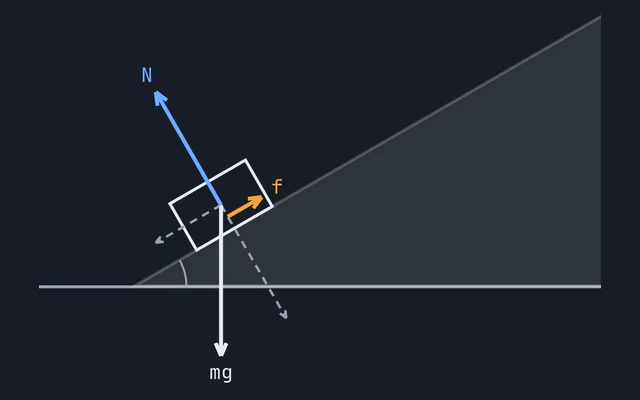
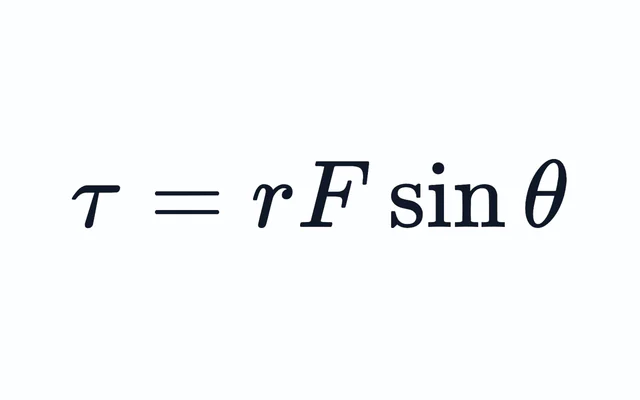
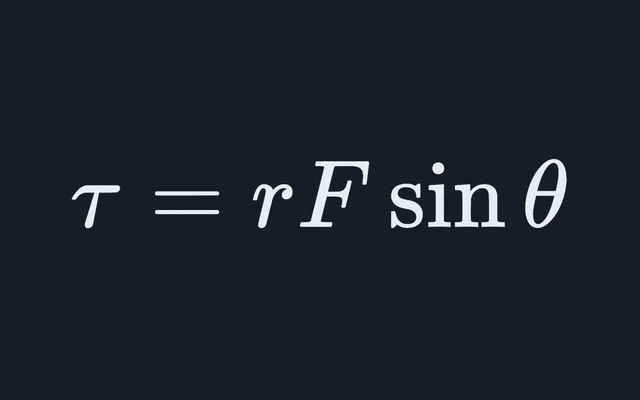
Forces. Along the slope, m a = m g sin θ − f. About the center, only friction has a lever arm: f R = I α. Rolling without slipping, α = a/R, so f = I a/R² = β m a. Then m a = m g sin θ − β m a, and a = g sin θ/(1 + β). The mass cancels, and R went with it when I = β m R² was divided by R².
Energy. Static friction does no work, so m g h = ½ m v² + ½ I ω² with ω = v/R: m g h = ½ m v² (1 + β), and v² = 2 g h/(1 + β). Of the kinetic energy, β/(1 + β) is in the spin, which is the share a body has to give up from its speed. A hoop gives up half, a sphere 2/7 and the cart none, so the cart wins and the hoop comes last.
Friction. The friction needed is f = m g sin θ · β/(1 + β), and the most static friction can give is μs m g cos θ, so the body rolls while μs ≥ tan θ · β/(1 + β) (OpenStax Example 11.1).
Cite this tool
Citing this tool
Last updated . Add the date you accessed it as well, which a citation of a page that can change asks for. If a specific result matters, cite the permalink from the tool’s share row instead of this page: it reproduces the exact parameters.
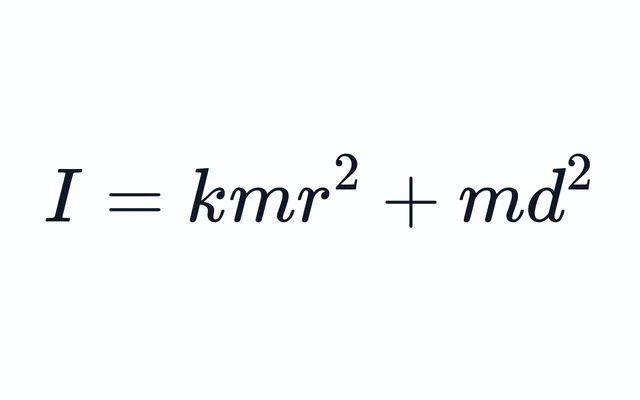
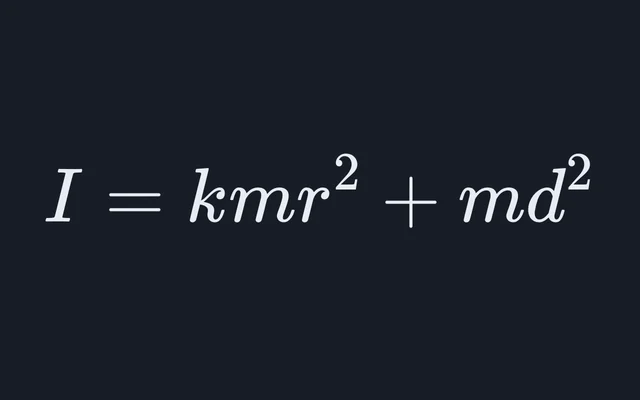
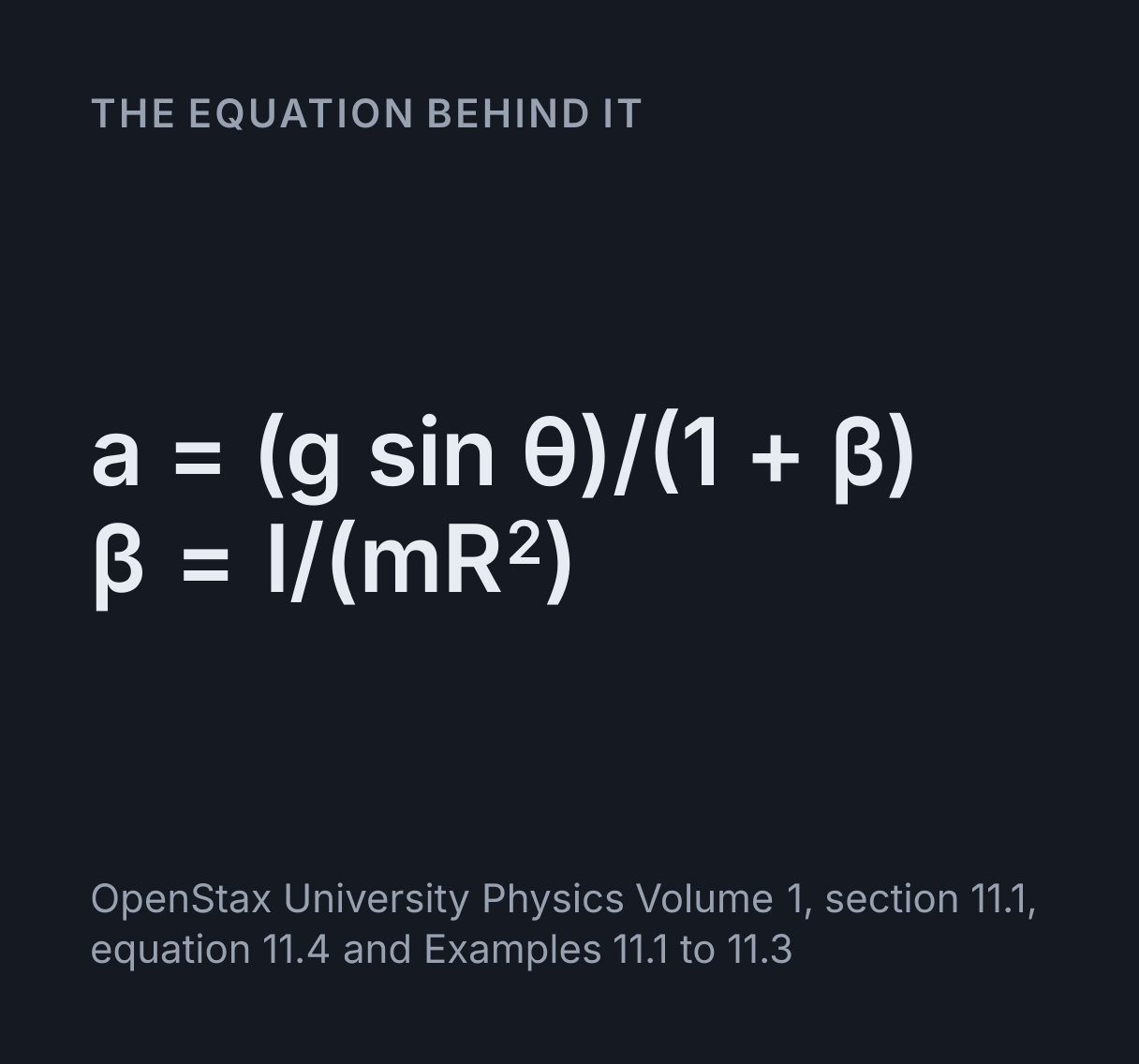
The equation
OpenStax University Physics Volume 1, section 11.1, equation 11.4 and Examples 11.1 to 11.3
The equation as an image to reuse
What the rolling race shows
Two bodies leave the top of identical ramps at the same moment. While friction holds, each one rolls without slipping at a = g sin θ/(1 + β), where β = I/mR² measures how far from the axle its mass sits: 1 for a hoop, 2/3 for a thin spherical shell, 1/2 for a disk or solid cylinder, 2/5 for a solid sphere and 0 for a low-friction cart. The smaller β, the sooner a rolling body finishes. That is OpenStax’s equation 11.4, a = mg sin θ/(m + I/r²), with I written as βmR².
The simulator opens on the race the AP Physics 1 Course and Exam Description (CED) asks students to explain with energy bar charts: a disk and a hoop of equal mass and radius. On a 15° ramp 2 m long, on Earth, the disk takes 1.538 s and the hoop 1.775 s, 0.238 s behind. The bars beside each lane show where the 5.076 J of potential energy goes as each body comes down.
What to try
- Run the CED’s three-way race. Set one lane to the low-friction cart and the other to each shape in turn. The cart always wins, at 1.255 s on the opening ramp, then the solid sphere at 1.485 s, the disk, the thin shell at 1.621 s and the hoop.
- Change the mass or the radius. Give the hoop 50 kg and a 1 m radius against a 0.1 kg, 1 cm disk. The times do not move: m and R cancel, and only β is left.
- Hollow out a cylinder. Choose the thick-walled cylinder and move r/R from 0 to 0.99. β runs from 1/2 to 0.990, and the time runs from the disk’s to just short of the hoop’s.
- Tilt until something slips. With wood on wood, μs = 0.5, the hoop starts to slip above 45°, the thin shell above 51.3° and the disk above 56.3°. The sphere needs only tan θ · 2/7 and still rolls at 60°. Slipping, the hoop feels kinetic friction, μk mg cos θ with μk = 0.3, less than rolling would need, so it jumps from last to ahead of the disk and the shell, and passes the sphere above 46.4°. Above 56.3° the hoop, shell and disk all slip and tie, since a slipping body’s a = g(sin θ − μk cos θ) has no β in it.
- Take the friction away. Open Friction and set μs to 0. Nothing spins, every body slides at g sin θ and ties with the cart, which is the third case of the CED’s ranking task.
Why the order holds while each body rolls: forces, then energy
The course description’s sample activity asks for both explanations. With forces: gravity pulls each body down the slope with mg sin θ, and static friction acts up the slope at the contact point. Friction is the only force with a lever arm about the center, so it supplies the torque fR = Iα that spins the body up. Rolling without slipping ties the spin to the speed, α = a/R, so the friction needed is βma. The larger β, the more friction holds the body back while it spins up, and the smaller its acceleration.
With energy: the body starts with mgh and, rolling without slipping, ends with the same total, split between ½mv² and ½Iω². Since ω = v/R, ½Iω² = β · ½mv², so a fraction β/(1 + β) of the kinetic energy goes into spin: 1/2 for a hoop, 1/3 for a disk and 2/7 for a sphere. Whatever goes into spin is missing from the speed, so v = √(2gh/(1 + β)) at the bottom. The cart puts nothing into spin and reaches √(2gh), 3.186 m/s on the opening ramp, against 2.602 m/s for the disk and 2.253 m/s for the hoop.
OpenStax’s Example 11.3 runs the same argument for a wheel taken as a hollow cylinder rolling 25.0 m down into a basin on Mars, with g = 3.71 m/s²: v = √(gh) = 9.63 m/s. The simulator’s Mars is NASA’s mean surface gravity, 3.73 m/s², and its ramps stop at 10 m, so the example itself stays in the unit tests.
How much friction rolling needs
The friction needed is f = mg sin θ · β/(1 + β), and the most static friction can give is μs mg cos θ. A body therefore rolls without slipping while μs ≥ tan θ · β/(1 + β), OpenStax’s condition in Example 11.1, which for a solid cylinder is μs ≥ (1/3) tan θ. On the opening 15° ramp the disk needs 0.0893 and the hoop 0.134. The Motion readout gives each lane’s figure, and the friction readouts under More readings give the force.
That friction acts at a point of the rim that is at rest on the ramp at that instant, so it does no work and takes no energy, as the CED’s essential knowledge 6.5.B.2 puts it. The Heat bar stays empty for a body that rolls. Friction changes how the energy is shared between speed and spin, never the total.
Slipping, the part beyond AP
Past the friction limit the contact slides over the ramp, and kinetic friction μk mg cos θ acts instead. The CED’s boundary statement puts the exact link between linear and angular quantities while slipping beyond AP Physics 1 and 2; students explain it in words (6.5.C). The readouts that depend on it carry the note “beyond AP”.
For anyone going further, the simulator follows OpenStax Example 11.2. The center accelerates at g(sin θ − μk cos θ), as a sliding block does, and the torque of kinetic friction spins the body up at α = μk g cos θ/(βR), which is 2μk g cos θ/R for a solid cylinder. Started from rest, R ω stays below v all the way down, so the body slips the whole length of the ramp. By the work-energy theorem for rotation (OpenStax 10.8), the energy lost to heat is μk mg cos θ times the distance the contact slid, the energy the CED’s 6.5.C.2 says kinetic friction dissipates.
The CED’s ranking task compares a wheel on three tracks: rough enough to roll, slipping, and frictionless. Its wheel goes on across a flat; here the race ends at the foot of the ramp, and the ranking is the same. Set a hoop on a 50° ramp with μs = 1.5, then 0.3 with μk = 0.25, then 0. The translational energy at the bottom ranks frictionless, slipping, rolling; the rotational energy the other way around; and the total is the same for rolling and frictionless, with less for the slipping hoop.
What the model leaves out
- Rolling friction. A real tire or ball deforms where it touches and loses a little energy each turn. The CED leaves it out of AP Physics 1, and so does this model.
- Air drag and the cart’s wheels. Nothing slows the bodies but friction at the contact, and the cart’s wheels are taken as massless, so its β is exactly 0.
- Uniform, rigid bodies. Each β is Figure 10.20’s value for a uniform shape. A real ball with a hollow core, a wheel with spokes or a can of soup has a β of its own.
- The drawing’s scale. Bodies are drawn with radii of 10 to 20 px over their 1 cm to 1 m range, not to the ramp’s scale. The painted radius turns as far as each body rolls on the drawing, so a rolling body never looks as if it skids.
Sources
- OpenStax, University Physics Volume 1, section 11.1, Rolling Motion: equations 11.1 to 11.4 and Examples 11.1 to 11.3.
- OpenStax, University Physics Volume 1, section 10.4, Figure 10.20, moments of inertia for common shapes.
- OpenStax, University Physics Volume 1, section 10.8, the work-energy theorem for rotation, equations 10.29 and 10.30.
- OpenStax, University Physics Volume 1, section 6.2, Table 6.1, coefficients of static and kinetic friction.
- College Board, AP Physics 1: Algebra-Based Course and Exam Description, effective fall 2024: topics 5.2, 5.4, 5.6, 6.1, 6.2 and 6.5, with 6.5.A to 6.5.C, their boundary statements and Unit 6 sample activities 3 to 5.
- NASA Goddard, Moon fact sheet, surface gravity.
- NASA Goddard, Mars fact sheet, mean surface gravity.
Earth is standard gravity, 9.80665 m/s². The drawings are this site’s own.
Model and assumptions
The method, what it assumes and how accurate it is
- Method
- Exact expression, no time stepping
- Repeatability
- Deterministic. The same link gives the same numbers on any machine.
What it assumes
- Each body is rigid and uniform, with β = I/mR² from OpenStax Figure 10.20: hoop 1, thin spherical shell 2/3, disk or solid cylinder 1/2, solid sphere 2/5, and (1 + (r/R)²)/2 for the thick-walled cylinder, OpenStax’s annular cylinder. The cart’s wheels are massless, so its β is 0 and nothing acts on it along the ramp but gravity.
- Released from rest, a body rolls without slipping when μs ≥ tan θ · β/(1 + β), at a = g sin θ/(1 + β) and α = a/R (OpenStax equation 11.4 and Example 11.1). A μs within a billionth of that need counts as meeting it.
- Below that need it slips the whole way down: a = g(sin θ − μk cos θ) and α = μk g cos θ/(βR), the torque of kinetic friction alone (OpenStax Example 11.2). With μk at 0, as on a frictionless ramp, it slides at g sin θ with no spin and no heat. From rest the contact speed R ω never catches up with v, because μk is used at no more than μs.
- Every force is constant over the run, so the distance, speed, spin and energies are exact expressions in time: d = a t²/2, φ = α t²/2. Rolling conserves m g h exactly; slipping turns μk m g cos θ times the distance the contact slides into heat.
- No rolling friction, no air drag and no deformation, as the AP Physics 1 course description sets rolling friction aside. Bodies are drawn with radii of 10 to 20 px over their 1 cm to 1 m range, not to the ramp’s scale, and spin on the drawing as far as they roll on it.
Where it stops holding. Rolling resistance, which slows real tires and balls; bodies that are not uniform, such as a ball with a hollow core or a spoked wheel, whose β differs from the table; a liquid-filled can, whose contents do not turn with it; and a cart with heavy wheels, whose wheels store energy the model leaves out. The Moment of Inertia Calculator is the right tool there.
Numerical accuracy
No method error to report: the result is a closed-form expression evaluated directly, with no time stepping to accumulate error. What remains is double-precision rounding, of order one part in 10^16 per operation.
Constants used: Standard gravity (g₀).
Common questions
Which rolls down a ramp first, a hoop, a disk or a sphere?
The solid sphere, then the disk, then the hoop, as long as each rolls without slipping, and a low-friction cart beats all three. Rolling, each accelerates at a = g sin θ/(1 + β), with β = I/mR² equal to 2/5 for a sphere, 1/2 for a disk and 1 for a hoop. On a 15° ramp 2 m long the sphere takes 1.485 s, the disk 1.538 s and the hoop 1.775 s; the cart, with β = 0, takes 1.255 s. On a steep ramp a body that slips can pass one that rolls: with wood on wood, μs = 0.5 and μk = 0.3, the hoop slips above 45° and overtakes the disk.
Does mass or radius change how fast an object rolls down an incline?
No. Mass and radius cancel from a = g sin θ/(1 + β), so only the shape factor β = I/mR² matters: a 50 kg hoop 2 m across and a 0.1 kg hoop 2 cm across reach the bottom together. A heavier body has more weight pulling it down the slope and, in the same proportion, more inertia to get moving and spinning.
What fraction of a rolling object’s kinetic energy is rotational?
β/(1 + β), because ½Iω² = β · ½mv² when ω = v/R. That is 1/2 for a hoop, 1/3 for a disk or solid cylinder and 2/7 for a solid sphere. The rest is translational, so the body with the larger β has less speed at the bottom: v = √(2gh/(1 + β)).
How much friction does rolling without slipping need?
Static friction f = mg sin θ · β/(1 + β), which needs μs ≥ tan θ · β/(1 + β), OpenStax’s condition in Example 11.1. A solid cylinder needs μs ≥ (1/3) tan θ, and a hoop on a 45° ramp needs 0.5. That friction acts at a point at rest on the ramp, so it does no work and the mechanical energy is conserved.
What happens when a rolling object slips?
Kinetic friction μk mg cos θ acts at the contact, which slides over the ramp, so the spin no longer keeps pace with the speed and kinetic friction turns some of the energy into heat. OpenStax Example 11.2 gives a = g(sin θ − μk cos θ) and α = 2μk g cos θ/R for a solid cylinder. The AP Physics 1 course description asks only for the qualitative story; the exact relationships while slipping are beyond AP Physics 1 and 2.