Lung
The lungs are paired organs whose main job is to exchange oxygen and carbon dioxide with the air you breathe. The trachea divides into two main bronchi, one for each lung. (OpenStax A&P 2e, 22.2; StatPearls, Bronchial and Thorax, Lungs)
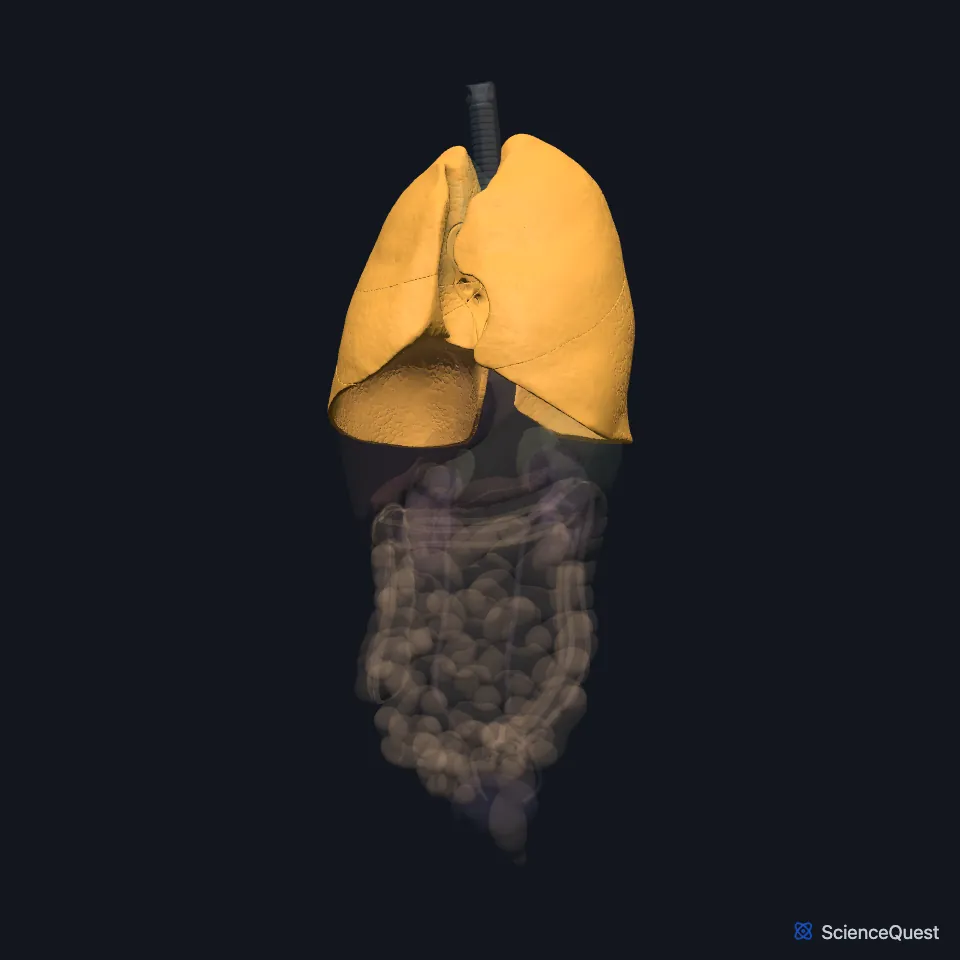
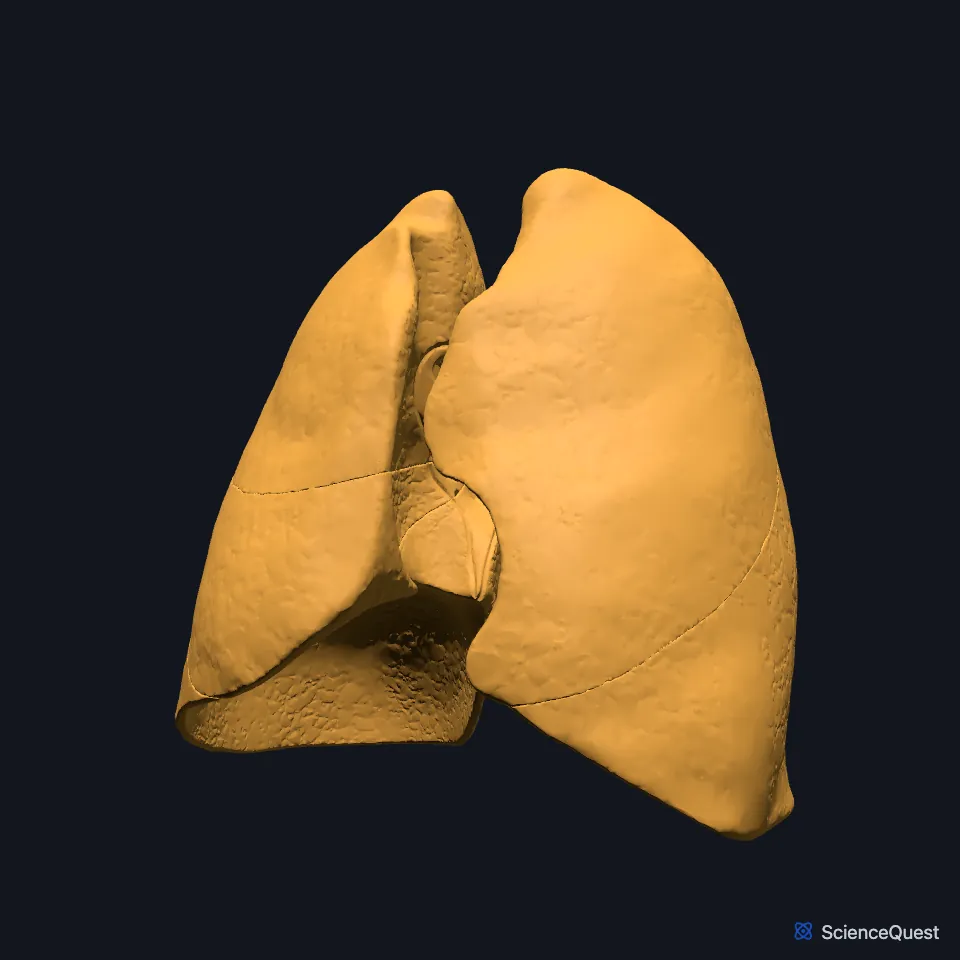
Where are the lungs?
They lie in the thoracic cavity on either side of the heart, inside the rib cage. The base of each lung rests on the diaphragm, and the apex rises above the first rib under a cap of cervical pleura. (StatPearls, Thorax, Lungs)
Each lung has three surfaces: the costal surface against the ribs, the mediastinal surface facing the midline, and the diaphragmatic surface at the base. (StatPearls, Thorax, Lungs; OpenStax A&P 2e, 22.2)
The right dome of the diaphragm sits higher than the left because of the liver below it. (StatPearls, Thorax, Lungs)
How many lobes does each lung have?
The right lung has three lobes, the upper, middle and lower. The left lung has two, the upper and lower. (StatPearls, Thorax, Lungs; OpenStax A&P 2e, 22.2)
In the right lung the horizontal fissure separates the upper and middle lobes, and the oblique fissure separates the lower lobe from both the middle and upper lobes. The left lung has only an oblique fissure, between its upper and lower lobes. (StatPearls, Thorax, Lungs and Thorax, Pleurae)
The right lung is shorter and wider than the left, and the left holds less volume. A cardiac notch in the front edge of the left lung makes room for the heart. (OpenStax A&P 2e, 22.2; StatPearls, Thorax, Lungs)
Each lobe divides into bronchopulmonary segments, each served by its own segmental bronchus and artery. The segments work as independent units, so a surgeon can remove a diseased one on its own. (OpenStax A&P 2e, 22.2; StatPearls, Lung Imaging and Bronchial)
What do the lungs do?
Gas exchange happens mainly in the alveoli. Oxygen diffuses from the alveolar air into the capillary blood, and carbon dioxide moves the other way. (StatPearls, Thorax, Lungs)
The exchange surface is very large, and where alveolus meets capillary the barrier is only about 0.5 μm thick. (OpenStax A&P 2e, 22.2 and 22.1; StatPearls, Partial Pressure of Oxygen)
Thin, flat type I pneumocytes form most of the alveolar lining and carry out gas exchange. Type II pneumocytes secrete surfactant, which lowers surface tension and keeps the alveoli from collapsing as you breathe out. (StatPearls, Thorax, Lungs)
The lungs have no muscle to expand themselves. The diaphragm and intercostal muscles drive breathing, and in respiratory distress the sternocleidomastoid and scalene muscles join in. (StatPearls, Bronchial and Thorax, Lungs)
What connects to the lungs?
The main bronchus, blood vessels, lymphatics and nerves enter each lung at the hilum, a depression in the middle of its mediastinal surface. From front to back, the hilum holds the vein, the artery and the bronchus. (OpenStax A&P 2e, 22.1; StatPearls, Thorax, Lungs)
Two circulations serve the lung. The pulmonary artery brings deoxygenated blood from the right ventricle to be oxygenated, and the bronchial arteries, part of the systemic circulation, feed the lung tissue itself. (StatPearls, Thorax, Lungs)
Four pulmonary veins return the oxygenated blood to the left atrium. (StatPearls, Thorax, Lungs)
Two serous layers of pleura enclose each lung. Pleural fluid between them cuts friction as you breathe, and its surface tension holds the layers together as the chest expands. (OpenStax A&P 2e, 22.2; StatPearls, Thorax, Lungs and Thorax, Lung Pleura And Mediastinum)
Vagal branches in the pulmonary plexus narrow the airways and increase gland secretion. Sympathetic branches widen the airways and reduce secretion. (StatPearls, Thorax, Lungs)
How do lungs vary?
Some lungs have accessory fissures, which can give odd patterns on imaging. Rarer variants are agenesis, the absence of one or both lungs, aplasia, a rudimentary lung, and accessory lobes. (StatPearls, Thorax, Lungs)
Where the sources differ
Estimates of the gas exchange surface vary. OpenStax gives about 70 square meters and the StatPearls chapter on the partial pressure of oxygen 70 to 100, while the StatPearls lung histology chapter gives both about 80 and about 140 square meters for some 300 million alveoli. (OpenStax A&P 2e, 22.2; StatPearls, Partial Pressure of Oxygen and Histology, Lung)
The two StatPearls articles count the left lung’s segments differently: the lungs article gives 8 to 9, the bronchi article 8 to 10. Both put the difference down to how the segments combine. (StatPearls, Thorax, Lungs and Bronchial)
The two StatPearls articles differ on the phrenic nerve. The lungs article counts it as one of the lung’s two nerve sources and has it supply parts of the visceral pleura. The pleurae article gives it the diaphragmatic and mediastinal pleura, and says that by long-standing convention the visceral pleura has no nerve supply, though recent research suggests it may have one. (StatPearls, Thorax, Lungs and Thorax, Pleurae)
| Feature | Detail and source |
|---|---|
| Lobes | Right: upper, middle, lower. Left: upper, lower (StatPearls, Thorax, Lungs) |
| Fissures | Right: oblique and horizontal. Left: oblique (StatPearls, Thorax, Lungs) |
| Bronchopulmonary segments | Right: 10. Left: 8 to 9, or 8 to 10, by source (StatPearls, Thorax, Lungs and Bronchial) |
| Hilum, front to back | Pulmonary vein, pulmonary artery, bronchus (StatPearls, Thorax, Lungs) |
| Nerves | Pulmonary plexus (vagal and sympathetic) (StatPearls, Thorax, Lungs) |
Touches in this model
Measured on the BodyParts3D meshes: surfaces within 2 mm of the lung, nearest first, 12 of 99.
- Bronchus in contact
- Esophagus in contact
- Left lobe of thymus in contact
- Liver in contact
- Right lobe of thymus in contact
- Anterior interventricular branch of left coronary artery in contact
- Arch of aorta in contact
- Body of sternum in contact
- Circumflex branch of left coronary artery in contact
- Coronary sinus in contact
- Descending aorta in contact
- Diaphragm in contact
Sources
- OpenStax Anatomy and Physiology 2e, section 22.2, The Lungs. CC BY-NC-SA 4.0. Read 2026-10-25.
- StatPearls, Anatomy, Thorax, Bronchial. Christina Amador; Carly Weber; Matthew A. Varacallo. Last update August 8, 2023. CC BY-NC-ND 4.0. Read 2026-10-25.
- StatPearls, Anatomy, Thorax, Lungs. Raheel Chaudhry; Adekunle E. Omole; Bruno Bordoni. Last update April 20, 2024. CC BY-NC-ND 4.0. Read 2026-10-25.
- StatPearls, Anatomy, Thorax, Pleurae. Logan Burstiner; Yasir Al Khalili. Last update July 24, 2023. CC BY-NC-ND 4.0. Read 2026-10-25.
- StatPearls, Lung Imaging. Srinidhi Srinivasan; Dawood Tafti. Last update September 13, 2026. CC BY-NC-ND 4.0. Read 2026-10-25.
- OpenStax Anatomy and Physiology 2e, section 22.1, Organs and Structures of the Respiratory System. CC BY-NC-SA 4.0. Read 2026-10-25.
- StatPearls, Partial Pressure of Oxygen. Ryan N. Hoecker; John Schweiger; Alex Llauget; Joseph Maxwell Hendrix. Last update April 11, 2026. CC BY-NC-ND 4.0. Read 2026-10-25.
- StatPearls, Anatomy, Thorax, Lung Pleura And Mediastinum. Navid Mahabadi; Alberto A. Goizueta; Bruno Bordoni. Last update March 24, 2024. CC BY-NC-ND 4.0. Read 2026-10-25.
- StatPearls, Histology, Lung. Yusuf S. Khan; Frederick J. Carey. Last update April 6, 2025. CC BY-NC-ND 4.0. Read 2026-10-25.
The values are facts and free to use; this page’s selection and presentation are © 2026 ScienceQuest.