Adrenal gland
The adrenal glands, also called the suprarenal glands, are a pair of endocrine glands, one on top of each kidney. Each has an outer cortex that makes steroid hormones and an inner medulla that makes epinephrine and norepinephrine. (StatPearls, Abdomen and Pelvis: Adrenal Glands (Suprarenal Glands); OpenStax A&P 2e, 17.6)
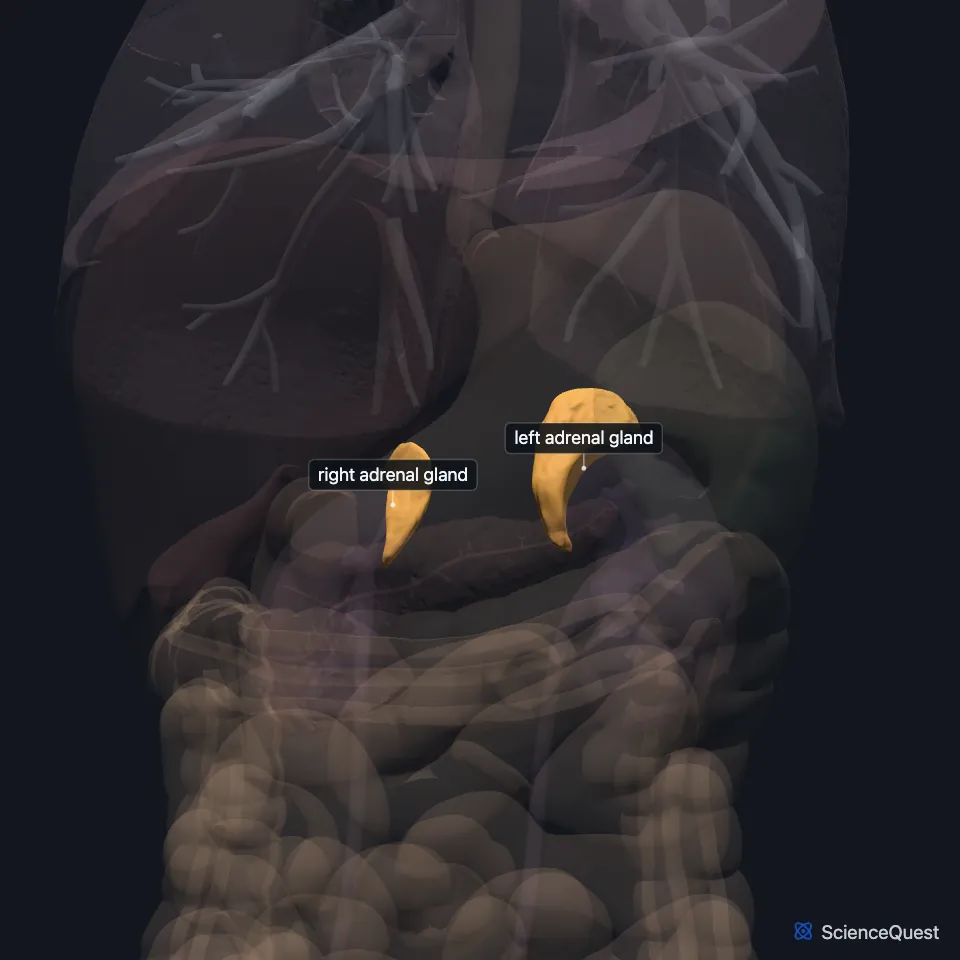
Where are the adrenal glands?
Each sits on top of its kidney, held to it by a fibrous capsule, inside the renal fascia in the perirenal space. (OpenStax A&P 2e, 17.6; StatPearls, Abdomen and Pelvis: Adrenal Glands (Suprarenal Glands))
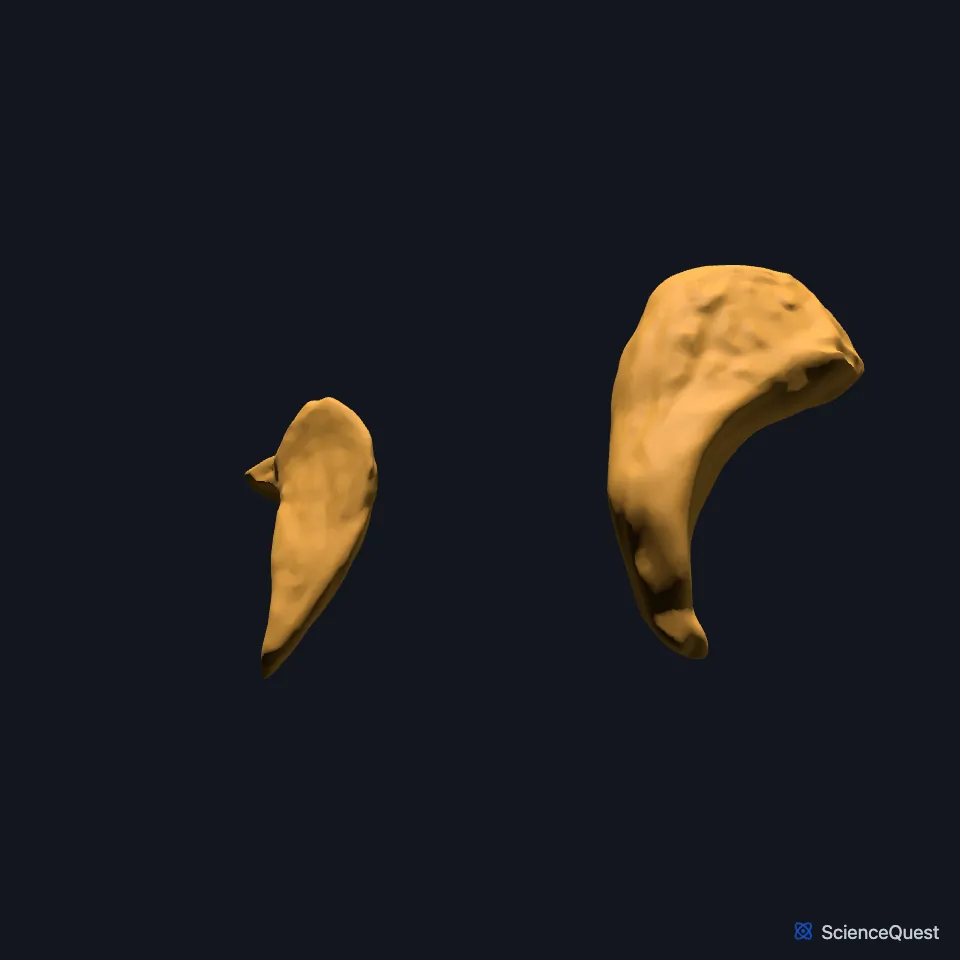
The right gland is pyramid-shaped and the left is crescent-shaped. At birth an adrenal gland is about a third the size of the kidney, and in an adult it is about a thirtieth. (StatPearls, Abdomen and Pelvis: Adrenal Glands (Suprarenal Glands))
What hormones do the adrenal glands make?
The outer zone of the cortex, the zona glomerulosa, makes mineralocorticoids, chiefly aldosterone. Aldosterone makes the kidneys keep sodium and excrete potassium, and the water that follows the sodium raises blood volume and blood pressure. (OpenStax A&P 2e, 17.6; StatPearls, Abdomen and Pelvis: Adrenal Glands (Suprarenal Glands) and Physiology, Adrenal Gland)
The middle zone, the zona fasciculata, makes glucocorticoids, mainly cortisol, under the control of ACTH from the anterior pituitary gland. Cortisol rises with stress and raises blood glucose: it drives gluconeogenesis, breaks down fat and, over time, wastes muscle. (OpenStax A&P 2e, 17.6; StatPearls, Abdomen and Pelvis: Adrenal Glands (Suprarenal Glands) and Physiology, Adrenal Gland)
The deepest zone, the zona reticularis, makes androgens, mainly DHEA, which other tissues convert to testosterone. In adult men the testes supply most testosterone, but in women the adrenal androgens are the main source. (OpenStax A&P 2e, 17.6; StatPearls, Abdomen and Pelvis: Adrenal Glands (Suprarenal Glands) and Physiology, Adrenal Gland)
The medulla is made of chromaffin cells, which act as a special kind of postsynaptic sympathetic neuron: preganglionic sympathetic fibers end on them. When the body meets a threat they release epinephrine and norepinephrine straight into the blood. (OpenStax A&P 2e, 17.6; StatPearls, Abdomen and Pelvis: Adrenal Glands (Suprarenal Glands) and Physiology, Catecholamines)
What is inside an adrenal gland?
A thick connective tissue capsule surrounds the gland. The fatty cortex is yellow and the medulla reddish brown. (StatPearls, Abdomen and Pelvis: Adrenal Glands (Suprarenal Glands))
The two parts have different origins. The cortex comes from mesoderm, while the medulla comes from neuroectoderm, through neural crest cells that migrate into the gland in the seventh week. (StatPearls, Abdomen and Pelvis: Adrenal Glands (Suprarenal Glands))
What lies next to the adrenal glands?
The right gland lies under the liver, behind the inferior vena cava and in front of the diaphragm. The left lies on the inner side of the spleen, above the splenic artery and vein, beside the abdominal aorta and in front of the diaphragm. (StatPearls, Abdomen and Pelvis: Adrenal Glands (Suprarenal Glands))
Each gland has three main sources of blood: several superior adrenal arteries from the inferior phrenic artery, a middle adrenal artery from the abdominal aorta and an inferior adrenal artery from the renal artery. Where these arteries arise varies a lot. (StatPearls, Abdomen and Pelvis: Adrenal Glands (Suprarenal Glands))
The right adrenal vein drains straight into the inferior vena cava, and the left drains into the left renal vein. (StatPearls, Abdomen and Pelvis: Adrenal Glands (Suprarenal Glands))
Preganglionic sympathetic fibers from spinal segments T5 to T8 reach the medulla in the greater splanchnic nerve. Some bypass the celiac ganglion and synapse directly on the chromaffin cells. (StatPearls, Abdomen and Pelvis: Adrenal Glands (Suprarenal Glands))
| Feature | Detail and source |
|---|---|
| Zona glomerulosa | Mineralocorticoids, chiefly aldosterone (OpenStax A&P 2e, 17.6; StatPearls, Abdomen and Pelvis: Adrenal Glands (Suprarenal Glands)) |
| Zona fasciculata | Glucocorticoids, chiefly cortisol (OpenStax A&P 2e, 17.6; StatPearls, Abdomen and Pelvis: Adrenal Glands (Suprarenal Glands)) |
| Zona reticularis | Androgens, chiefly DHEA (OpenStax A&P 2e, 17.6; StatPearls, Abdomen and Pelvis: Adrenal Glands (Suprarenal Glands)) |
| Medulla | Epinephrine and norepinephrine (OpenStax A&P 2e, 17.6; StatPearls, Physiology, Adrenal Gland) |
| Veins | Right to the inferior vena cava, left to the left renal vein (StatPearls, Abdomen and Pelvis: Adrenal Glands (Suprarenal Glands)) |
Touches in this model
Measured on the BodyParts3D meshes: surfaces within 2 mm of the adrenal gland, nearest first.
- Left kidney in contact
- Liver in contact
- Right kidney in contact
- Diaphragm in contact
- Intervertebral disk of eleventh thoracic vertebra in contact
- Left psoas major in contact
- Right twelfth rib in contact
- Skin in contact
- Twelfth thoracic vertebra in contact
- Eleventh thoracic vertebra 0.6 mm away
- Left twelfth rib 1.6 mm away
- Spleen 1.9 mm away
Sources
- StatPearls, Anatomy, Abdomen and Pelvis: Adrenal Glands (Suprarenal Glands). Rishi Megha; Chase J. Wehrle; Sarang Kashyap; Stephen W. Leslie. Last update October 17, 2022. CC BY-NC-ND 4.0. Read 2026-10-25.
- OpenStax Anatomy and Physiology 2e, section 17.6, The Adrenal Glands. CC BY-NC-SA 4.0. Read 2026-10-25.
- StatPearls, Physiology, Adrenal Gland. Meghan Dutt; Chase J. Wehrle; Ishwarlal Jialal. Last update May 1, 2023. CC BY-NC-ND 4.0. Read 2026-10-25.
- StatPearls, Physiology, Catecholamines. Bassem Khalil; Alan Rosani; Steven J. Warrington. Last update December 11, 2024. CC BY-NC-ND 4.0. Read 2026-10-25.
The values are facts and free to use; this page’s selection and presentation are © 2026 ScienceQuest.