Flexor hallucis longus
The flexor hallucis longus is one of the four muscles of the deep posterior compartment of the leg. It flexes the big toe and also plantarflexes and inverts the foot. (StatPearls, Calf Flexor Hallucis Longus Muscle)
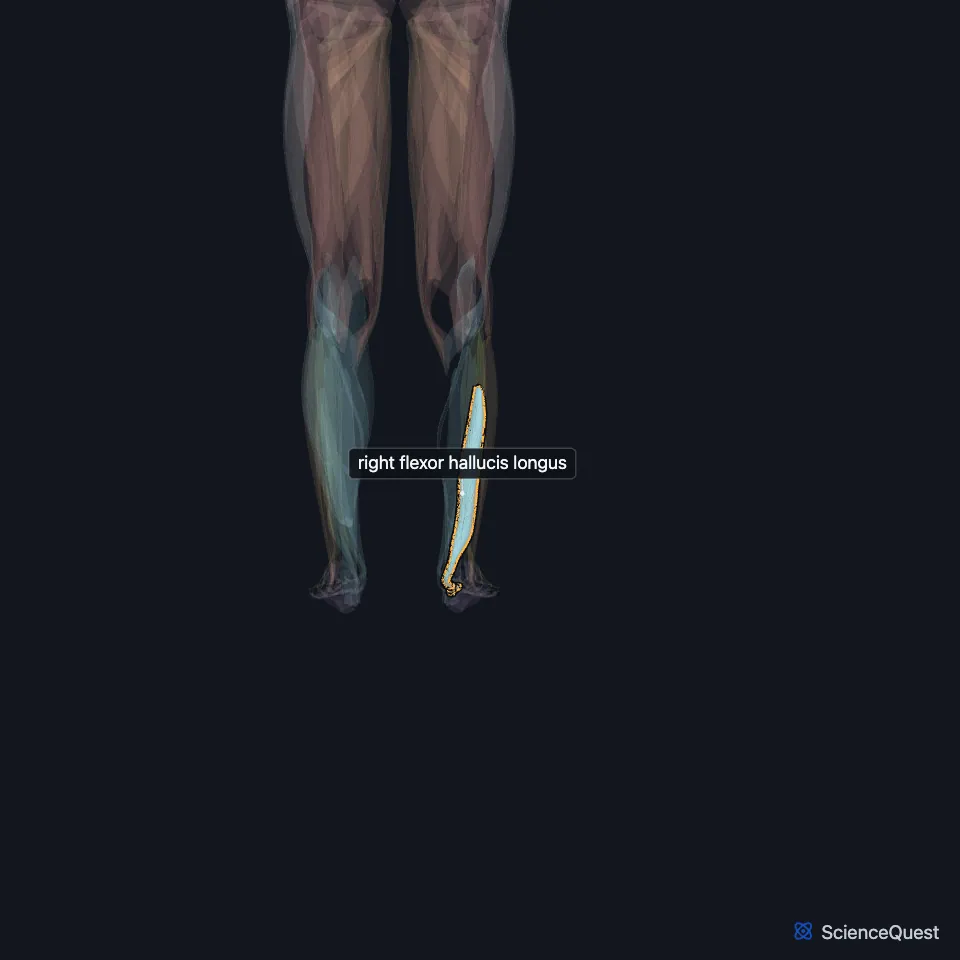
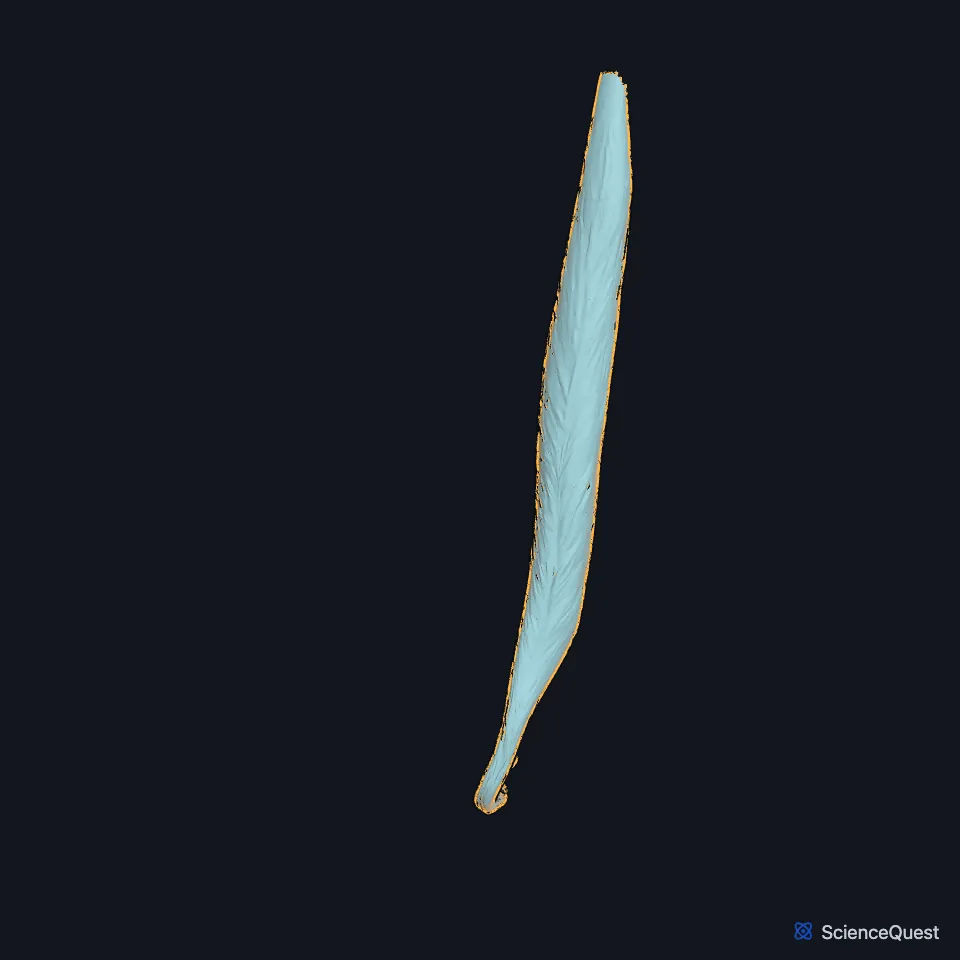
Open it in the Lower Limb Muscles Explorer See it alone in 3D
Where is the flexor hallucis longus?
It lies on the fibular side of the leg. It arises from the lower two-thirds of the back of the fibula, all but its lowest 2.5 cm, and from the lower part of the interosseous membrane. (Gray’s Anatomy (1918), Posterior Crural Muscles, deep group; StatPearls, Leg Posterior Compartment)
Its tendon inserts on the plantar side of the base of the distal phalanx of the big toe. (StatPearls, Calf Flexor Hallucis Longus Muscle)
What path does its tendon take?
Its tendon lies in a groove across the back of the lower tibia, the back of the talus and the underside of the sustentaculum tali of the calcaneus. Tendinous fibers turn the grooves on the talus and calcaneus into canals lined by a sheath. (Gray’s Anatomy (1918), Posterior Crural Muscles, deep group)
In the sole it runs between the two heads of the flexor hallucis brevis. On the way it crosses above the flexor digitorum longus tendon from the lateral to the medial side, joined to it by a fibrous slip. (Gray’s Anatomy (1918), Posterior Crural Muscles, deep group)
What does the flexor hallucis longus do?
It flexes the metatarsophalangeal and interphalangeal joints of the big toe and plantarflexes the ankle at the talocrural joint. It also gives dynamic support to the medial longitudinal arch. (StatPearls, Leg Posterior Compartment)
With the flexor digitorum longus it helps the gastrocnemius and soleus push the foot down as you walk or stand on tiptoe, the movement Gray’s 1918 calls extending the foot. (Gray’s Anatomy (1918), Posterior Crural Muscles, deep group)
Ballet dancers, who work in extreme plantarflexion, often develop stenosing tenosynovitis of its tendon. (StatPearls, Calf Flexor Hallucis Longus Muscle)
Its antagonist is the extensor hallucis longus. (StatPearls, Calf Flexor Hallucis Longus Muscle)
What supplies the flexor hallucis longus, and what lies near it?
A muscular branch of the tibial nerve supplies it, with most fibers from S1 and S2 and some from L5. (StatPearls, Calf Flexor Hallucis Longus Muscle)
The fibular artery runs deep to it. Its own supply is a muscular branch of what StatPearls calls the peroneal portion of the posterior tibial artery. (StatPearls, Tibialis Posterior Muscle and Calf Flexor Hallucis Longus Muscle)
Its tendon lies close to the calcaneal tendon, so surgeons transfer it more than any other tendon when the calcaneal tendon cannot be repaired. (StatPearls, Calf Flexor Hallucis Longus Muscle)
Does the flexor hallucis longus vary?
Most people have a slip between it and the flexor digitorum longus. A rare extra muscle, the peroneocalcaneus internus, arises near it on the back of the fibula, passes over the sustentaculum tali beside its tendon and inserts on the calcaneus. (StatPearls, Calf Flexor Hallucis Longus Muscle)
Where the sources differ
Sources give different roots for its nerve: S1 and S2 in the StatPearls popliteus article, most fibers from S1 and S2 and some from L5 in the StatPearls flexor hallucis longus article, and the fifth lumbar with the first and second sacral nerves in Gray’s 1918. (StatPearls, Popliteus Muscle and Calf Flexor Hallucis Longus Muscle; Gray’s Anatomy (1918), Posterior Crural Muscles, deep group)
| Feature | Detail and source |
|---|---|
| Origin | Lower two-thirds of the back of the fibula; lower interosseous membrane (StatPearls, Leg Posterior Compartment and Tibial Nerve) |
| Insertion | Base of the distal phalanx of the big toe, plantar side (StatPearls, Calf Flexor Hallucis Longus Muscle) |
| Action | Flexes the big toe; plantarflexes and inverts the foot (StatPearls, Calf Flexor Hallucis Longus Muscle) |
| Nerve | Tibial nerve (StatPearls, Calf Flexor Hallucis Longus Muscle) |
Touches in this model
Measured on the BodyParts3D meshes: surfaces within 2 mm of the flexor hallucis longus, nearest first, 12 of 20.
- Lateral head of right flexor hallucis brevis in contact
- Medial head of right flexor hallucis brevis in contact
- Right abductor hallucis in contact
- Right extensor hallucis longus in contact
- Right fibularis brevis in contact
- Right fibularis longus in contact
- Right flexor digitorum longus in contact
- Right soleus in contact
- Right tibialis posterior in contact
- Distal phalanx of right big toe in contact
- Interosseous membrane of right leg in contact
- Proximal phalanx of right big toe in contact
Sources
Sources read
- StatPearls, Anatomy, Bony Pelvis and Lower Limb: Calf Flexor Hallucis Longus Muscle. Christopher J. Murdock; Akul Munjal; Kofi Agyeman. Last update . CC BY-NC-ND 4.0. Read .
- Anatomy of the Human Body (Gray’s Anatomy), 20th US edition, 1918, Myology, The Muscles and Fasciae of the Leg, 2. The Posterior Crural Muscles, the deep group, pages 483 to 486; Internet Archive scan of the 1918 Lea and Febiger printing, terminology of 1918. Henry Gray; edited by Warren H. Lewis. Public domain. Read .
- StatPearls, Anatomy, Bony Pelvis and Lower Limb: Leg Posterior Compartment. Rami Abuqubo; Steven B. Graefe; James La Rose. Last update . CC BY-NC-ND 4.0. Read .
- StatPearls, Anatomy, Bony Pelvis and Lower Limb: Tibialis Posterior Muscle. Nicholas M. Corcoran; Matthew A. Varacallo. Last update . CC BY-NC-ND 4.0. Read .
- StatPearls, Anatomy, Bony Pelvis and Lower Limb: Tibial Nerve. Sohil S. Desai; James La Rose. Last update . CC BY-NC-ND 4.0. Read .
- StatPearls, Anatomy, Bony Pelvis and Lower Limb: Popliteus Muscle. Scott Hyland; Matthew A. Varacallo. Last update . CC BY-NC-ND 4.0. Read .
The values are facts and free to use; this page’s selection and presentation are © 2026 ScienceQuest.