Fibularis tertius
The fibularis tertius, also called the peroneus tertius, is a small muscle of the anterior compartment of the leg, often an extension of the extensor digitorum longus. Its tendon inserts on the top of the base of the fifth metatarsal. (StatPearls, Leg Anterior Compartment)
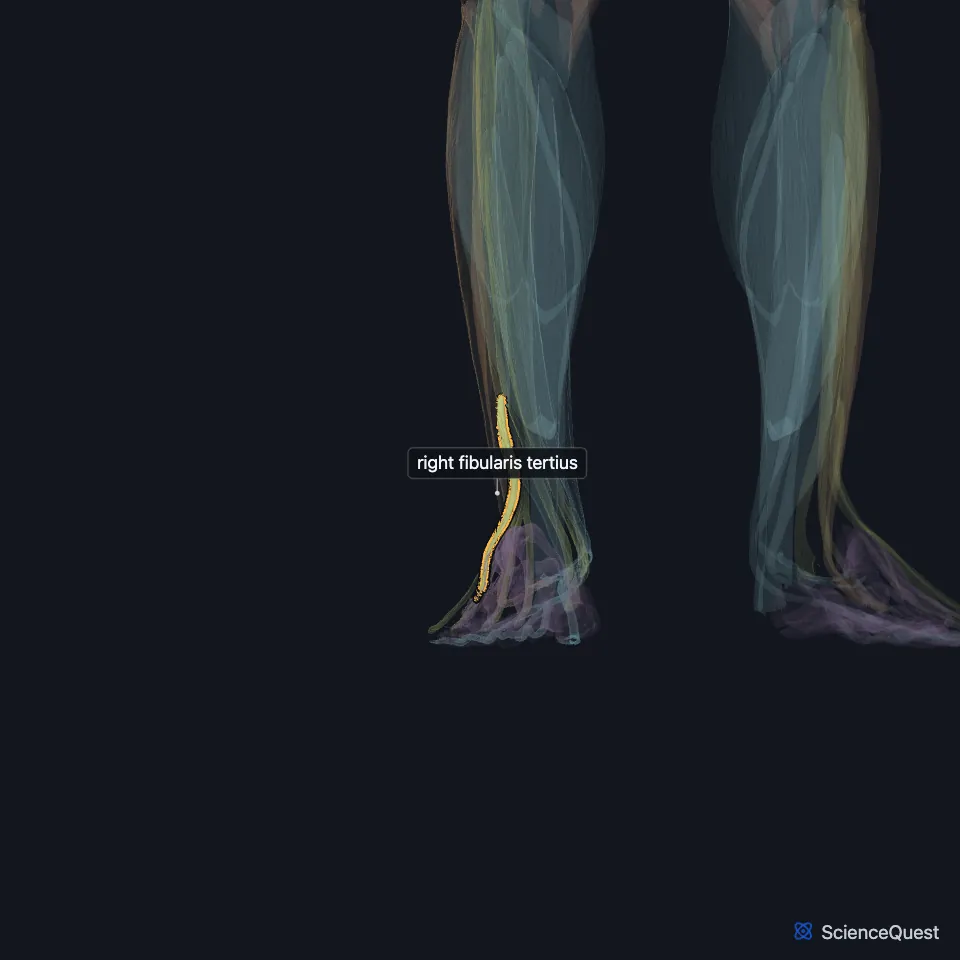
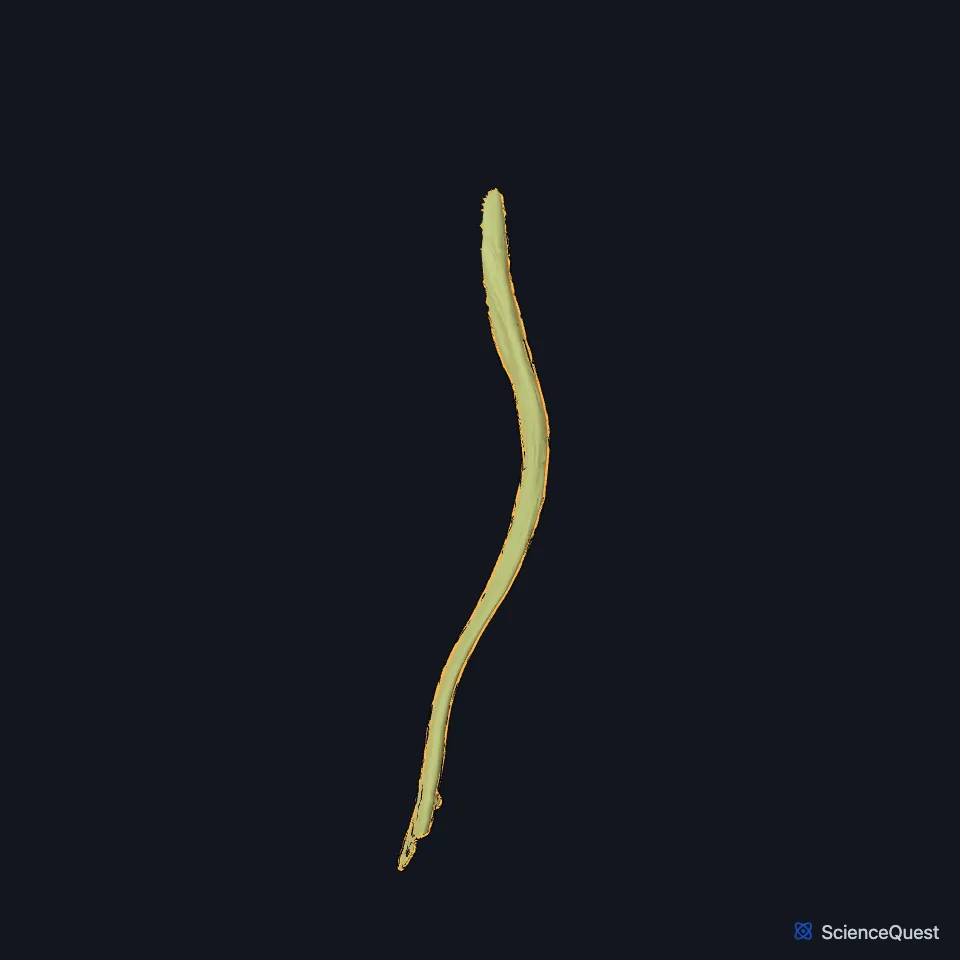
Open it in the Lower Limb Muscles Explorer See it alone in 3D
Where is the fibularis tertius?
Its fibers arise from the lower third or more of the anterior surface of the fibula, the lower part of the interosseous membrane and a septum it shares with the fibularis brevis. Across the studies in a 2017 meta-analysis, the commonest origin was the lower half of the fibula. (Gray’s Anatomy (1918), Anterior Crural Muscles; Yammine and Erić 2017, Biomed Res Int)
How is the fibularis tertius built?
Gray’s 1918 treats it as part of the extensor digitorum longus, in effect its fifth tendon. That tendon shares a canal with the long extensor under the transverse and cruciate crural ligaments, then inserts on the dorsal surface of the base of the fifth metatarsal. (Gray’s Anatomy (1918), Anterior Crural Muscles)
Its tendon and belly can be hard to separate from the extensor digitorum longus. The meta-analysis authors suggest this is why clinical examination finds the muscle less often than dissection does. (Yammine and Erić 2017, Biomed Res Int)
What does the fibularis tertius do?
It gives weak help to dorsiflexion of the ankle and contributes to eversion of the foot. (StatPearls, Leg Anterior Compartment)
Gray’s 1918 has it raise the lateral border of the foot, everting it, together with the fibularis brevis and fibularis longus. (Gray’s Anatomy (1918), Anterior Crural Muscles)
With the fibularis brevis and the tibialis anterior it gives suspensory support to the transverse arch of the foot. (StatPearls, Arches of the Foot)
What supplies the fibularis tertius?
The deep fibular nerve supplies it, as it does the tibialis anterior, extensor hallucis longus and extensor digitorum longus. The anterior tibial artery supplies the whole compartment. (StatPearls, Calf Deep Peroneal Nerve and Leg Anterior Compartment)
Is the fibularis tertius always present?
Gray’s 1918 says it is sometimes wanting, and StatPearls names it the muscle that varies most often in the anterior compartment, absent or underdeveloped in some people. (Gray’s Anatomy (1918), Anterior Crural Muscles; StatPearls, Leg Anterior Compartment)
A 2017 meta-analysis of 35 studies (7601 legs) found it in 93.2% of adult cadaveric legs but in 80% on clinical examination. In 95% of the legs that lacked it, the studies found an accessory fibular muscle instead. (Yammine and Erić 2017, Biomed Res Int)
It is rare in monkeys, and gorillas have it in about 30% of cases. The authors read its steady presence in humans as a sign that it mattered in the evolution of upright, two-legged posture. (Yammine and Erić 2017, Biomed Res Int)
Where the sources differ
Sources name the ankle movement in opposite terms: StatPearls calls the anterior compartment muscles the extensors of the ankle, meaning dorsiflexion, while Gray’s 1918 calls the tibialis anterior and fibularis tertius the direct flexors of the foot at the ankle. (StatPearls, Leg Anterior Compartment; Gray’s Anatomy (1918), Anterior Crural Muscles)
| Feature | Detail and source |
|---|---|
| Origin | Lower anterior fibula; interosseous membrane (StatPearls, Leg Anterior Compartment) |
| Insertion | Dorsal base of the fifth metatarsal (StatPearls, Leg Anterior Compartment) |
| Action | Weak help with dorsiflexion; contributes to eversion (StatPearls, Leg Anterior Compartment) |
| Nerve | Deep fibular (deep peroneal) nerve (StatPearls, Calf Deep Peroneal Nerve) |
Touches in this model
Measured on the BodyParts3D meshes: surfaces within 2 mm of the fibularis tertius, nearest first.
- Right extensor digitorum brevis in contact
- Right extensor digitorum longus in contact
- Interosseous membrane of right leg in contact
- Right cuboid bone in contact
- Right fifth metatarsal bone in contact
- Right fourth metatarsal bone in contact
- Right tibia in contact
- Skin in contact
- Right extensor hallucis longus 0.9 mm away
- Right flexor hallucis longus 1.8 mm away
Sources
Sources read
- StatPearls, Anatomy, Bony Pelvis and Lower Limb: Leg Anterior Compartment. Bradley Lezak; Marjorie V. Launico. Last update . CC BY-NC-ND 4.0. Read .
- Anatomy of the Human Body (Gray’s Anatomy), 20th US edition, 1918, Myology, The Muscles and Fasciae of the Leg, 1. The Anterior Crural Muscles, pages 480 to 482; Internet Archive scan of the 1918 Lea and Febiger printing, terminology of 1918. Henry Gray; edited by Warren H. Lewis. Public domain. Read .
- BioMed Research International, The Fibularis (Peroneus) Tertius Muscle in Humans: A Meta-Analysis of Anatomical Studies with Clinical and Evolutionary Implications, Biomed Res Int 2017, article 6021707 (full text, PMC5449999). Yammine K, Erić M. CC BY 4.0. Read .
- StatPearls, Anatomy, Bony Pelvis and Lower Limb: Arches of the Foot. Hiteshkumar M. Chauhan; Muhammad Taqi. Last update . CC BY-NC-ND 4.0. Read .
- StatPearls, Anatomy, Bony Pelvis and Lower Limb: Calf Deep Peroneal Nerve (Deep Fibular Nerve). Lane L. Palmisano; Marjorie V. Launico. Last update . CC BY-NC-ND 4.0. Read .
The values are facts and free to use; this page’s selection and presentation are © 2026 ScienceQuest.