Stomach
The stomach is the widest part of the digestive tract. It links the esophagus to the first part of the small intestine, the duodenum. (StatPearls, Stomach; OpenStax A&P 2e, 23.4)
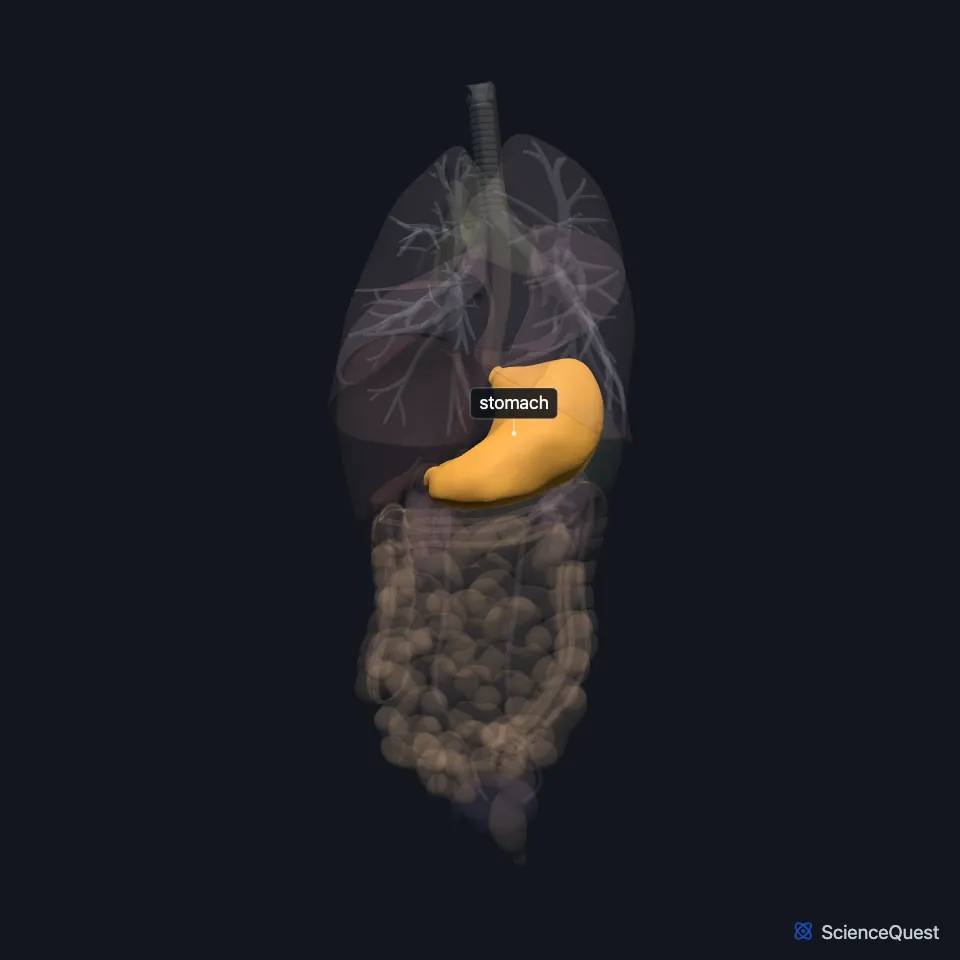
Where is the stomach?
It lies in the upper abdomen, mostly left of the midline. Fixed at its esophageal and duodenal ends, it moves and changes size in between. (StatPearls, Stomach; OpenStax A&P 2e, 23.4)
Two folds of peritoneum attach to it. The lesser omentum runs from the underside of the liver to the lesser curvature, and the greater omentum carries on from the greater curvature. (OpenStax A&P 2e, 23.4; StatPearls, Stomach)
What are the parts of the stomach?
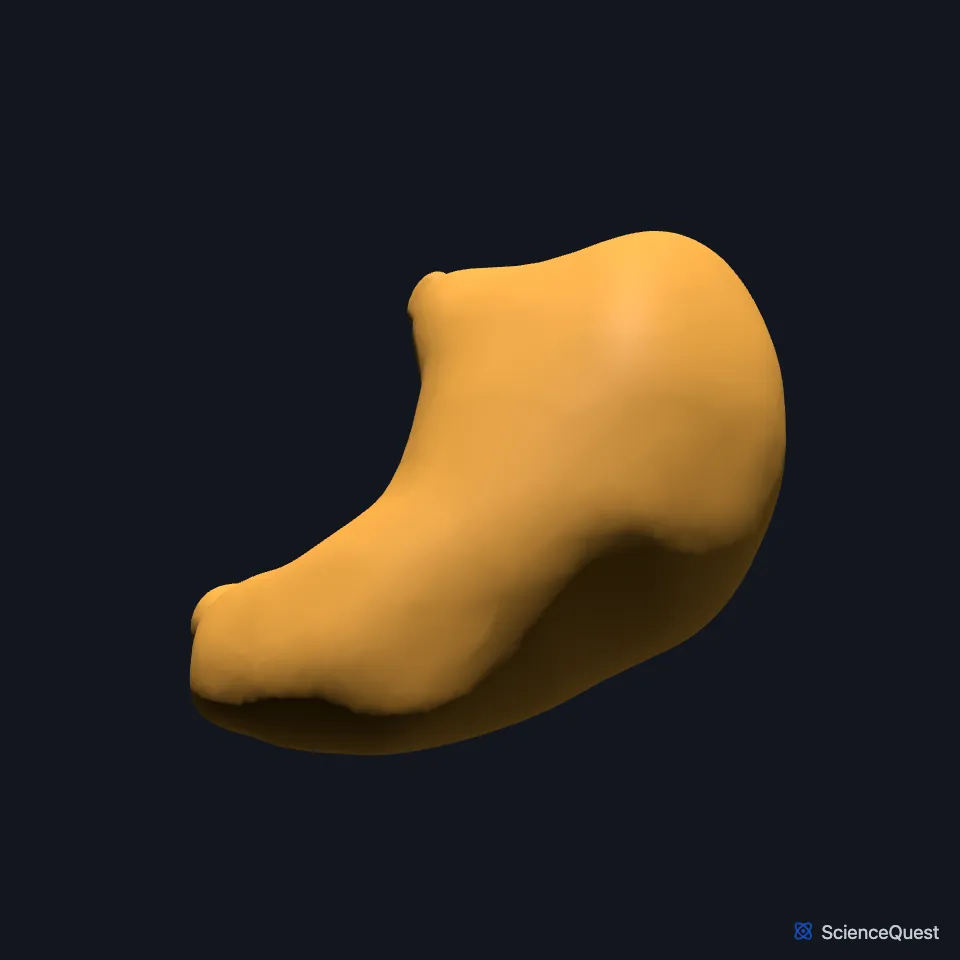
It has four regions. The cardia is where food enters from the esophagus; the fundus is the dome-shaped part next to it; the body is the largest part; the funnel-shaped pylorus leads to the duodenum. (OpenStax A&P 2e, 23.4; StatPearls, Stomach)
Where the pylorus meets the duodenum, its muscle thickens into the pyloric sphincter, which controls how fast the stomach empties. (OpenStax A&P 2e, 23.4; StatPearls, Stomach)
The lesser curvature forms its right border. The greater curvature, four or five times as long, arches back, up and to the left. (OpenStax A&P 2e, 23.4; Gray’s Anatomy (1918), The Stomach)
Besides the usual circular and longitudinal layers, its muscle has an inner oblique layer, found only in the stomach, which churns food. Its lining lies in folds called rugae, which let it stretch as food arrives. (OpenStax A&P 2e, 23.4; StatPearls, Stomach and Physiology, Stomach)
What does the stomach do?
Its upper part relaxes as food arrives, so it can hold a meal. Mixing waves about every 20 seconds blend food with gastric juice into chyme, and with each wave the pyloric sphincter lets a small amount into the small intestine. (OpenStax A&P 2e, 23.4; StatPearls, Stomach and Physiology, Stomach)
Parietal cells in the gastric glands secrete hydrochloric acid. The acid converts pepsinogen from chief cells into pepsin, which breaks proteins down into smaller peptides. (OpenStax A&P 2e, 23.4; StatPearls, Physiology, Stomach)
Parietal cells also make intrinsic factor, without which the body cannot absorb vitamin B12 in the terminal ileum. It is the only stomach function necessary to life. (OpenStax A&P 2e, 23.4; StatPearls, Stomach)
A meal passes on to the duodenum within 2 to 4 hours. Carbohydrate-rich food leaves fastest and fatty meals stay longest. (OpenStax A&P 2e, 23.4; StatPearls, Stomach)
Foveolar cells on its surface shield the lining from acid and pepsin with a coat of mucus and bicarbonate. (OpenStax A&P 2e, 23.4; StatPearls, Physiology, Stomach and Stomach)
What lies around the stomach?
In front of it lie the diaphragm, the left lobe of the liver and the anterior abdominal wall. Behind it, beyond the lesser sac, lie the pancreas, the spleen, the left kidney and adrenal gland, the splenic artery and the transverse mesocolon. (StatPearls, Stomach)
Its main artery is the celiac trunk. The left and right gastric arteries run along the lesser curvature, the right and left gastro-omental arteries along the greater curvature, and 3 to 5 short gastric arteries from the splenic artery reach the fundus. (StatPearls, Stomach)
Its veins reach the portal vein, some directly and others through the splenic and superior mesenteric veins. (StatPearls, Stomach)
The vagus nerve gives its parasympathetic supply, the left vagus on the front and the right on the back. Sympathetic fibers from spinal segments T5 to T9 arrive through the greater splanchnic nerve and the celiac plexus. (StatPearls, Stomach)
Where the sources differ
The sources give different capacities. OpenStax says the stomach can stretch to hold as much as 4 liters, more than 75 times its empty volume; StatPearls says about 2 to 3 liters. (OpenStax A&P 2e, 23.4; StatPearls, Stomach)
| Feature | Detail and source |
|---|---|
| Regions | Cardia, fundus, body, pylorus (OpenStax A&P 2e, 23.4; StatPearls, Stomach) |
| Curvatures | Lesser (right border) and greater (four or five times longer) (OpenStax A&P 2e, 23.4; Gray’s Anatomy (1918), The Stomach) |
| Muscle layers | Longitudinal, circular and inner oblique (OpenStax A&P 2e, 23.4; StatPearls, Physiology, Stomach) |
| Main artery | Celiac trunk (StatPearls, Stomach) |
| Nerves | Vagus nerve; greater splanchnic nerve (T5 to T9) (StatPearls, Stomach) |
Touches in this model
Measured on the BodyParts3D meshes: surfaces within 2 mm of the stomach, nearest first, 12 of 14.
- Colon in contact
- Duodenum in contact
- Esophagus in contact
- Liver in contact
- Spleen in contact
- Descending aorta in contact
- Diaphragm in contact
- Left costal cartilage in contact
- Left internal oblique in contact
- Left rectus abdominis in contact
- Left transversus abdominis in contact
- Skin in contact
Sources
- StatPearls, Anatomy, Abdomen and Pelvis: Stomach. Shazia R. Chaudhry; Maria Nataly P. Liman; Adekunle E. Omole; Diana C. Peterson. Last update July 17, 2024. CC BY-NC-ND 4.0. Read 2026-10-25.
- OpenStax Anatomy and Physiology 2e, section 23.4, The Stomach. CC BY-NC-SA 4.0. Read 2026-10-25.
- Gray’s Anatomy of the Human Body, 20th US edition (1918), Splanchnology, The Stomach, page 1162. Henry Gray; edited by Warren H. Lewis. Public domain. Read 2026-10-25.
- StatPearls, Physiology, Stomach. Mark Hsu; Anthony O. Safadi; Forshing Lui. Last update July 17, 2023. CC BY-NC-ND 4.0. Read 2026-10-25.
The values are facts and free to use; this page’s selection and presentation are © 2026 ScienceQuest.